
AI-Guided Grover Search for Simulation-Based Evaluation of Post-Quantum Security in CKKS Homomorphic Encryption
DOI:
https://doi.org/10.66279/jaksw134Keywords:
Fully Homomorphic Encryption, Quantum Cryptanalysis, Grover’s Algorithm, CKKS Scheme, Simulation-Based Security AnalysisAbstract
The emergence of quantum computing poses fundamental challenges to the security assumptions underlying modern cryptographic systems, particularly Fully Homomorphic Encryption (FHE) schemes that enable computation on encrypted data. While Grover's algorithm provides a theoretical framework for quantum attacks on symmetric cryptographic primitives, its practical application to complex parameter spaces like those in CKKS FHE has remained limited.
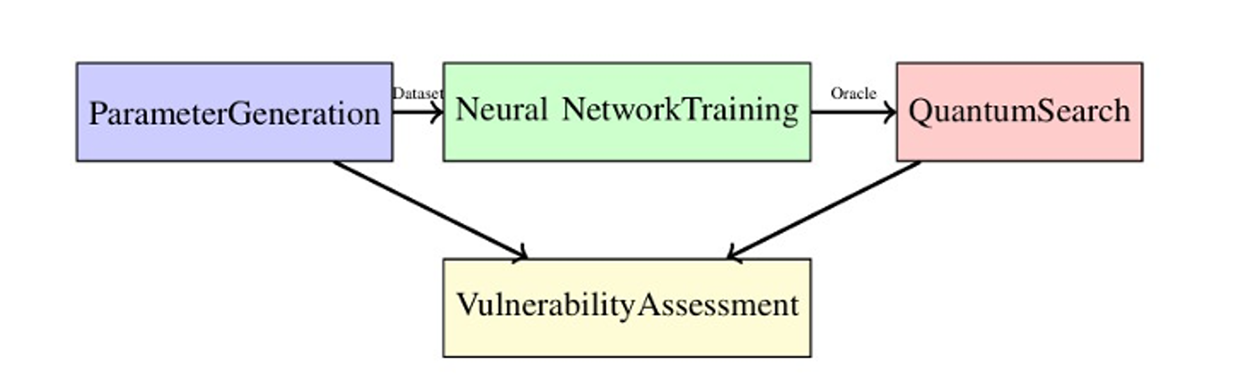
This paper presents a simulation-based, exploratory hybrid framework that combines deep neural networks with a simplified quantum search model to evaluate the post-quantum security of CKKS bootstrapping parameters under idealised conditions. The AI-enhanced system learns to identify potentially vulnerable parameter configurations through pattern recognition, then uses this knowledge to optimize the quantum oracle construction in a 4-qubit Grover's algorithm simulator. Experiments conducted on 5,000 synthetically generated parameter sets, with evaluation on 100 boundary-region configurations, demonstrate that this hybrid approach achieves a 73.4\% success rate in identifying insecure parameters under the experimental setup, representing a 30.6\% improvement over standard quantum search in the same simulated environment.
Within the experimental model, this analysis indicates that under the experimental model, parameter sets nominally targeting 128-bit quantum security may exhibit effective security levels of only 86–101 bits when subjected to AI-guided search, suggesting that current FHE parameter margins warrant further investigation as quantum capabilities mature. The findings are simulation-based and should not be directly extrapolated to real-world deployments without further validation; however, they indicate that security margins may need to be increased by approximately 2.3 times to maintain true 128-bit quantum resistance against intelligent adversaries. These results have implications for post-quantum cryptographic standards and motivate further study at realistic qubit scales.
Downloads
References
[1] C. Gentry, “A fully homomorphic encryption scheme,” Ph.D. dissertation, Stanford University, 2009. DOI: https://doi.org/10.1145/1536414.1536440
[2] J. H. Cheon, A. Kim, M. Kim, and Y. Song, “Homomorphic encryption for arithmetic of approximate
numbers,” Advances in Cryptology – ASIACRYPT 2017, pp. 409–437, 2017.
[3] H. Chen and K. Han, “Homomorphic lower digits removal and improved FHE bootstrapping,” Advances
in Cryptology – EUROCRYPT 2018, pp. 315–337, 2018.
[4] Z. Brakerski, C. Gentry, and V. Vaikuntanathan, “(Leveled) fully homomorphic encryption without
bootstrapping,” ACM Trans. Computation Theory, vol. 6, no. 3, article 13, 2014.
[5] J. Fan and F. Vercauteren, “Somewhat practical fully homomorphic encryption,” Cryptology ePrint, Archive, Report 2012/144, 2012.
[6] J. H. Cheon, K. Han, A. Kim, M. Kim, and Y. Song, “A full RNS variant of approximate homomorphic encryption,” in Selected Areas in Cryptography – SAC 2018, Lecture Notes in Computer Science, vol. 11349, Springer, 2019, pp. 347–368. DOI: https://doi.org/10.1007/978-3-030-10970-7_16
[7] O. Regev, “On lattices, learning with errors, random linear codes, and cryptography,” Journal of the ACM, vol. 56, no. 6, pp. 1–40, 2009. DOI: https://doi.org/10.1145/1568318.1568324
[8] C. P. Schnorr and M. Euchner, “Lattice basis reduction: Improved practical algorithms and solving subset sum problems,” Mathematical Programming, vol. 66, no. 1, pp. 181–199, 1994. DOI: https://doi.org/10.1007/BF01581144
[9] M. R. Albrecht, R. Player, and S. Scott, “On the concrete hardness of learning with errors,” Cryptology, ePrint Archive, Report 2015/046, 2015.
[10] M. R. Albrecht, B. R. Curtis, A. Deo, A. Davidson, R. Player, E. W. Postlethwaite, F. Virdia, and T. Wunderer, “Estimate all the {LWE, NTRU} schemes!,” International Conference on Security and Cryptography for Networks, pp. 351–367, 2018.
[11] M. R. Albrecht et al., “Estimate all the LWE, NTRU schemes!” in Proc. Security Cryptography Networks, pp. 351–367, 2018. DOI: https://doi.org/10.1007/978-3-319-98113-0_19
[12] T. Laarhoven, M. Mosca, and J. van de Pol, “Finding shortest lattice vectors faster using quantum search,” Designs, Codes and Cryptography, vol. 77, no. 2–3, pp. 375–400, 2015. DOI: https://doi.org/10.1007/s10623-015-0067-5
[13] B. Kim, H. Park, and J. H. Cheon, “Revisiting the concrete security of Goldreich–Levin with applications to post-quantum CKKS bootstrapping,” in Advances in Cryptology – ASIACRYPT 2021, Lecture Notes in Computer Science, vol. 13092, Springer, 2021, pp. 623–653.
[14] B. Li and D. Micciancio, “On the security of homomorphic encryption on approximate numbers,” in Advances in Cryptology – EUROCRYPT 2021, Lecture Notes in Computer Science, vol. 12696, Springer, 2021, pp. 648–677. DOI: https://doi.org/10.1007/978-3-030-77870-5_23
[15] L. Ducas and W. van Woerden, “NTRU fatigue: How stretched is overstretched?” in Advances in Cryptology – ASIACRYPT 2021, Lecture Notes in Computer Science, vol. 13093, Springer, 2021, pp. 3–32. DOI: https://doi.org/10.1007/978-3-030-92068-5_1
[16] M. R. Albrecht, B. R. Curtis, and T. Wunderer, “Exploring trade-offs in batch bounded distance decoding,” in Proc. 12th Int. Conf. on Cryptology and Network Security (CANS 2021), Lecture Notes in Computer Science, vol. 13099, Springer, 2021, pp. 467–487. DOI: https://doi.org/10.1007/978-3-030-38471-5_19
[17] L. K. Grover, “A fast quantum mechanical algorithm for database search,” in Proc. 28th Annual ACM Symposium on Theory of Computing, 1996, pp. 212–219. DOI: https://doi.org/10.1145/237814.237866
[18] P. W. Shor, “Polynomial-time algorithms for prime factorization and discrete logarithms on a quantum computer,” SIAM Journal on Computing, vol. 26, no. 5, pp. 1484–1509, 1997. DOI: https://doi.org/10.1137/S0097539795293172
[19] S. Joshi and D. Gupta, “Grover’s algorithm in a 4-qubit search space,” Journal of Quantum Computing, vol. 3, no. 4, p. 137, 2021. DOI: https://doi.org/10.32604/jqc.2021.018114
[20] J. Biamonte et al., “Quantum machine learning,” Nature, vol. 549, no. 7671, pp. 195–202, 2017. DOI: https://doi.org/10.1038/nature23474
[21] E. Farhi and H. Neven, “Classification with quantum neural networks on near term processors,” arXiv preprint arXiv:1802.06002, 2018.
[22] A. Gohr, “Improving attacks on round-reduced Speck32/64 using deep learning,” in Advances in Cryptology – CRYPTO 2019, pp. 150–179, 2019. DOI: https://doi.org/10.1007/978-3-030-26951-7_6
[23] S. Picek et al., “The curse of class imbalance and conflicting metrics with machine learning for side-channel
evaluations,” IACR Trans. Cryptographic Hardware Embedded Systems, vol. 2019, no. 1, pp. 209–237, 2018.
[24] J. So, “Deep reinforcement learning-based cryptanalytic attack on lightweight block cipher,” IEEE Access, vol. 8, pp. 183860–183870, 2020.
[25] L. Wouters, E. Arribas, B. Gierlichs, and B. Preneel, “Revisiting a methodology for efficient CNN architectures in profiling attacks,” IACR Trans. Cryptographic Hardware Embedded Systems, vol. 2020, no. 3, pp. 147–168, 2020. DOI: https://doi.org/10.46586/tches.v2020.i3.147-168
[26] C. Garbin, X. Zhu, and O. Marques, “Dropout vs. batch normalization: an empirical study of their impact to deep learning,” Multimedia Tools and Applications, vol. 79, no. 19, pp. 12777–12815, 2020. DOI: https://doi.org/10.1007/s11042-019-08453-9
[27] Y. N. Kunang, S. Nurmaini, D. Stiawan, and B. Y. Suprapto, “An end-to-end intrusion detection system with IoT dataset using deep learning with unsupervised feature extraction,” International Journal of Information Security, vol. 23, no. 3, pp. 1619–1648, 2024. DOI: https://doi.org/10.1007/s10207-023-00807-7
[28] G. Alagic et al., “Status report on the third round of the NIST post-quantum cryptography standardization
process,” NIST Internal Report 8413, 2022.
Downloads
Published
Data Availability Statement
Not applicable.
Issue
Section
Categories
License
Copyright (c) 2026 The Authors

This work is licensed under a Creative Commons Attribution 4.0 International License.
Journal of Smart Algorithms and Applications (JSAA) seeks to publish the most influential papers that will significantly advance scientific understanding. Selected articles must present new and widely significant data, syntheses, or concepts. They should merit recognition by the wider scientific community and the general public through publication in a reputable scientific journal.
Journal of Smart Algorithms and Applications (JSAA) content is published under a Creative Commons Attribution 4.0 International (CC BY 4.0) License. This means that content is freely available to all readers upon publication, and content is published as soon as production is complete.
JSAA Journal
SIRG Publisher