A Deep Learning Framework for Breast Cancer Detection Using Histopathological Imaging
Keywords:
Breast cancer detection, Histopathology images, BreakHis dataset, Early tumor detection, Computer-aided diagnosis.Abstract
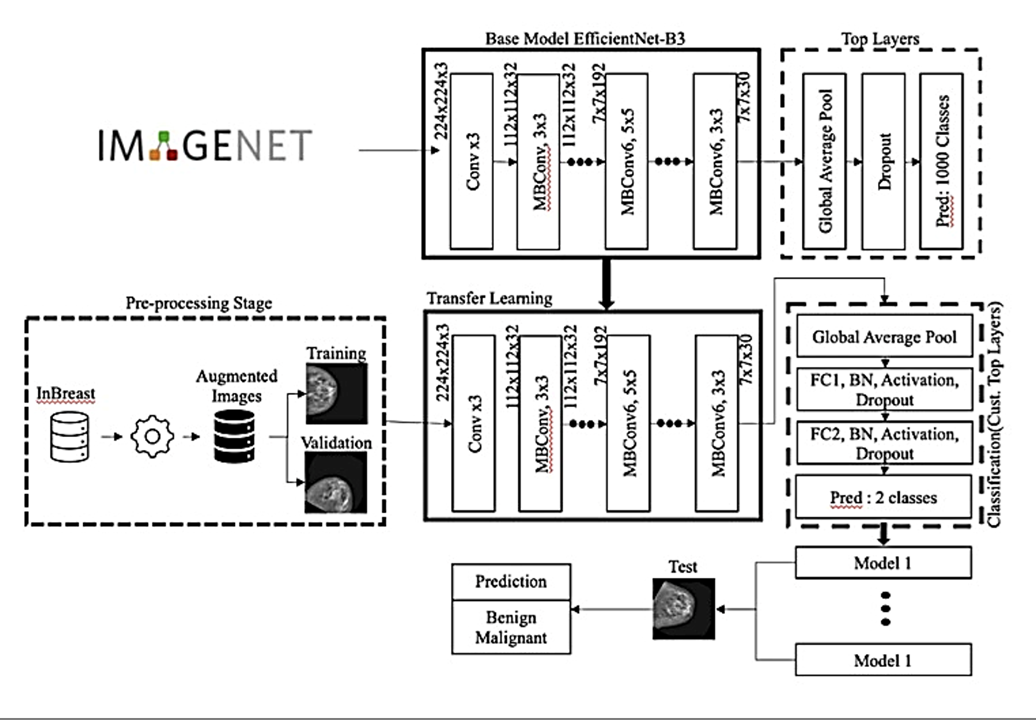
Breast cancer remains a significant global public health challenge, representing the most frequently diagnosed cancer among women and one of the leading causes of cancer-related mortality. Early detection and accurate diagnosis are critical for improving survival rates and expanding treatment options. Conventional diagnostic modalities such as mammography, ultrasound imaging, and biopsy are widely used; however, these approaches are often limited by inter-observer variability, image quality issues, and time-intensive clinical workflows. Recent advances in artificial intelligence, particularly deep learning, have demonstrated strong potential to support and enhance breast cancer detection through automated and consistent image analysis. This paper presents a comprehensive review of state-of-the-art deep learning techniques applied to breast cancer detection, with a focus on convolutional neural network–based approaches. In addition to the literature review, a practical implementation is presented to evaluate the effectiveness of deep learning in histopathological image classification. The proposed implementation employs the EfficientNetB3 architecture as a feature extraction backbone and is evaluated using the BreakHis dataset, which contains labeled breast histopathology images. The methodology includes image preprocessing, data augmentation, model training, and performance evaluation using standard validation metrics. Experimental results demonstrate that the proposed model achieves a validation accuracy of 97.4%, indicating strong discriminative capability and competitive performance relative to existing approaches reported in the literature. Despite these promising results, several challenges remain before widespread clinical adoption can be realized. These include ensuring model generalizability across diverse clinical settings, addressing data scarcity and class imbalance, improving interpretability to gain clinician trust, and navigating regulatory and ethical considerations. Overall, this study highlights both the progress and limitations of deep learning–based breast cancer detection systems and underscores their potential role as decision-support tools in future clinical workflows.
Downloads
References
[1] Litjens, G., et al. (2017). A survey on deep learning in medical image analysis. Medical Image Analysis.
[2] Pisano, E. D., et al. (2005). Diagnostic performance of digital versus film mammography for breast-cancer screening. The New England Journal of Medicine.
[3] Jiang, Y., et al. (2021). Emerging role of deep learning-based artificial intelligence in tumor pathology. Cancer Communications.
[4] McKinney, S. M., et al. (2020). International evaluation of an AI system for breast cancer screening. Nature.
[5] WHO. (2023). Breast Cancer Fact Sheet. https://www.who.int/news-room/fact-sheets/detail/breast-cancer.
[6] M. A. F. A. El-Hendawy, S., Al-Suhaibani, N., El-Kafoury, H., Al-Saygis, I., & Schmidhalter, U. (2019). Spectral reflectance indices as a rapid and non-destructive phenotyping tool for estimating the biomass and grain yield of spring wheat under arid and semi-arid conditions. Field Crops Research, 233, 107-122.
[7] Araújo, T., et al. (2023). Deep learning approaches for breast cancer histopathology classification: A comprehensive review. Computers in Biology and Medicine.
[8] Elmore, J. G., et al. (2015). Diagnostic concordance among pathologists interpreting breast biopsy specimens. JAMA .
[9] Kim, H., et al. (2023). Decision fusion of deep learning models for improved breast cancer detection in mammograms. Computers in Biology and Medicine.
[10] Kumar, V., et al. (2020). Robbins and Cotran Pathologic Basis of Disease (10th ed.). Elsevier.
[11] Shen, D., et al. (2023). Deep learning in medical image analysis: Past, present, and future. Annual Review of Biomedical Engineering.
[12] Esteva, A., et al. (2019). A guide to deep learning in healthcare. Nature Medicine.
[13] Bray, F., et al. (2018). Global cancer statistics 2018: GLOBOCAN estimates of incidence and mortality worldwide for 36 cancers in 185 countries. CA: A Cancer Journal for Clinicians.
[14] M. F. Mridha et al., “A Comprehensive Survey on Deep-Learning-Based Breast Cancer Diagnosis,” Cancers, vol. 13, no. 23, p. 6116, Dec. 2021, doi: 10.3390/cancers13236116.
[15] K. Khan, S. Awang, M. A. Talab, and H. Kahtan, “A comprehensive review of machine learning and deep learning techniques for intraclass variability breast cancer recognition,” Franklin Open, vol. 11, p. 100296, Jun. 2025, doi: 10.1016/j.fraope.2025.100296.
[16] F. Nasir, S. Rahman, and N. Nasir, “Breast Cancer Detection Using Convolutional Neural Networks: A Deep Learning-Based Approach,” Cureus, May 2025, doi: 10.7759/cureus.83421.
[17] A. Heikal, A. El-Ghamry, S. Elmougy, and M. Z. Rashad, “Fine tuning deep learning models for breast tumor classification,” Scientific Reports, vol. 14, no. 1, May 2024, doi: 10.1038/s41598-024-60245-w.
[18] N. Talukdar et al., “Breast cancer detection redefined: Integrating Xception and EfficientNet-B5 for superior mammography imaging,” Innovative Practice in Breast Health, vol. 7, p. 100038, 2025, doi: 10.1016/j.ibreh.2025.100038.
[19] Y. Zhou, F. Jin, G. Suo, and J. Yang, “ResViT-GANNet: a deep learning framework for classifying breast cancer histopathology images using multimodal attention and GAN-based augmentation,” BMC Medical Imaging, vol. 25, no. 1, Sep. 2025, doi: 10.1186/s12880-025-01940-6.
Downloads
Published
Issue
Section
Categories
License
Copyright (c) 2026 The Authors

This work is licensed under a Creative Commons Attribution 4.0 International License.
Journal of Smart Algorithms and Applications (JSAA) seeks to publish the most influential papers that will significantly advance scientific understanding. Selected articles must present new and widely significant data, syntheses, or concepts. They should merit recognition by the wider scientific community and the general public through publication in a reputable scientific journal.
Journal of Smart Algorithms and Applications (JSAA) content is published under a Creative Commons Attribution 4.0 International (CC BY 4.0) License. This means that content is freely available to all readers upon publication, and content is published as soon as production is complete.
JSAA Journal
SIRG Publisher