
Beyond Accuracy: Cost-Aware, Explainable Predictive Maintenance for Industrial Machine Health Monitoring Using Sensor RUL Estimation
DOI:
https://doi.org/10.66279/713yns26Keywords:
Predictive Maintenance, Remaining Useful Life (RUL), Random Forest, Cost-Sensitive LearningAbstract
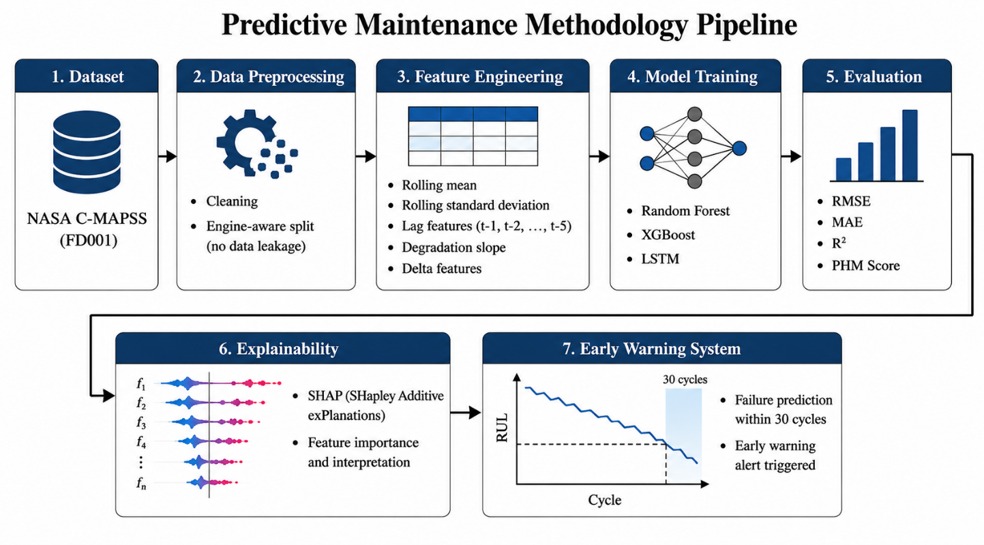
Predictive maintenance in safety-critical aerospace systems requires not only accurate remaining useful life (RUL) prediction, but also decision-relevant outputs that are explainable, cost-sensitive, and operationally actionable. However, existing approaches primarily optimize metrics such as RMSE and MAE while overlooking asymmetric error costs, interpretability, and early-warning performance. This paper presents a comprehensive framework evaluated on the NASA C-MAPSS FD001 turbofan dataset, addressing these limitations. Four models, Ridge Regression, Random Forest, XGBoost, and LSTM, are trained on a 112-feature space derived from 14 sensors using rolling statistics, lag features, degradation slopes, and delta transformations. Models are evaluated using RMSE, MAE, R², and the NASA PHM asymmetric score. Results indicate that Random Forest achieves the lowest RMSE (12.13 cycles), while XGBoost attains the best PHM Score (230.02), suggesting improved robustness under asymmetric cost conditions. SHAP-based analysis identifies delta and variability features of key sensors as dominant degradation indicators, offering physically interpretable insights. Additionally, an early-warning system evaluated at a 30-cycle horizon shows that Random Forest achieves an F1-score of 0.737 with minimal missed failures, while LSTM demonstrates higher recall at the cost of increased false alarms. These findings highlight the importance of combining accuracy, cost-awareness, and explainability to support practical predictive maintenance decision-making.
Downloads
References
[1] Y. Z. Chen, E. Tsoutsanis, C. Wang, and L. F. Gou, “A time-series turbofan engine successive fault diagnosis under both steady-state and dynamic conditions,” Energy, vol. 263, p. 125848, Jan. 2023, doi: 10.1016/J.ENERGY.2022.125848. DOI: https://doi.org/10.1016/j.energy.2022.125848
[2] W. Li and T. Li, “Comparison of deep learning models for predictive maintenance in industrial manufacturing systems using sensor data,” Scientific Reports 2025 15:1, vol. 15, no. 1, pp. 23545-, Jul. 2025, doi: 10.1038/s41598-025-08515-z. DOI: https://doi.org/10.1038/s41598-025-08515-z
[3] D. Kapoor, D. Gupta, S. AgarwaI, M. Uppal, S. Juneja, and M. K. Sharma, “STARNet: Stacked Transfer-Aware for Robust Remaining Useful Life Prediction for C-MAPSS Multi-Regime Engines,” IEEE Access, 2026, doi: 10.1109/ACCESS.2026.3663754. DOI: https://doi.org/10.1109/ACCESS.2026.3663754
[4] B. M. Atsafack, C. Kabiri, and G. Rushingabigwi, “Predictive Maintenance for Hydraulic Turbine Unit: A Comparative Deep Learning Approach Using Internet of Things Data in Real-Time,” IEEE Access, vol. 13, pp. 158340–158352, 2025, doi: 10.1109/ACCESS.2025.3607733. DOI: https://doi.org/10.1109/ACCESS.2025.3607733
[5] C. Zhang and L. Liu, “Machine learning prediction model for medical environment comfort based on SHAP and LIME interpretability analysis,” Scientific Reports 2025 15:1, vol. 15, no. 1, pp. 39269-, Nov. 2025, doi: 10.1038/s41598-025-22972-6. DOI: https://doi.org/10.1038/s41598-025-22972-6
[6] J. Liu, X. Yi, and Y. Wang, “Performance evaluation of equipment PHM systems: a variable-weight fuzzy comprehensive evaluation method,” Int. J. Syst. Sci., Nov. 2025, doi: 10.1080/00207721.2025.2587741. DOI: https://doi.org/10.1080/00207721.2025.2587741
[7] U. Yıldırım and H. Afşer, “Linear Methods for Predictive Maintenance: The Case of NASA C-MAPSS Datasets,” Applied Sciences 2025, Vol. 15, Page 9945, vol. 15, no. 18, p. 9945, Sep. 2025, doi: 10.3390/APP15189945. DOI: https://doi.org/10.3390/app15189945
[8] J. Li, X. Li, and D. He, “A Directed Acyclic Graph Network Combined With CNN and LSTM for Remaining Useful Life Prediction,” IEEE Access, vol. 7, pp. 75464–75475, 2019, doi: 10.1109/ACCESS.2019.2919566. DOI: https://doi.org/10.1109/ACCESS.2019.2919566
[9] I. Hector and R. Panjanathan, “Predictive maintenance in Industry 4.0: a survey of planning models and machine learning techniques,” PeerJ Comput. Sci., vol. 10, pp. 1–50, May 2024, doi: 10.7717/PEERJ-CS.2016/TABLE-2. DOI: https://doi.org/10.7717/peerj-cs.2016
[10] H. Özcan, “Interpretable ensemble remaining useful life prediction enables dynamic maintenance scheduling for aircraft engines,” Scientific Reports 2025, 15:1, vol. 15, no. 1, pp. 39795-, Nov. 2025, doi: 10.1038/s41598-025-23473-2. DOI: https://doi.org/10.1038/s41598-025-23473-2
[11] F. Calabrese, A. Regattieri, M. Bortolini, M. Gamberi, and F. Pilati, “Predictive Maintenance: A Novel Framework for a Data-Driven, Semi-Supervised, and Partially Online Prognostic Health Management Application in Industries,” Applied Sciences 2021, Vol. 11, Page 3380, vol. 11, no. 8, p. 3380, Apr. 2021, doi: 10.3390/APP11083380. DOI: https://doi.org/10.3390/app11083380
[12] S. Zheng, K. Ristovski, A. Farahat, and C. Gupta, “Long Short-Term Memory Network for Remaining Useful Life estimation,” 2017 IEEE International Conference on Prognostics and Health Management, ICPHM 2017, pp. 88–95, Jul. 2017, doi: 10.1109/ICPHM.2017.7998311. DOI: https://doi.org/10.1109/ICPHM.2017.7998311
[13] Y. Wu, M. Yuan, S. Dong, L. Lin, and Y. Liu, “Remaining useful life estimation of engineered systems using vanilla LSTM neural networks,” Neurocomputing, vol. 275, pp. 167–179, Jan. 2018, doi: 10.1016/J.NEUCOM.2017.05.063. DOI: https://doi.org/10.1016/j.neucom.2017.05.063
[14] F. O. Heimes, “Recurrent neural networks for remaining useful life estimation,” 2008 International Conference on Prognostics and Health Management, PHM 2008, 2008, doi: 10.1109/PHM.2008.4711422. DOI: https://doi.org/10.1109/PHM.2008.4711422
[15] X. Li, Q. Ding, and J. Q. Sun, “Remaining useful life estimation in prognostics using deep convolution neural networks,” Reliab. Eng. Syst. Saf., vol. 172, pp. 1–11, Apr. 2018, doi: 10.1016/J.RESS.2017.11.021. DOI: https://doi.org/10.1016/j.ress.2017.11.021
[16] “DASHlink - Turbofan engine degradation simulation data set.” Accessed: Jun. 26, 2026. [Online]. Available: https://c3.ndc.nasa.gov/dashlink/resources/139/
[17] P. J., A. H., and H. I. , “Leveraging Transfer Learning and Fine-Tuning for Improved Skin Cancer Detection in Dermatoscopic Images,” Journal of Smart Algorithms and Applications (JSAA), vol. 1, no. 2, pp. 37–42, Dec. 2025, Accessed: Jun. 26, 2026. [Online]. Available: https://pub.scientificirg.com/index.php/JSAA/article/view/13
[18] M. Y. A. Alsaleem, O. S. Hasan, Y. Albugg, M. Y. A. Alsaleem, O. S. Hasan, and Y. Albugg, “Explainable Tree-Based Ensemble Models for Diabetes Prediction Using SHAP,” AUIQ Technical Engineering Science, vol. 3, no. 2, p. 3, May 2026, doi: 10.70645/3078-3437.1063. DOI: https://doi.org/10.70645/3078-3437.1063
[19] A. Atwa, A. Atwa, A. Y. Ismaeel, and A. A. Elngar, “Machine Learning for Chronic Disease Classification and Comorbidity Detection: Methodological Gaps and Future Directions,” Journal of Smart Algorithms and Applications (JSAA), vol. 3, no. 2, pp. 87–104, Apr. 2026, doi: 10.66279/5a6sr902. DOI: https://doi.org/10.66279/5a6sr902
Downloads
Published
Data Availability Statement
Dataset available upon request
Issue
Section
Categories
License
Copyright (c) 2026 The Authors

This work is licensed under a Creative Commons Attribution 4.0 International License.
Journal of Smart Algorithms and Applications (JSAA) seeks to publish the most influential papers that will significantly advance scientific understanding. Selected articles must present new and widely significant data, syntheses, or concepts. They should merit recognition by the wider scientific community and the general public through publication in a reputable scientific journal.
Journal of Smart Algorithms and Applications (JSAA) content is published under a Creative Commons Attribution 4.0 International (CC BY 4.0) License. This means that content is freely available to all readers upon publication, and content is published as soon as production is complete.
JSAA Journal
SIRG Publisher