
A Critical Review and Methodological Framework for Robust Tabular Learning in Industrial Predictive Maintenance
DOI:
https://doi.org/10.66279/dthrm347Keywords:
Predictive maintenance, Tabular learning, Missing data, Distribution shift, Leakage-aware evaluationAbstract
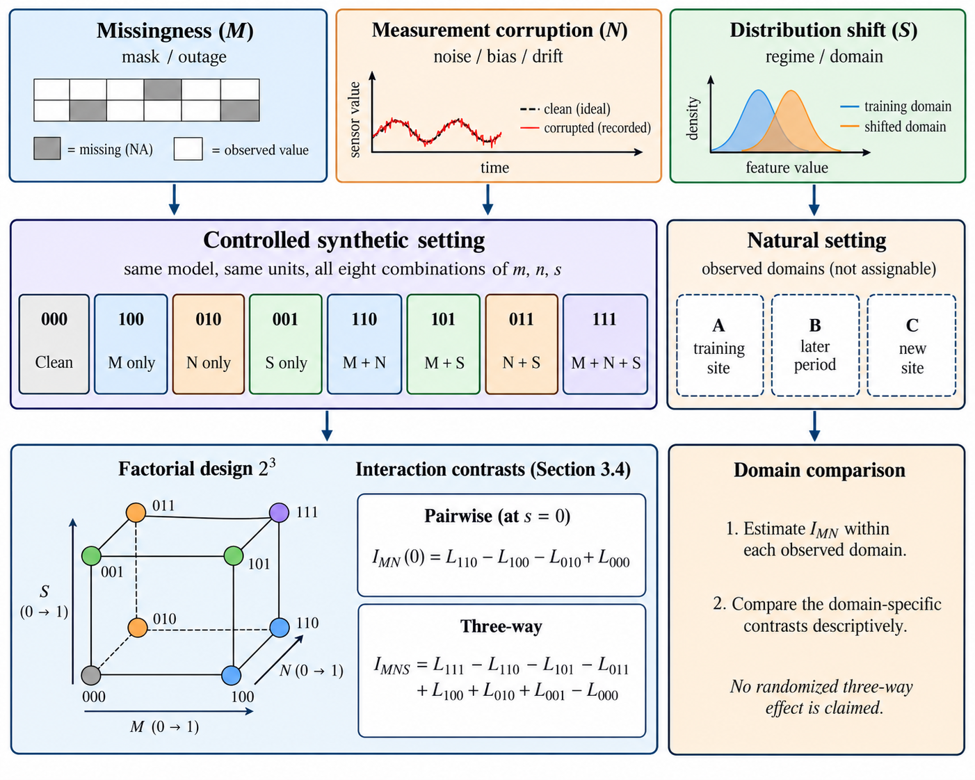
Data-driven predictive maintenance (PdM) relies increasingly on machine learning models trained in sensor and operational data. However, missing measurements, sensor corruption, and distribution shift can complicate the evaluation of predictive reliability under changing industrial conditions. This critical narrative review examines how these data imperfections are addressed in industrial maintenance research and related tabular-learning literature. It critically synthesizes evidence from industrial tabular studies, sequential sensor applications, general-purpose benchmarks, and methodological research, focusing on differences in data characteristics, prediction tasks, stressor mechanisms, and validation procedures. The synthesis identifies important limitations in the available evidence, particularly the lack of comparable controlled factorial evaluations of missingness, measurement corruption, and distribution shift in the industrial tabular PdM studies examined. Consequently, the reviewed findings do not provide a sufficient basis for general conclusions about model robustness under compound imperfections or universal rankings across model families. To support future investigations, this review develops a mechanism-aware conceptual framework distinguishing the three stressors and presents pairwise and three-way loss-interaction contrasts for analyzing potential non-additive effects. It also proposes a leakage-aware evaluation protocol incorporating realistic stressor configurations, appropriate validation strategies, uncertainty estimation, and maintenance-oriented performance measures. The review contributes a critical synthesis and a methodological proposal for future empirical research; neither the proposed framework nor its practical effectiveness is experimentally validated in this study.
Downloads
References
[1] W. Zhang, D. Yang, and H. Wang, “Data-Driven Methods for Predictive Maintenance of Industrial Equipment: A Survey,” IEEE Syst. J., vol. 13, no. 3, pp. 2213–2227, Sep. 2019, doi: 10.1109/JSYST.2019.2905565. DOI: https://doi.org/10.1109/JSYST.2019.2905565
[2] M. Fernandes, J. M. Corchado, and G. Marreiros, “Machine learning techniques applied to mechanical fault diagnosis and fault prognosis in the context of real industrial manufacturing use-cases: a systematic literature review,” Applied Intelligence, vol. 52, no. 12, pp. 14246–14280, Mar. 2022, doi: 10.1007/s10489-022-03344-3. DOI: https://doi.org/10.1007/s10489-022-03344-3
[3] W. Li and T. Li, “Comparison of deep learning models for predictive maintenance in industrial manufacturing systems using sensor data,” Scientific Reports, vol. 15, Art. no. 23545, Jul. 2025, doi: 10.1038/s41598-025-08515-z. DOI: https://doi.org/10.1038/s41598-025-08515-z
[4] W. Wang, Z. Wang, Z. Cai, C. Hu, and S. Si, “Robust uncertainty quantification for online remaining useful life prediction with randomly missing and partially faulty sensor data,” Reliab. Eng. Syst. Saf., vol. 262, 2025, doi: 10.1016/j.ress.2025.111177. DOI: https://doi.org/10.1016/j.ress.2025.111177
[5] D. Zhuang, P. Gong, Y. Shao, L. Shu, Q. Zhu, X. Li, and D. Zhang, “Physically-constrained Mamba-SDE for remaining useful life prediction under irregular observations,” in Proc. 32nd ACM SIGKDD Conf. Knowl. Discov. Data Min. (KDD ’26), 2026, doi: 10.1145/3770855.3817877; arXiv:2606.01894. DOI: https://doi.org/10.1145/3770855.3817877
[6] C. Tsallis, P. Papageorgas, D. Piromalis, and R. A. Munteanu, “Application-Wise Review of Machine Learning-Based Predictive Maintenance: Trends, Challenges, and Future Directions,” Applied Sciences, vol. 15, no. 9, Art. no. 4898, Apr. 2025, doi: 10.3390/app15094898. DOI: https://doi.org/10.3390/app15094898
[7] S. Somvanshi, S. Das, S. A. Javed, G. Antariksa, and A. Hossain, “A survey on deep tabular learning,” arXiv:2410.12034, Oct. 2024.
[8] Y. Guo, Z. Cheng, J. Zhang, B. Sun, and Y. K. Wang, “A review on adversarial–based deep transfer learning mechanical fault diagnosis,” Journal of Big Data, vol. 11, Art. no. 151, Oct. 2024, doi: 10.1186/s40537-024-01006-4. DOI: https://doi.org/10.1186/s40537-024-01006-4
[9] R. Sivaraman Iyer, S. L. Patil, U. M. Chaskar, and V. K. Pachghare, “Attention-enhanced spatiotemporal deep learning for predictive maintenance in oil and gas assets: towards Maintenance 5.0,” Scientific Reports, vol. 16, Art. no. 19836, Apr. 2026, doi: 10.1038/s41598-026-47109-1. DOI: https://doi.org/10.1038/s41598-026-47109-1
[10] F. Dunkin et al., “A Multigranularity Fuzzy Inference Approach for Out-of-Distribution Detection in Fault Diagnosis,” IEEE Trans. Syst. Man Cybern. Syst., vol. 56, no. 6, pp. 3612–3622, Jun. 2026, doi: 10.1109/TSMC.2026.3659876. DOI: https://doi.org/10.1109/TSMC.2026.3659876
[11] L. Grinsztajn, E. Oyallon, and G. Varoquaux, “Why do tree-based models still outperform deep learning on typical tabular data?,” Adv. Neural Inf. Process. Syst., vol. 35, 2022. DOI: https://doi.org/10.52202/068431-0037
[12] D. McElfresh et al., “When do neural nets outperform boosted trees on tabular data?,” Adv. Neural Inf. Process. Syst., vol. 36, 2023. DOI: https://doi.org/10.52202/075280-3337
[13] J. Gardner, Z. Popović, and L. Schmidt, “Benchmarking Distribution Shift in Tabular Data with TableShift,” Adv. Neural Inf. Process. Syst., vol. 36, pp. 53385–53432, Dec. 2023, doi: 10.52202/075280-2324. DOI: https://doi.org/10.52202/075280-2324
[14] I. Rubachev, N. Kartashev, Y. Gorishniy, and A. Babenko, “TabReD: Analyzing Pitfalls and Filling the Gaps in Tabular Deep Learning Benchmarks,” in Proc. International Conference on Learning Representations (ICLR), 2025.
[15] Z. J. Cheng, Z. Y. Jia, Z. Zhou, Y. F. Li, and L. Z. Guo, “TabFSBench: Tabular Benchmark for Feature Shifts in Open Environments,” Proc. Mach. Learn. Res., vol. 267, pp. 10025–10089, 2025.
[16] J. V. Autran, V. Kuhn, J. P. Diguet, M. Dubois, and C. Buche, “AI4I-PMDI: Predictive maintenance datasets with complex industrial settings’ irregularities,” Procedia Comput. Sci., vol. 246, no. C, pp. 1201–1209, Jan. 2024, doi: 10.1016/j.procs.2024.09.546. DOI: https://doi.org/10.1016/j.procs.2024.09.546
[17] K. Zhang, Q. Yang, C. Li, X. Sun, and J. Chen, “Missing Data Recovery Methods on Multivariate Time Series in IoT: A Comprehensive Survey,” IEEE Communications Surveys and Tutorials, vol. 28, pp. 149–180, 2026, doi: 10.1109/COMST.2025.3585962. DOI: https://doi.org/10.1109/COMST.2025.3585962
[18] L. Tamang, M. R. Bouadjenek, R. Dazeley, and S. Aryal, “Handling Out-of-Distribution Data: A Survey,” IEEE Trans. Knowl. Data Eng., vol. 37, no. 10, pp. 5948–5966, 2025, doi: 10.1109/TKDE.2025.3592614. DOI: https://doi.org/10.1109/TKDE.2025.3592614
[19] J. Liu, T. Wang, P. Cui, and H. Namkoong, “On the need for a language describing distribution shifts: Illustrations on tabular datasets,” Adv. Neural Inf. Process. Syst., vol. 36, 2023. DOI: https://doi.org/10.52202/075280-2237
[20] W. AlKalbani, A. AlAzri, and M. N. Ahmad, “Data Quality Assessment Framework for Predictive Maintenance (PdM) in Industrial AI: Review,” Lecture Notes in Computer Science, vol. 16215 LNCS, pp. 35–49, 2026, doi: 10.1007/978-981 95-3808-9_3. DOI: https://doi.org/10.1007/978-981-95-3808-9_3
[21] L. Cao, J. Su, and Y. Wang, “A Systematic Framework for Data Quality Assessment in Industrial Process Monitoring,” IEEE Journal of Emerging and Selected Topics in Industrial Electronics, vol. 7, no. 2, pp. 823–832, Apr. 2026, doi: 10.1109/JESTIE.2026.3667011. DOI: https://doi.org/10.1109/JESTIE.2026.3667011
[22] J. Moufid, R. Koulali, K. Moussaid, and N. Abghour, “Impact of Internal Validation Protocols on Predictive Maintenance Performance in Biomedical Equipment,” Technologies, vol. 14, no. 2, Art. no. 115, Feb. 2026, doi: 10.3390/technologies14020115. DOI: https://doi.org/10.3390/technologies14020115
[23] H. Snyder, “Literature review as a research methodology: An overview and guidelines,” J. Bus. Res., vol. 104, pp. 333–339, Nov. 2019, doi: 10.1016/J.JBUSRES.2019.07.039. DOI: https://doi.org/10.1016/j.jbusres.2019.07.039
[24] C. Baethge, S. Goldbeck-Wood, and S. Mertens, “SANRA—a scale for the quality assessment of narrative review articles,” Res. Integr. Peer Rev., vol. 4, Art. no. 5, 2019, doi: 10.1186/s41073-019-0064-8. DOI: https://doi.org/10.1186/s41073-019-0064-8
[25] A. Beikmohammadi, M. H. Hamian, N. Khoeyniha, T. Lindgren, O. Steinert, and S. Magnússon, “A cost-sensitive transformer model for prognostics under highly imbalanced industrial data,” Cluster Computing, vol. 29, Art. no. 345, 2026, doi: 10.1007/s10586-026-06080-2. DOI: https://doi.org/10.1007/s10586-026-06080-2
[26] A. M. Qahtani, “A leakage-aware and reproducible evaluation framework for predictive maintenance classification,” International Journal of Advanced Computer Science and Applications, vol. 17, no. 3, 2026, doi: 10.14569/IJACSA.2026.0170383. DOI: https://doi.org/10.14569/IJACSA.2026.0170383
[27] C. Gondek, D. Hafner, and O. R. Sampson, “Prediction of failures in the air pressure system of Scania trucks using a random forest and feature engineering,” in Advances in Intelligent Data Analysis XV (IDA 2016), Lecture Notes in Computer Science, vol. 9897. Cham, Switzerland: Springer, 2016, pp. 398–402, doi: 10.1007/978-3-319-46349-0_36. DOI: https://doi.org/10.1007/978-3-319-46349-0_36
[28] Z. Wu, H. Zhang, J. Guo, Y. Ji, and M. Pecht, “Imbalanced bearing fault diagnosis under variant working conditions using cost-sensitive deep domain adaptation network,” Expert Syst. Appl., vol. 193, p. 116459, May 2022, doi: 10.1016/J.ESWA.2021.116459. DOI: https://doi.org/10.1016/j.eswa.2021.116459
[29] D. Tang, “A deep learning framework for remaining useful life prediction of turbofan engines with partial sensor failure,” PLOS ONE, vol. 21, no. 4, Art. no. e0347312, Apr. 2026, doi: 10.1371/journal.pone.0347312. DOI: https://doi.org/10.1371/journal.pone.0347312
[30] A. Mary A. C., R. Rakshinee, S. Jeyaseelan, V. Sakthivel, and P. Prakash, “Predictive modeling for metro performance using MetroPT3 dataset,” International Journal of Advanced Computer Science and Applications, vol. 16, no. 8, 2025, doi: 10.14569/IJACSA.2025.0160854. DOI: https://doi.org/10.14569/IJACSA.2025.0160854
[31] Z.-J. Cheng, Z.-Y. Jia, K.-Y. Yu, Z. Zhou, and L.-Z. Guo, “Fully test-time adaptation for feature decrement in tabular data,” in Proc. IJCAI, 2025, pp. 4940–4948, doi: 10.24963/ijcai.2025/550. DOI: https://doi.org/10.24963/ijcai.2025/550
[32] Z. Che, S. Purushotham, K. Cho, D. Sontag, and Y. Liu, “Recurrent neural networks for multivariate time series with missing values,” Sci. Rep., vol. 8, Art. no. 6085, 2018, doi: 10.1038/s41598-018-24271-9. DOI: https://doi.org/10.1038/s41598-018-24271-9
[33] P.-A. Mattei and J. Frellsen, “MIWAE: Deep generative modelling and imputation of incomplete data sets,” in Proc. 36th Int. Conf. Mach. Learn., PMLR 97, 2019, pp. 4413–4423.
[34] J. Josse, J. M. Chen, N. Prost, G. Varoquaux, and E. Scornet, “On the consistency of supervised learning with missing values,” Stat. Papers, vol. 65, pp. 5447–5479, 2024, doi: 10.1007/s00362-024-01550-4. DOI: https://doi.org/10.1007/s00362-024-01550-4
[35] M. Le Morvan, J. Josse, E. Scornet, and G. Varoquaux, “NeuMiss networks: Differentiable programming for supervised learning with missing values,” Adv. Neural Inf. Process. Syst., vol. 33, 2020.
[36] J. Yoon, J. Jordon, and M. van der Schaar, “GAIN: Missing data imputation using generative adversarial nets,” in Proc. 35th Int. Conf. Mach. Learn., PMLR 80, 2018, pp. 5689–5698.
[37] B. Veloso, R. P. Ribeiro, J. Gama, and P. M. Pereira, “The MetroPT dataset for predictive maintenance,” Scientific Data, vol. 9, Art. no. 764, Dec. 2022, doi: 10.1038/s41597-022-01877-3. DOI: https://doi.org/10.1038/s41597-022-01877-3
[38] N. Davari, B. Veloso, R. Ribeiro, and J. Gama, “MetroPT-3 dataset,” UCI Machine Learning Repository, 2021, doi: 10.24432/C5VW3R.
[39] S. Matzka, “Explainable artificial intelligence for predictive maintenance applications,” in Proc. 3rd Int. Conf. Artif. Intell. Ind. Appl. (AI4I), 2020, pp. 69–74, doi: 10.1109/AI4I49448.2020.00023; dataset: UCI Machine Learning Repository, doi: 10.24432/C5HS5C. DOI: https://doi.org/10.1109/AI4I49448.2020.00023
[40] UCI Machine Learning Repository, “APS failure at Scania trucks,” 2016, doi: 10.24432/C51S51.
[41] NASA Prognostics Center of Excellence, “Turbofan engine degradation simulation data set (C-MAPSS),” 2008.
[42] R. J. Carroll, D. Ruppert, L. A. Stefanski, and C. M. Crainiceanu, Measurement Error in Nonlinear Models: A Modern Perspective, 2nd ed. Boca Raton, FL, USA: Chapman & Hall/CRC, 2006. DOI: https://doi.org/10.1201/9781420010138
[43] H. Sohn, K. Worden, and C. R. Farrar, “Statistical Damage Classification Under Changing Environmental and Operational Conditions,” J. Intell. Mater. Syst. Struct., vol. 13, no. 9, pp. 561–574, 2002, doi: 10.1106/104538902030904. DOI: https://doi.org/10.1106/104538902030904
[44] T. T. N. Thai, P. Do, B. Iung, and P. Gardoni, “Impact of Sensor Degradation on Measurement Uncertainty in Prognostics and Maintenance Decision-Making:,” Int. J. Progn. Health Manag., vol. 16, no. 4, Nov. 2025, doi: 10.36001/IJPHM.2025.V16I4.4306. DOI: https://doi.org/10.36001/ijphm.2025.v16i4.4306
[45] Y. Liu et al., “Review on deep learning-assisted soft sensors using imperfect measurements,” Meas. Sci. Technol., vol. 37, no. 10, p. 102001, Mar. 2026, doi: 10.1088/1361-6501/AE49B3. DOI: https://doi.org/10.1088/1361-6501/ae49b3
[46] D. B. Rubin, “Inference and missing data,” Biometrika, vol. 63, no. 3, pp. 581–592, 1976, doi: 10.1093/biomet/63.3.581. DOI: https://doi.org/10.1093/biomet/63.3.581
[47] R. J. Little, “Missing data assumptions,” Annu. Rev. Stat. Appl., vol. 8, pp. 89–107, Mar. 2021, doi: 10.1146/annurev statistics-040720-031104. DOI: https://doi.org/10.1146/annurev-statistics-040720-031104
[48] J. Kim, J. H. Park, S. M. Choi, and G. W. Kim, “MARFI: Missingness-Aware Rectified-Flow Imputation for MNAR Data in Predictive Maintenance,” IEEE Access, vol. 14, pp. 127480–127505, 2026, doi: 10.1109/ACCESS.2026.3721507. DOI: https://doi.org/10.1109/ACCESS.2026.3721507
[49] D. Imkamp et al., “Challenges and trends in manufacturing measurement technology - The ‘industrie 4.0’ concept,” Journal of Sensors and Sensor Systems, vol. 5, no. 2, pp. 325–335, Oct. 2016, doi: 10.5194/JSSS-5-325-2016. DOI: https://doi.org/10.5194/jsss-5-325-2016
[50] L. S. Shapley, “A value for n-person games,” in Contributions to the Theory of Games, Vol. II, H. W. Kuhn and A. W. Tucker, Eds. Princeton, NJ, USA: Princeton Univ. Press, 1953, pp. 307–317. DOI: https://doi.org/10.1515/9781400881970-018
[51] R. J. A. Little and D. B. Rubin, Statistical Analysis with Missing Data, 3rd ed. Hoboken, NJ, USA: Wiley, 2019, doi: 10.1002/9781119482260. DOI: https://doi.org/10.1002/9781119482260
[52] S. van Buuren and K. Groothuis-Oudshoorn, “mice: Multivariate imputation by chained equations in R,” J. Stat. Softw., vol. 45, no. 3, pp. 1–67, 2011, doi: 10.18637/jss.v045.i03. DOI: https://doi.org/10.18637/jss.v045.i03
[53] D. J. Stekhoven and P. Bühlmann, “MissForest—non-parametric missing value imputation for mixed-type data,” Bioinformatics, vol. 28, no. 1, pp. 112–118, 2012, doi: 10.1093/bioinformatics/btr597. DOI: https://doi.org/10.1093/bioinformatics/btr597
[54] T. Chen and C. Guestrin, “XGBoost: A scalable tree boosting system,” in Proc. 22nd ACM SIGKDD Int. Conf. Knowl. Discov. Data Min., 2016, doi: 10.1145/2939672.2939785. DOI: https://doi.org/10.1145/2939672.2939785
[55] S. Kaufman, S. Rosset, C. Perlich, and O. Stitelman, “Leakage in data mining: Formulation, detection, and avoidance,” ACM Trans. Knowl. Discov. Data, vol. 6, no. 4, Art. no. 15, 2012, doi: 10.1145/2382577.2382579. DOI: https://doi.org/10.1145/2382577.2382579
[56] J. Piatkowski, L. Karbowiak, and F. Depta, “A lightweight algorithm for synchronized multimodal data acquisition using temporal sample alignment,” Scientific Reports, vol. 15, Art. no. 22711, Jul. 2025, doi: 10.1038/s41598-02507797-7. DOI: https://doi.org/10.1038/s41598-025-07797-7
[57] J. Yoon, Y. Zhang, J. Jordon, and M. van der Schaar, “VIME: Extending the Success of Self- and Semi-supervised Learning to Tabular Domain,” Adv. Neural Inf. Process. Syst., vol. 33, pp. 11033–11043, 2020.
[58] D. Bahri, H. Jiang, Y. Tay, and D. Metzler, “SCARF: Self-supervised contrastive learning using random feature corruption,” in Int. Conf. Learn. Represent., 2022.
[59] X. Huang, A. Khetan, M. Cvitkovic, and Z. Karnin, “TabTransformer: Tabular data modeling using contextual embeddings,” arXiv:2012.06678, 2020.
[60] Z. Zhou, K.-Y. Yu, L.-Z. Guo, and Y.-F. Li, “Fully test-time adaptation for tabular data,” Proc. AAAI Conf. Artif. Intell., vol. 39, no. 21, pp. 23027–23035, 2025, doi: 10.1609/aaai.v39i21.34466. DOI: https://doi.org/10.1609/aaai.v39i21.34466
[61] N. Hollmann et al., “Accurate predictions on small data with a tabular foundation model,” Nature, vol. 637, no. 8045, pp. 319–326, Jan. 2025, doi: 10.1038/s41586-024-08328-6. DOI: https://doi.org/10.1038/s41586-024-08328-6
[62] L. Grinsztajn et al., “TabPFN-2.5: Advancing the state of the art in tabular foundation models,” arXiv:2511.08667, Nov. 2025.
[63] J. Qu, D. Holzmüller, G. Varoquaux, and M. Le Morvan, “TabICL: A tabular foundation model for in-context learning on large data,” in Proc. 42nd Int. Conf. Mach. Learn., PMLR 267, 2025, pp. 50817–50847.
[64] L. Prokhorenkova, G. Gusev, A. Vorobev, A. V. Dorogush, and A. Gulin, “CatBoost: Unbiased boosting with categorical features,” Adv. Neural Inf. Process. Syst., vol. 31, 2018.
[65] S. Ö. Arik and T. Pfister, “TabNet: Attentive interpretable tabular learning,” Proc. AAAI Conf. Artif. Intell., vol. 35, no. 8, pp. 6679–6687, 2021, doi: 10.1609/aaai.v35i8.16826. DOI: https://doi.org/10.1609/aaai.v35i8.16826
[66] Y. Gorishniy, I. Rubachev, V. Khrulkov, and A. Babenko, “Revisiting deep learning models for tabular data,” Adv. Neural Inf. Process. Syst., vol. 34, 2021.
[67] K. Helli, D. Schnurr, N. Hollmann, S. Müller, and F. Hutter, “Drift-Resilient TabPFN: In-Context Learning Temporal Distribution Shifts on Tabular Data,” Adv. Neural Inf. Process. Syst., vol. 37, pp. 98742–98781, Dec. 2024, doi: 10.52202/079017-3134. DOI: https://doi.org/10.52202/079017-3134
[68] C. Guo, G. Pleiss, Y. Sun, and K. Q. Weinberger, “On calibration of modern neural networks,” in Proc. 34th Int. Conf. Mach. Learn., PMLR 70, 2017, pp. 1321–1330.
[69] Y. Ovadia et al., “Can you trust your model’s uncertainty? Evaluating predictive uncertainty under dataset shift,” Adv. Neural Inf. Process. Syst., vol. 32, 2019.
Downloads
Published
Data Availability Statement
This critical narrative review presents no newly generated or analyzed experimental data, and no original simulation, trained model, or executable benchmark is reported. The discussion is based on published sources and publicly documented dataset resources cited in the references.
Issue
Section
Categories
License
Copyright (c) 2026 The Authors

This work is licensed under a Creative Commons Attribution 4.0 International License.
Journal of Smart Algorithms and Applications (JSAA) seeks to publish the most influential papers that will significantly advance scientific understanding. Selected articles must present new and widely significant data, syntheses, or concepts. They should merit recognition by the wider scientific community and the general public through publication in a reputable scientific journal.
Journal of Smart Algorithms and Applications (JSAA) content is published under a Creative Commons Attribution 4.0 International (CC BY 4.0) License. This means that content is freely available to all readers upon publication, and content is published as soon as production is complete.