Trust-Aware Smart Algorithms for Open Digital Service Ecosystems: A Structured Review
DOI:
https://doi.org/10.66279/220j1a39Keywords:
smart algorithms, trust-aware AI, open digital ecosystems, explainable recommendation, digital service platformsAbstract
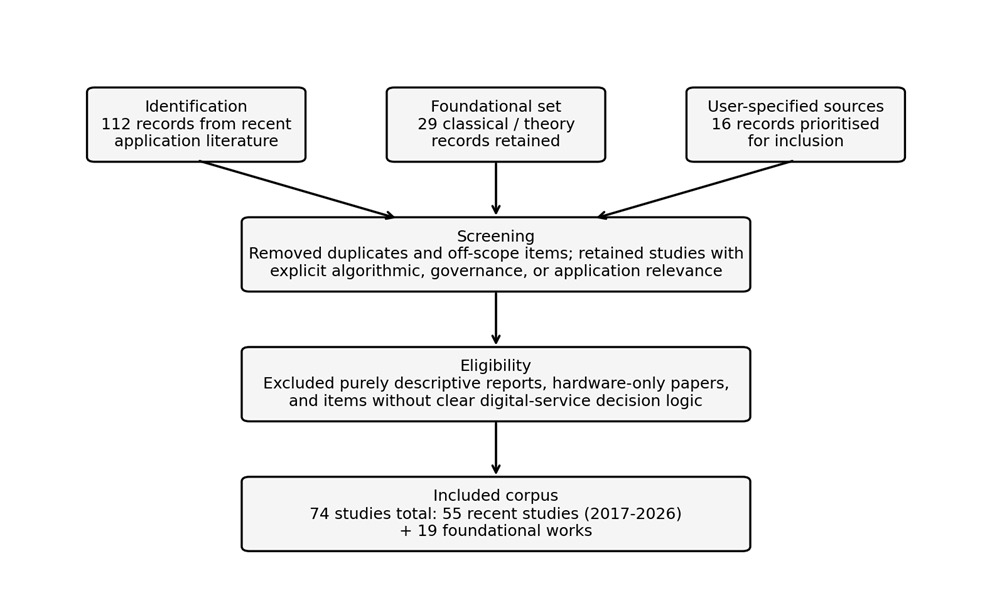
Open digital service ecosystems are reshaping how users discover and act on services across commerce, tourism, finance, education, accessibility, and public compliance. However, the literature on underlying algorithms remains fragmented, some prioritize ranking accuracy, others focus on adoption, and a smaller body examines explainability, fairness, privacy, accessibility, and governance. This paper presents a structured review of 74 studies (55 from 2017 to March 2026, plus 19 foundational works) mapping the transition from closed, accuracy-centered recommenders to open, trust-aware, multi-objective smart algorithms. Hybrid and context-aware architectures remain dominant, but recent work increasingly incorporates conversational interfaces, human-in-the-loop control, privacy constraints, and fairness-aware reranking. Five recurring gaps emerge: data fragmentation, weak explanation quality, limited accessibility auditing, poor integration of institutional rules, and weak cross-sector transferability. Trust is best understood as a composite property involving data provenance, procedural transparency, contextual fit, user control, and reliable escalation paths. Based on these findings, the paper proposes a six-layer design model (data interoperability, contextual risk profiling, hybrid inference, governance-aware reranking, explanation interfaces, and human oversight). Contributions: (1) a PRISMA-informed review protocol; (2) a taxonomic classification of five smart algorithm families; (3) a composite trust framework operationalized from Mayer et al. (1995); (4) quantitative comparisons of trust-related metrics; (5) mathematical formulations for trust-aware reranking and explanation generation; (6) a benchmark against NIST AI RMF and EU AI Act; and (7) a six-layer architectural model with implementation examples.
Downloads
References
[1] M. I. Islam, S. I. Ansarullah, K. U. Nisa, S. Mufti, A. R. Dar, and A. O. Salau, “Social network design for disability peer support: Identifying barriers, applying standards, and implementing measurable solutions,” Open Information Science, vol. 10, no. 1, 2026. DOI: https://doi.org/10.1515/opis-2025-0036
[2] S. Ahmed, N. Alaa, A. Khaled, S. Ali, L. Zein, and N. Subramanian, “Evidence-grounded vision–rag framework for clinically reliable visual reasoning in chest x-ray analysis,” Journal of Smart Algorithms and Applications (JSAA), vol. 2, no. 2, pp. 49–60, 2026.
[3] M. I. ul Islam, K. U. Nisa, S. I. Ansarullah, S. Mufti, M. Danish, O. Ajala, and A. O. Salau, “Leveraging ai-generated visuals for enhancing management of career orientation: A quasi-experimental study,” Open Information Science, vol. 9, no. 1, p 20250019, 2025. DOI: https://doi.org/10.1515/opis-2025-0019
[4] P. J. Johri, A. A. Asiri, E. A. Assery, S. Hassan, E. Emad, E. Abdelrahman, et al., “A robust two-stage retrieval-augmented vision-language framework for knowledge-intensive multimodal reasoning and alignment,” Computational Discovery and Intelligent Systems (CDIS), vol. 2, no. 2, pp. 42–52, 2026. DOI: https://doi.org/10.66279/2da0zk02
[5] S. Anđelić, Z. Brnjas, and I. Domazet, “Education and entrepreneurship,” Journal of security and sustainability issues, pp. 383–393, 2017.
[6] A. Hammad, M. H. Almourish, I. AbuNahleh, and M. El-Mowafy, “Implicit geometric-semantic fusion for task-oriented 6-dof grasp detection via visual affordance and stability learning,” Engineering Systems and Intelligent Technologies (ESIT), vol. 2, no. 2, pp. 24–38, 2026. DOI: https://doi.org/10.66279/apg4me53
[7] P. Resnick and H. R. Varian, “Recommender systems,” Communications of the ACM, vol. 40, no. 3, pp. 56–58, 1997. DOI: https://doi.org/10.1145/245108.245121
[8] J. Lu, D. Wu, M. Mao, W. Wang, and G. Zhang, “Recommender system application developments: a survey,” Decision support systems, vol. 74, pp. 12–32, 2015. DOI: https://doi.org/10.1016/j.dss.2015.03.008
[9] S. M. McNee, J. Riedl, and J. A. Konstan, “Being accurate is not enough: how accuracy metrics have hurt recommender systems,” in CHI’06 extended abstracts on Human factors in computing systems, pp. 1097–1101, 2006. DOI: https://doi.org/10.1145/1125451.1125659
[10] L. Floridi, J. Cowls, M. Beltrametti, R. Chatila, P. Chazerand, V. Dignum, C. Luetge, R. Madelin, U. Pagallo, F. Rossi, et al., “Ai4people—an ethical framework for a good ai society: Opportunities, risks, principles, and recommendations,” Minds and machines, vol. 28, no. 4, pp. 689–707, 2018. DOI: https://doi.org/10.1007/s11023-018-9482-5
[11] H. Saeed, M. Adel, Y. Ataa, M. Mohamed, H. Ahmed, T. W. Hong, and N. Jayarajan, “Reliable drug–target interaction prediction using convolutional neural networks with robust negative sample generation,” Journal of Smart Algorithms and Applications (JSAA), vol. 2, no. 2, pp. 34–48, 2026.
[12] Y. Zhang and X. Chen, “Explainable recommendation: A survey and new perspectives,” Foundations and Trends® in Information Retrieval, vol. 14, no. 1, pp. 1-101, 2020. DOI: https://doi.org/10.1561/1500000066
[13] N. Mehrabi, F. Morstatter, N. Saxena, K. Lerman, and A. Galstyan, “A survey on bias and fairness in machine learning,” ACM computing surveys (CSUR), vol. 54, no. 6, pp. 1–35, 2021. DOI: https://doi.org/10.1145/3457607
[14] Y. A. Satar, H. A. Almansouri, and A. A. Hassanain, “Cvar-optimized distributionally robust stacked ensemble with range-based current signatures for reliable fault detection in photovoltaic farms,” Engineering Systems and Intelligent Technologies (ESIT), vol. 1, no. 1, pp. 1–14, 2026.
[15] F. McSherry and I. Mironov, “Differentially private recommender systems: Building privacy into the netflix prize contenders,” in Proceedings of the 15th ACM SIGKDD international conference on Knowledge discovery and data mining, pp. 627–636, 2009. DOI: https://doi.org/10.1145/1557019.1557090
[16] H. Snyder, “Literature review as a research methodology: An overview and guidelines,” Journal of business research, vol. 104, pp. 333–339, 2019. DOI: https://doi.org/10.1016/j.jbusres.2019.07.039
[17] M. J. Page, J. E. McKenzie, P. M. Bossuyt, I. Boutron, T. C. Hoffmann, C. D. Mulrow, L. Shamseer, J. M. Tetzlaff,
E. A. Akl, S. E. Brennan, et al., “The prisma 2020 statement: an updated guideline for reporting systematic reviews,” bmj, vol. 372, 2021.
[18] H. Abdollahpouri, R. Burke, and B. Mobasher, “Managing popularity bias in recommender systems with personalized re-ranking,” arXiv preprint arXiv:1901.07555, 2019.
[19] M. Aly, M. Ali, A. Kandil, and A. ElKersh, “A data-driven computational framework for ledge morphology prediction in aluminum engineering systems,” Engineering Systems and Intelligent Technologies (ESIT), vol. 1, no. 2, pp. 42–52, 2026.
[20] R. Burke, “Multisided fairness for recommendation,” arXiv preprint arXiv:1707.00093, 2017.
[21] M. Badouch, M. Boutaounte, O. Zioudi, and H. Mahmoud, “The future of travel: A review of chatbot recommender systems in e-tourism and smart tourism,” in International Conference on Electrical Systems and Smart Technologies, pp. 103–115, Springer, 2024. DOI: https://doi.org/10.1007/978-3-031-86705-7_10
[22] D. Mehraj, M. I. Ul Islam, I. H. Qureshi, S. Basheer, M. M. Baba, V. u. Nissa, and M. Asif Shah, “Factors affecting entrepreneurial intention for sustainable tourism among the students of higher education institutions,” Cogent Business & Management, vol. 10, no. 3, p. 2256484, 2023. DOI: https://doi.org/10.1080/23311975.2023.2256484
[23] U. Gnewuch, S. Morana, O. Hinz, R. Kellner, and A. Maedche, “More than a bot? the impact of disclosing human involvement on customer interactions with hybrid service agents,” Information Systems Research, vol. 35, no. 3, pp. 936–955, 2024. DOI: https://doi.org/10.1287/isre.2022.0152
[24] M. I. u. Islam, U. M. Lone, I. A. Bhat, S. Aamir, and A. O. Salau, “Open network for digital commerce in india: past, present, and future,” Open Information Science, vol. 8, no. 1, p. 20240005, 2024. DOI: https://doi.org/10.1515/opis-2024-0005
[25] M. Rawanda, “Transforming customer service with ai agents: Enhancing efficiency and personalisation in the service sector: Balancing automation and the human touch,” Harnessing emotion AI for customer support and employee wellbeing, pp. 241–268, 2025. DOI: https://doi.org/10.4018/979-8-3373-3658-9.ch010
[26] Y. K. Dwivedi, N. Kshetri, L. Hughes, E. L. Slade, A. Jeyaraj, A. K. Kar, A. M. Baabdullah, A. Koohang, V. Raghavan,
M. Ahuja, et al., “So what if chatgpt wrote it? multidisciplinary perspectives on opportunities, challenges and implications of generative conversational ai for research, practice and policy,” International Journal of Information Management, vol. 71, no. 102642, pp. 1–63, 2023. DOI: https://doi.org/10.1016/j.ijinfomgt.2023.102642
[27] M. G. Jacobides, C. Cennamo, and A. Gawer, “Towards a theory of ecosystems,” Strategic management journal, vol. 39, no. 8, pp. 2255–2276, 2018. DOI: https://doi.org/10.1002/smj.2904
[28] S. I. Ansarullah, M. I. Islam, G. Begum, and N. A. Bhat, “Leveraging digital tools to enhance school counselling: Case studies and best practices,” in Enhancing School Counseling With Technology and Case Studies, pp. 49–72, IGI Global Scientific Publishing, 2025. DOI: https://doi.org/10.4018/979-8-3693-8392-6.ch003
[29] R. Adner, “Ecosystem as structure: An actionable construct for strategy,” Journal of management, vol. 43, no. 1, pp. 39–58, 2017. DOI: https://doi.org/10.1177/0149206316678451
[30] E. Kasneci, K. Seßler, S. Küchemann, M. Bannert, D. Dementieva, F. Fischer, U. Gasser, G. Groh, S. Günnemann, E. Hüllermeier, et al., “Chatgpt for good? on opportunities and challenges of large language models for education,” Learning and individual differences, vol. 103, p. 102274, 2023. DOI: https://doi.org/10.1016/j.lindif.2023.102274
[31] M. I. Islam, K. U. Nisa, S. Mufti, S. I. Ansarullah, S. Ikhlaq, and T. Yousuf, “Artificial intelligence in tax compliance: Transforming taxpayer behavior and system efficiency,” in Modeling and Profiling Taxpayer Behavior and Compliance, pp. 251–270, IGI Global Scientific Publishing, 2025. DOI: https://doi.org/10.4018/979-8-3373-0422-9.ch011
[32] S. I. Ansarullah, M. I. Islam, F. Ahmad, M. Danish, A. R. Dar, and S. Mufti, “Predicting stock markets using linear regression and cloud computing: A literature review and case study approach,” in Advancements in Cloud-Based Intelligent Informative Engineering, pp. 331–352, IGI Global Scientific Publishing, 2025. DOI: https://doi.org/10.4018/979-8-3373-0781-7.ch015
[33] R. Luckin and M. Cukurova, “Designing educational technologies in the age of ai: A learning sciences-driven approach,” British Journal of Educational Technology, vol. 50, no. 6, pp. 2824–2838, 2019. DOI: https://doi.org/10.1111/bjet.12861
[34] S. J. Russell, Artificial intelligence a modern approach. Pearson Education, Inc., 2010.
[35] M. I. Islam, K. U. Nisa, S. Ikhlaq, T. Yousuf, S. Gulzar, and S. I. Ansarullah, “Fostering social innovation through urban technologies,” in Tech-Enabled Urbanism and Entrepreneurship for Inclusive Cities, pp. 103–119, Springer, 2026. DOI: https://doi.org/10.1007/978-981-95-3873-7_6
[36] L. Rawanda et al., “Issues and problems faced by children in conflict with law during and after their detention,” Sri Lanka Journal of Social Sciences, vol. 44, no. 2, 2021. DOI: https://doi.org/10.4038/sljss.v44i2.8055
[37] D. Mehraj, M. I. U. Islam, V. U. Nissa, and S. Iqbal, “Challenges and prospects in the adoption of mobile payment systems in india,” Business, management and economics annual volume 2024, 2024. DOI: https://doi.org/10.5772/intechopen.114904
[38] R. S. Sutton and A. G. Barto, Reinforcement learning: An introduction. MIT press, second ed., 2018.
[39] J. Preskill, “Quantum computing in the nisq era and beyond,” Quantum, vol. 2, p. 79, 2018. DOI: https://doi.org/10.22331/q-2018-08-06-79
[40] P. Kairouz and H. B. McMahan, “Advances and open problems in federated learning,” Foundations and trends in machine learning, vol. 14, no. 1-2, pp. 1–210, 2021. DOI: https://doi.org/10.1561/2200000083
[41] T. Li, A. K. Sahu, M. Zaheer, M. Sanjabi, A. Talwalkar, and V. Smith, “Federated optimization in heterogeneous networks,” Proceedings of Machine learning and systems, vol. 2, pp. 429–450, 2020.
[42] W. X. Zhao, K. Zhou, J. Li, T. Tang, X. Wang, Y. Hou, Y. Min, B. Zhang, J. Zhang, Z. Dong, et al., “A survey of large language models,” arXiv preprint arXiv:2303.18223, vol. 1, no. 2, pp. 1–124, 2023.
[43] S. I. Ansarullah, S. Ikhlaq, T. Yousuf, M. I. ul Islam, S. Mufti, and F. A. Fayaz, “Quantum-enhanced artificial intelligence: The next frontier in computing and decision-making,” in From Bits to Qubits: The Quantum Transformation of Computing: The Power of Quantum Computing, pp. 77–106, Springer, 2026. DOI: https://doi.org/10.1007/978-3-032-00586-1_4
Downloads
Published
Data Availability Statement
This is review paper, hence no data avilability.
Issue
Section
Categories
License
Copyright (c) 2026 The Authors

This work is licensed under a Creative Commons Attribution 4.0 International License.
Journal of Smart Algorithms and Applications (JSAA) seeks to publish the most influential papers that will significantly advance scientific understanding. Selected articles must present new and widely significant data, syntheses, or concepts. They should merit recognition by the wider scientific community and the general public through publication in a reputable scientific journal.
Journal of Smart Algorithms and Applications (JSAA) content is published under a Creative Commons Attribution 4.0 International (CC BY 4.0) License. This means that content is freely available to all readers upon publication, and content is published as soon as production is complete.
JSAA Journal
SIRG Publisher