Machine Learning for Chronic Disease Classification and Comorbidity Detection: Methodological Gaps and Future Directions
DOI:
https://doi.org/10.66279/5a6sr902Keywords:
Machine Learning;, Chronic Disease Classification, Comorbidity Detection, Fibromyalgia, Explainable AIAbstract
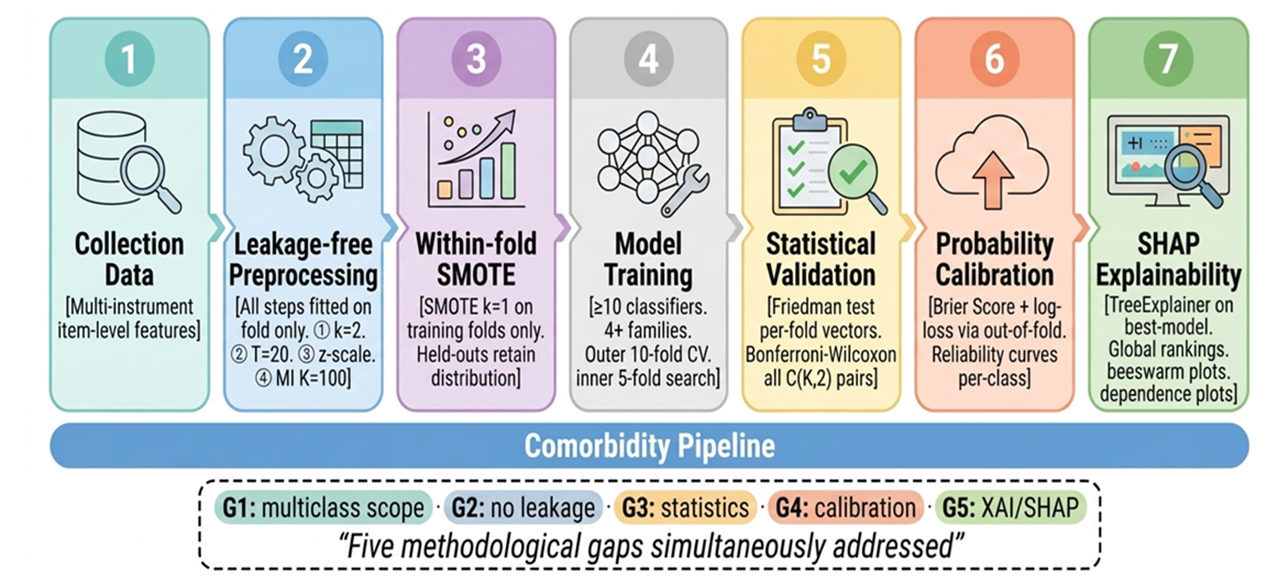
The rapid proliferation of machine learning (ML) methods across clinical medicine has generated a rich but fragmented body of evidence for chronic disease classification. Despite consistently high reported accuracy, the literature is characterised by five systematic methodological limitations: exclusive reliance on binary single-disease classification tasks, absence of leakage-free preprocessing protocols, lack of non-parametric statistical validation, omission of probability calibration evaluation, and minimal integration of explainability frameworks. This narrative review critically examines 25 representative ML studies spanning musculoskeletal disorders (particularly disc herniation), inflammatory bowel conditions, fibromyalgia, cardiovascular disease, and related chronic comorbidities, published between 2012 and 2025. Studies are analysed thematically across algorithmic approach, task scope, class imbalance strategy, and methodological rigour. Algorithmic families represented include classical support vector machines and tree ensembles, deep learning architectures (CNN, LSTM, U-Net), optimization-enhanced methods (WOA, GGO, PSO, SO), and natural language processing models (RoBERTa). Across all 25 studies, performance metrics range from 82.47% to 99.9% accuracy, yet none simultaneously addresses multiclass comorbidity discrimination, leakage-free preprocessing, and model explainability. The review identifies five critical gaps and maps them to concrete future research directions, with particular emphasis on the unmet need for a unified multiclass framework capable of differential diagnosis among clinically overlapping chronic conditions within fibromyalgia populations. These findings suggest that current ML models are not yet clinically ready for the differential diagnosis of comorbid chronic conditions without methodological reform.
Downloads
References
[1] T. Vos, S. S. Lim, C. Abbafati, K. M. Abbas, M. Abbasi, M. Abbasifard, M. Abbasi-Kangevari, H. Abbastabar, F. Abd-Allah, A. Abdelalim et al., “Global burden of 369 diseases and injuries in 204 countries and territories, 1990–2019: a systematic analysis for the global burden of disease study 2019,” The Lancet, vol. 396, no. 10258, pp.
1204–1222, 2020.
[2] K. Barnett, S. W. Mercer, M. Norbury, G. Watt, S. Wyke, and B. Guthrie, “Epidemiology of multimorbidity and implications for health care, research, and medical education: a cross-sectional study,” The Lancet, vol. 380, no. 9836, pp. 37–43, 2012.
[3] J. M. Valderas, B. Starfield, B. Sibbald, C. Salisbury, and M. Roland, “Defining comorbidity: implications for understanding health and health services,” Annals of Family Medicine, vol. 7, no. 4, pp. 357–363, 2009.
[4] A. L. Beam and I. S. Kohane, “Big data and machine learning in health care,” Jama, vol. 319, no. 13, pp. 1317–1318, 2018.
[5] S. B. Kotsiantis, I. Zaharakis, P. Pintelas et al., “Supervised machine learning: A review of classification techniques,” Emerging artificial intelligence applications in computer engineering, vol. 160, no. 1, pp. 3–24, 2007.
[6] W. R. Hersh, “Healthcare data analytics,” BMJ, vol. 334, no. 7585, pp. 1139–1140, 2007.
[7] F. Jiang, Y. Jiang, H. Zhi, Y. Dong, H. Li, S. Ma, Y. Wang, Q. Dong, H. Shen, and Y. Wang, “Artificial intelligence in healthcare: past, present and future,” Stroke and Vascular Neurology, vol. 2, no. 4, pp. 230–243, 2017.
[8] E. J. Topol, “High-performance medicine: the convergence of human and artificial intelligence,” Nature Medicine, vol. 25, no. 1, pp. 44–56, 2019.
[9] A. Rajkomar, J. Dean, and I. Kohane, “Machine learning in medicine,” New England Journal of Medicine, vol. 380, no. 14, pp. 1347–1358, 2019.
[10] M. Alsmirat, N. Al-Mnayyis, M. Al-Ayyoub, and A.-M. Asma’A, “Deep learning-based disk herniation computer aided diagnosis system from mri axial scans,” IEEE Access, vol. 10, pp. 32 315–32 323, 2022.
[11] S. Ganiger and K. Rajashekharaiah, “Chronic diseases diagnosis using machine learning,” in 2018 International Conference on Circuits and Systems in Digital Enterprise Technology (ICCSDET). IEEE, 2018, pp. 1–6.
[12] S. Kaufman, S. Rosset, C. Perlich, and O. Stitelman, “Leakage in data mining: Formulation, detection, and avoidance,” ACM Transactions on Knowledge Discovery from Data (TKDD), vol. 6, no. 4, pp. 1–21, 2012.
[13] N. V. Chawla, K. W. Bowyer, L. O. Hall, and W. P. Kegelmeyer, “Smote: Synthetic minority over-sampling technique,” Journal of Artificial Intelligence Research, vol. 16, pp. 321–357, 2002.
[14] M. Friedman, “A comparison of alternative tests of significance for the problem of m rankings,” The annals of mathematical statistics, vol. 11, no. 1, pp. 86–92, 1940.
[15] J. Platt, “Probabilistic outputs for support vector machines and comparisons to regularized likelihood methods,” Advances in large margin classifiers, vol. 10, no. 3, pp. 61–74, 1999.
[16] S. M. Lundberg and S.-I. Lee, “A unified approach to interpreting model predictions,” Advances in neural information processing systems, vol. 30, 2017.
[17] F. K. Dosilovic, M. Brcic, and N. Hlupic, “Explainable artificial intelligence: A survey,” in 2018 41st International Convention on Information and Communication Technology, Electronics and Microelectronics (MIPRO), May 2018, pp. 0210–0215.
[18] P. D. Barua, M. Kobayashi, M. Tanabe, M. Baygin, J. K. Paul, T. Iype, S. Dogan, T. Tuncer, R.-S. Tan, and U. R. Acharya, “Innovative fibromyalgia detection approach based on quantum-inspired 3lbp feature extractor using ecg
signal,” IEEE Access, vol. 11, pp. 101 359–101 372, 2023.
[19] B. A. Kleykamp, M. C. Ferguson, E. McNicol, I. Bixho, L. M. Arnold, R. R. Edwards, R. Fillingim, H. Grol-Prokopczyk, D. C. Turk, and R. H. Dworkin, “The prevalence of psychiatric and chronic pain comorbidities in fibromyalgia: an action systematic review,” in Seminars in arthritis and rheumatism, vol. 51, no. 1. Elsevier, 2021, pp. 166–174.
[20] Z. U. Hussain, R. Comerford, F. Comerford, N. Ng, D. Ng, A. Khan, C. Lees, and A. Hussain, “A comparison of machine learning approaches for predicting the progression of crohn’s disease,” in 2020 IEEE Student Conference on Research and Development (SCOReD). IEEE, 2020, pp. 529–533.
[21] B. N. Green, C. D. Johnson, and A. Adams, “Writing narrative literature reviews for peer-reviewed journals: secrets of the trade,” Journal of Chiropractic Medicine, vol. 5, no. 3, pp. 101–117, 2006.
[22] H. He and E. A. Garcia, “Learning from imbalanced data,” IEEE Transactions on Knowledge and Data Engineering, vol. 21, no. 9, pp. 1263–1284, 2009.
[23] R. Blagus and L. Lusa, “Smote for high-dimensional class-imbalanced data,” BMC Bioinformatics, vol. 14, pp. 1–16, 2013.
[24] S. Ghosh, M. R. Malgireddy, V. Chaudhary, and G. Dhillon, “A new approach to automatic disc localization in clinical lumbar mri: Combining machine learning with heuristics,” in 2012 9th IEEE International Symposium on Biomedical
Imaging (ISBI). IEEE, 2012, pp. 114–117.
[25] M. S. Islam, M. Asaduzzaman, and M. M. Rahman, “Feature selection and classification of spinal abnormalities to detect low back pain disorder using machine learning approaches,” in 2019 1st International Conference on Advances in Science, Engineering and Robotics Technology (ICASERT). IEEE, 2019, pp. 1–4.
[26] E. Ebrahimzadeh, F. Fayaz, F. Ahmadi, and M. Nikravan, “A machine learning-based method in order to diagnose lumbar disc herniation disease by mr image processing,” MedLife Open Access, vol. 1, no. 1, p. 1, 2018.
[27] E.-H. A. Rady and A. S. Anwar, “Prediction of kidney disease stages using data mining algorithms,” Informatics in medicine unlocked, vol. 15, p. 100178, 2019.
[28] W. Mbarki, M. Bouchouicha, S. Frizzi, F. Tshibasu, L. B. Farhat, and M. Sayadi, “Lumbar spine discs classification based on deep convolutional neural networks using axial view mri,” Interdisciplinary Neurosurgery, vol. 22, p. 100837,
2020.
[29] A. Kukker and R. Sharma, “A genetic algorithm assisted fuzzy q-learning epileptic seizure classifier,” Computers & Electrical Engineering, vol. 92, p. 107154, 2021.
[30] M. Pal, S. Parija, R. K. Mohapatra, S. Mishra, A. A. Rabaan, A. Al Mutair, S. Alhumaid, J. A. Al-Tawfiq, and
K. Dhama, “Symptom-based covid-19 prognosis through ai-based iot: A bioinformatics approach,” BioMed Research International, vol. 2022, no. 1, p. 3113119, 2022.
[31] M. Pal, S. Parija, G. Panda, K. Dhama, and R. K. Mohapatra, “Risk prediction of cardiovascular disease using machine learning classifiers,” Open Medicine, vol. 17, no. 1, pp. 1100–1113, 2022.
[32] A. Sarker, S. Lakamana, Y. Guo, Y. Ge, A. Leslie, O. Okunromade, E. Gonzalez-Polledo, J. Perrone, and A. M.
McKenzie-Brown, “# chronicpain: automated building of a chronic pain cohort from twitter using machine learning,” Health data science, vol. 3, p. 0078, 2023.
[33] A. M. Elshewey, A. H. Abed, D. S. Khafaga, A. A. Alhussan, M. M. Eid, and E.-S. M. El-Kenawy, “Enhancing heart disease classification based on greylag goose optimization algorithm and long short-term memory,” Scientific Reports, vol. 15, no. 1, p. 1277, 2025.
[34] Z. Tarek, A. A. Alhussan, D. S. Khafaga, E.-S. M. El-Kenawy, and A. M. Elshewey, “A snake optimization algorithm-based feature selection framework for rapid detection of cardiovascular disease in its early stages,” Biomedical Signal Processing and Control, vol. 102, p. 107417, 2025.
[35] A. M. Elshewey, A. A. Alhussan, D. S. Khafaga, E.-S. M. Elkenawy, and Z. Tarek, “Eeg-based optimization of eye state classification using modified-ber metaheuristic algorithm,” Scientific Reports, vol. 14, no. 1, p. 24489, 2024.
[36] N. El-Rashidy, Z. Tarek, A. M. Elshewey, and M. Y. Shams, “Multitask multilayer-prediction model for predicting mechanical ventilation and the associated mortality rate,” Neural Computing and Applications, vol. 37, no. 3, pp. 1321–1343, 2025.
[37] A. M. Elshewey and A. M. Osman, “Orthopedic disease classification based on breadth-first search algorithm,” Scientific Reports, vol. 14, no. 1, p. 23368, 2024.
[38] B. Ramesh and K. P. Rao, “Intelligent detection of chronic kidney disease using optimized mlp models and feature selection techniques on the ap-ckd dataset,” IAENG International Journal of Computer Science, vol. 52, no. 10, 2025.
[39] K. Kangra and J. Singh, “A novel hybrid approach to predict diabetes using boruta and genetic algorithm.” IAENG International Journal of Computer Science, vol. 52, no. 10, 2025.
[40] P. V. Terlapu and K. Bhumika, “Intelligent liver disease identification using optimized multilayer perceptron using whale optimization algorithm (woa),” IAENG International Journal of Computer Science, vol. 52, no. 11, 2025.
[41] S. R. Kishan, B. Senthilkumaran, S. Malluvalasa et al., “Machine learning based healthcare system for assessment of
quality life,” IAENG International Journal of Computer Science, vol. 52, no. 11, 2025.
[42] N. Vodnala, P. Lankireddy, and P. Yarlagadda, “Identifying key features for machine learning classification of copd and asthma cough,” IAENG International Journal of Computer Science, vol. 52, no. 10, 2025.
[43] S. Raj and B. Mahanand, “Efficient classification of diffuse lung disease in class imbalance data,” IAENG International Journal of Computer Science, vol. 52, no. 7, 2025.
[44] A. Amalia, M. S. Lydia, S. M. Hardi, A. B. Jamesie, and H. Fahmi, “Optimizing celiac disease detection through dataset balancing and deep learning in a mobile application,” IAENG International Journal of Computer Science,
vol. 52, no. 9, 2025.
[45] T. G. Dietterich, “Ensemble methods in machine learning,” in International workshop on multiple classifier systems. Springer, 2000, pp. 1–15.
[46] L. Breiman, J. H. Friedman, R. A. Olshen, and C. J. Stone, “Classification and regression trees,” 1984.
[47] L. Breiman, “Random forests,” Machine learning, vol. 45, pp. 5–32, 2001.
[48] P. Geurts, D. Ernst, and L. Wehenkel, “Extremely randomized trees,” Machine learning, vol. 63, no. 1, pp. 3–42, 2006.
[49] J. H. Friedman, “Greedy function approximation: a gradient boosting machine,” Annals of statistics, pp. 1189–1232, 2001.
[50] T. Chen and C. Guestrin, “Xgboost: A scalable tree boosting system,” in Proceedings of the 22nd acm sigkdd
international conference on knowledge discovery and data mining, 2016, pp. 785–794.
[51] Y. Freund and R. E. Schapire, “A decision-theoretic generalization of on-line learning and an application to boosting,” Journal of computer and system sciences, vol. 55, no. 1, pp. 119–139, 1997.
[52] C. Cortes and V. Vapnik, “Support-vector networks,” Machine learning, vol. 20, pp. 273–297, 1995.
[53] D. R. Cox, “The regression analysis of binary sequences,” Journal of the Royal Statistical Society Series B: Statistical Methodology, vol. 20, no. 2, pp. 215–232, 1958.
[54] R. A. Fisher, “The use of multiple measurements in taxonomic problems,” Annals of Eugenics, vol. 7, no. 2, pp. 179–188, 1936.
[55] G. H. John and P. Langley, “Estimating continuous distributions in bayesian classifiers,” arXiv preprint arXiv:1302.4964, 2013.
[56] T. Cover and P. Hart, “Nearest neighbor pattern classification,” IEEE transactions on information theory, vol. 13, no. 1, pp. 21–27, 1967.
[57] D. E. Rumelhart, G. E. Hinton, and R. J. Williams, “Learning representations by back-propagating errors,” nature, vol. 323, no. 6088, pp. 533–536, 1986.
[58] L. S. Shapley et al., “A value for n-person games,” 1953.
[59] F. Wilcoxon, “Individual comparisons by ranking methods,” Biometrics bulletin, vol. 1, no. 6, pp. 80–83, 1945.
[60] W. B. Glenn et al., “Verification of forecasts expressed in terms of probability,” Monthly weather review, vol. 78, no. 1, pp. 1–3, 1950.
Downloads
Published
Data Availability Statement
Not Applicable
Issue
Section
Categories
License
Copyright (c) 2026 The Authors

This work is licensed under a Creative Commons Attribution 4.0 International License.
Journal of Smart Algorithms and Applications (JSAA) seeks to publish the most influential papers that will significantly advance scientific understanding. Selected articles must present new and widely significant data, syntheses, or concepts. They should merit recognition by the wider scientific community and the general public through publication in a reputable scientific journal.
Journal of Smart Algorithms and Applications (JSAA) content is published under a Creative Commons Attribution 4.0 International (CC BY 4.0) License. This means that content is freely available to all readers upon publication, and content is published as soon as production is complete.
JSAA Journal
SIRG Publisher