
Early Detection of Alzheimer’s Disease from Daily Behavioral Time-Series Using Interpretable Hidden Markov Models
Keywords:
Alzheimer's Disease, Hidden Markov Models, Daily Behavioral Time-Series, Smart-Home Monitoring, Interpretable Machine LearningAbstract
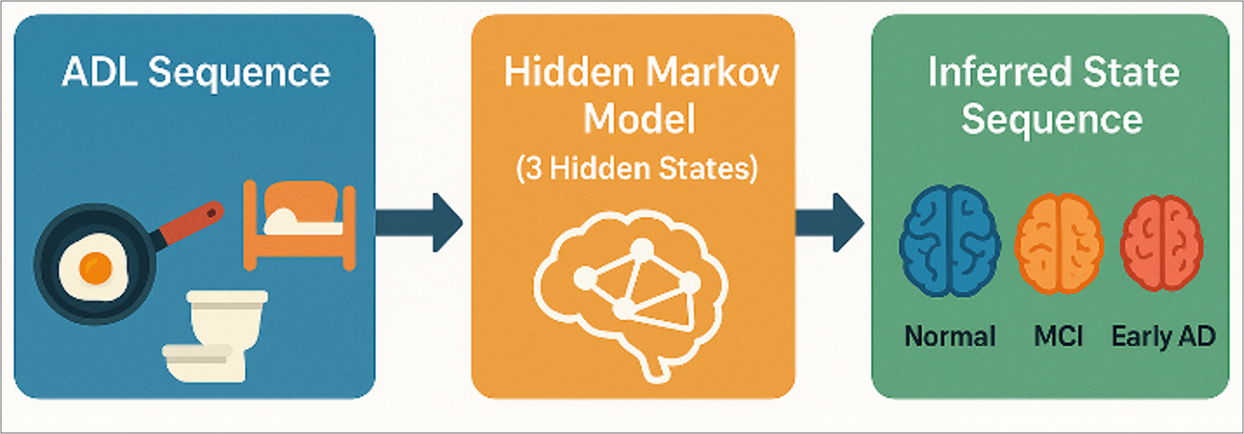
Alzheimer's disease is a progressive neurodegenerative disorder that demands early, accessible, and interpretable diagnostic approaches. Traditional diagnostic methods, such as neuroimaging and clinical testing, are often costly and impractical for continuous monitoring. In this paper, we propose a novel diagnostic system that employs Hidden Markov Models (HMMs) to analyze simulated daily behavioral time-series data inspired by smart-home sensor patterns. The model captures transitions between cognitive states (Normal, MCI, and Early Alzheimer's) based on observed Activities of Daily Living (ADLs). A synthetic dataset (Sim-ADL), generated to reflect real-world behavioral distributions like the CASAS-Aruba environment, is used to train and validate the system. The framework demonstrates moderate classification performance," revealing potential challenges in identifying early cognitive decline stages. Despite this, the model provides clinically interpretable results via transition and emission probability matrices. Compared to deep learning methods, the HMM approach balances interpretability and performance, making it a suitable low-cost tool for early-stage Alzheimer's detection and continuous home-based cognitive monitoring.
Downloads
References
[1] Messina A, Amati R, Annoni AM, Bano B, Albanese E, Fiordelli M, et al. (2024) Culturally adapting the World Health Organization digital intervention for family caregivers of people with dementia (iSupport): a community-based participatory approach. JMIR Formative Research 8(1):e46941.
[2] Albert MS, DeKosky ST, Dickson D, Dubois B, Feldman HH, Fox NC, et al. (2011) The diagnosis of mild cognitive impairment due to Alzheimer’s disease: recommendations from the National Institute on Aging–Alzheimer’s Association workgroups on diagnostic guidelines for Alzheimer’s disease. Alzheimer’s & Dementia 7(3):270–279.
[3] Jack CR Jr, Bennett DA, Blennow K, Carrillo MC, Dunn B, Haeberlein SB, et al. (2018) NIA-AA research framework: toward a biological definition of Alzheimer’s disease. Alzheimer’s & Dementia 14(4):535–562.
[4] Cook DJ, Crandall AS, Thomas BL, Krishnan NC (2012) CASAS: a smart home in a box. Computer 46(7):62–69.
[5] Dodge HH, Zhu J, Mattek NC, Bowman M, Ybarra O, Wild KV, et al. (2015) Web-enabled conversational interactions as a method to improve cognitive functions: results of a 6-week randomized controlled trial. Alzheimer’s & Dementia: Translational Research & Clinical Interventions 1(1):1–12.
[6] Ma Q, Zheng J, Li S, Cottrell GW (2019) Learning representations for time series clustering. In: Advances in Neural Information Processing Systems, vol 32.
[7] Rabiner LR (1989) A tutorial on hidden Markov models and selected applications in speech recognition. Proceedings of the IEEE 77(2):257–286.
[8] Luz S, Haider F, De la Fuente S, Fromm D, MacWhinney B (2021) Detecting cognitive decline using speech only: the ADReSSo challenge. arXiv preprint arXiv:2104.09356.
[9] Van Kasteren T, Noulas A, Englebienne G, Kröse B (2008) Accurate activity recognition in a home setting. In: Proceedings of the 10th International Conference on Ubiquitous Computing, pp 1–9.
[10] Cook DJ, Schmitter-Edgecombe M, Crandall A, Thomas BL (2013) Assessing the quality of activities in a smart environment. Methods of Information in Medicine 52(6):480–485. https://doi.org/10.3414/ME12-02-0017
[11] Dawadi N, Cook DJ, Schmitter-Edgecombe M (2020) Automated cognitive health assessment from smart home-based behavior data. IEEE Journal of Biomedical and Health Informatics 24(4):1188–1196. https://doi.org/10.1109/JBHI.2019.2938414
[12] Shaik MA, et al. (2025) Advancing remote monitoring for patients with Alzheimer disease and related dementias: systematic review. JMIR Aging 8. https://doi.org/10.2196/69175
[13] Civitarese G, Fiori M, Arighi A, et al. (2025) The SERENADE project: sensor-based explainable detection of cognitive decline. arXiv preprint, April 2025.
[14] Ren H, et al. (2025) Using machine learning to predict cognitive decline in older adults from the Chinese Longitudinal Healthy Longevity Survey: model development and validation study. JMIR Aging 1.
[15] Ahamed MKU, et al. (2025) A hybrid filtering and deep learning approach for early Alzheimer’s disease identification. Scientific Reports 15:27694.
[16] Alasiry A, et al. (2025) A novel neuroimaging-based early detection framework for Alzheimer disease using deep learning. Scientific Reports 15:23011.
[17] CASAS Smart Home dataset – scripted complex activities with cognitive diagnosis (2025). Zenodo. https://doi.org/10.5281/zenodo.15717153.
Downloads
Published
Issue
Section
Categories
License
Copyright (c) 2026 The Authors

This work is licensed under a Creative Commons Attribution 4.0 International License.
Computational Discovery and Intelligent Systems (CDIS) seeks to publish the most influential papers that will significantly advance scientific understanding. Selected articles must present new and widely significant data, syntheses, or concepts. They should merit recognition by the wider scientific community and the general public through publication in a reputable scientific journal.
In addition to the content, this is published under a Creative Commons Attribution 4.0 International (CC BY 4.0) License. This means the content is freely available to all readers upon publication, and it is published as soon as production is complete.
SIRG Publisher