
Lung Cancer Classification using Microarray Gene Expression Data and Machine Learning Approach
Keywords:
Microarray, Gene Expression, Machine Learning (ML), Biomarkers, Lung CancerAbstract
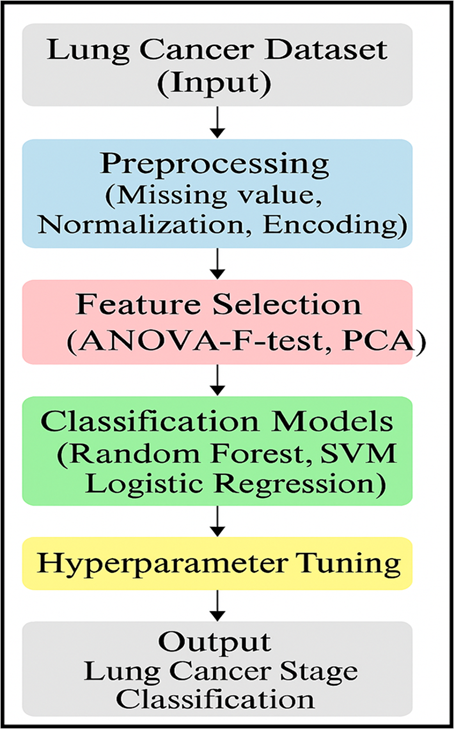
This work proposes an enhanced machine learning pipeline for accurate lung cancer subtype classification, utilizing statistical feature extraction and ensemble modeling. A publicly available Lung Cancer dataset (Lung.arff) containing 203 samples and 12,600 gene features for five classes was employed. Normalization, imputation of missing data, and class balancing via the SMOTE were applied for preprocessing. Feature selection was combined with an ANOVA F-test, and the top 50 discriminative genes were selected using Mutual Information and Random Forest–based feature importance. Subsequently, four classifiers-Logistic Regression, Support Vector Machine (with RBF kernel), Random Forest, and XGBoost were trained and comparatively evaluated using nested 5-fold cross-validation, ensuring a robust and unbiased assessment of the model performance. Experimental results validated that the XGBoost classifier achieved 90.8% accuracy, whereas the voting ensemble of RF, SVM, and XGBoost achieved 91.3% accuracy and improved the macro F1-score. Top-ranked genes from SHAP analysis show high consistency with current lung cancer biomarkers, validating the interpretability of the model. The results highlight the robustness of the incorporation of statistical feature selection and ensemble learning for precise lung cancer subtype classification.
Downloads
References
[28] Y. Rimal, N. Sharma, S. Paudel, A. Alsadoon, M.P. Koirala, S.J.S.R. Gill, Comparative analysis of heart disease prediction using logistic regression, SVM, KNN, and random forest with cross-validation for improved accuracy, 15(1) (2025) 13444.
[29] A.A. Asiri, A. Shaf, T. Ali, M. Aamir, M. Irfan, S.J.P.C.S. Alqahtani, Enhancing brain tumor diagnosis: an optimized CNN hyperparameter model for improved accuracy and reliability, 10 (2024) e1878.
[30] S. Sfaksi, L.J.P.A. Djerou, Applications, Symbolic regression-guided knowledge distillation for interpretable gene selection in cancer classification, 28(4) (2025) 200.
[31] M.J.D.T. Mohammadagha, R. Forest, Hyperparameter Optimization Strategies for Tree-Based Machine Learning Models Prediction: A Comparative Study of AdaBoost, Decision Trees, and Random Forest, (2025).
[32] M.A. Ruz Canul, J.A. Ruz-Hernandez, A.Y. Alanis, J.C. Gonzalez Gomez, J.J.S. Gálvez, Modified Soft Margin Optimal Hyperplane Algorithm for Support Vector Machines Applied to Fault Patterns and Disease Diagnosis, 17(10) (2025) 1749.
[33] S.-J. Sammut, M. Crispin-Ortuzar, S.-F. Chin, E. Provenzano, H.A. Bardwell, W. Ma, W. Cope, A. Dariush, S.-J. Dawson, J.E.J.N. Abraham, Multi-omic machine learning predictor of breast cancer therapy response, 601(7894) (2022) 623-629.
[34] Q. Xu, W. Xie, B. Liao, C. Hu, L. Qin, Z. Yang, H. Xiong, Y. Lyu, Y. Zhou, A.J.J.o.h.e. Luo, Interpretability of clinical decision support systems based on artificial intelligence from technological and medical perspective: A systematic review, 2023(1) (2023) 9919269.
Downloads
Published
Issue
Section
Categories
License
Copyright (c) 2025 The Authors

This work is licensed under a Creative Commons Attribution 4.0 International License.
Computational Discovery and Intelligent Systems (CDIS) seeks to publish the most influential papers that will significantly advance scientific understanding. Selected articles must present new and widely significant data, syntheses, or concepts. They should merit recognition by the wider scientific community and the general public through publication in a reputable scientific journal.
In addition to the content, this is published under a Creative Commons Attribution 4.0 International (CC BY 4.0) License. This means the content is freely available to all readers upon publication, and it is published as soon as production is complete.
SIRG Publisher