Energy-Efficient IoT and Edge Computing Framework for Wearable Health Monitoring and Chronic Disease Management
Keywords:
Wearable IoT, health monitoring, chronic disease management, remote patient care, smart sensorsAbstract
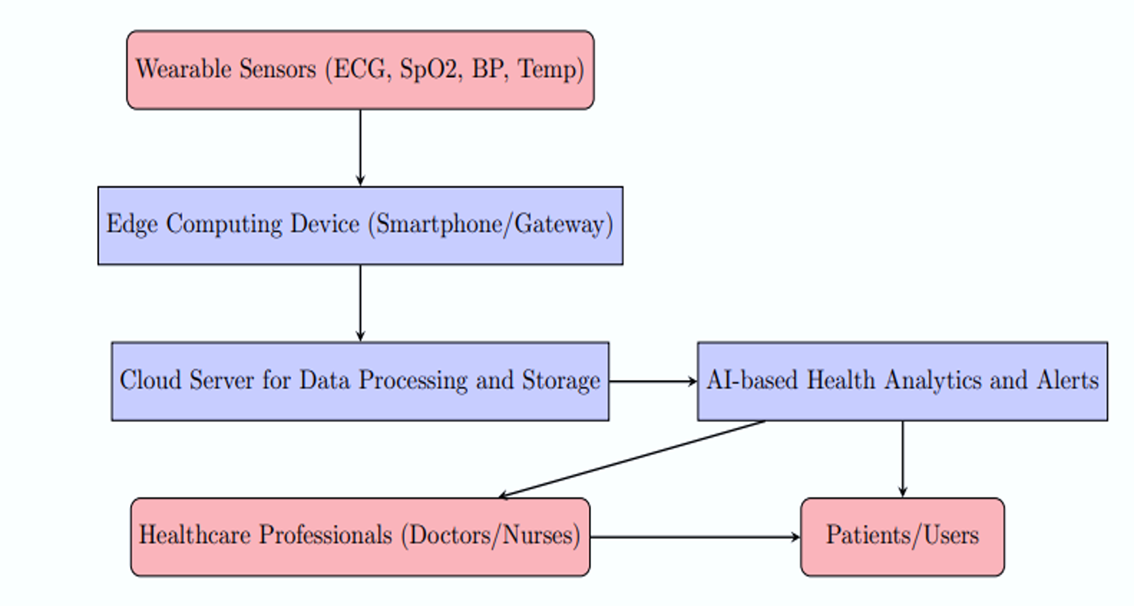
Advances in Internet of Things (IoT), edge computing, and smart sensor technologies are reshaping chronic disease management and remote patient care, with growing emphasis on energy-efficient solutions. This work presents an energy-efficient wearable health monitoring framework that integrates IoT-enabled smart sensors with edge-based data processing to continuously capture and analyze vital parameters, including heart rate, blood pressure, blood glucose, and SpO₂ levels. By performing preliminary data processing and abnormality detection at the edge, the system reduces cloud communication overhead, thereby extending device battery life and improving responsiveness. Machine learning algorithms embedded in the edge layer detect abnormal physiological patterns and predict potential health risks, triggering early alerts for timely medical intervention. Experimental evaluation demonstrates high accuracy (95.4%), sensitivity (93.8%), and specificity (96.2%) in detecting and monitoring chronic conditions. Real-time data visualization and personalized health insights further empower patients to take proactive roles in managing their health, while healthcare providers benefit from reduced hospital visits and improved continuity of care. The proposed framework addresses key challenges in wearable healthcare systems, particularly power optimization and data security, making it a cost-effective and scalable solution for sustainable, connected healthcare ecosystems.
Downloads
References
[1] W. Li, Y. Chai, F. Khan, S.R.U. Jan, S. Verma, V.G. Menon, f. Kavita, X.J.M.n. Li, applications, A comprehensive survey on machine learning-based big data analytics for IoT-enabled smart healthcare system, 26(1) (2021) 234-252.
[2] M. Haffner-Luntzer, S. Foertsch, V. Fischer, K. Prystaz, M. Tschaffon, Y. Mödinger, C.S. Bahney, R.S. Marcucio, T. Miclau, A.J.P.o.t.N.A.o.S. Ignatius, Chronic psychosocial stress compromises the immune response and endochondral ossification during bone fracture healing via β-AR signaling, 116(17) (2019) 8615-8622.
[3] P. Shojaei, E. Vlahu-Gjorgievska, Y.-W.J.C. Chow, Security and privacy of technologies in health information systems: A systematic literature review, 13(2) (2024) 41.
[4] P.K. Sari, P.W. Handayani, A.N. Hidayanto, S. Yazid, R.F. Aji, Information security behavior in health information systems: a review of research trends and antecedent factors, Healthcare, MDPI, 2022, p. 2531.
[5] B. Venkataramanaiah, R. Joany, B. Singh, T. Vinoth, G.S. Krishna, T. Nandhini, IoT Based Real-Time Virtual Doctor Model for Human Health Monitoring, 2023 Intelligent Computing and Control for Engineering and Business Systems (ICCEBS), IEEE, 2023, pp. 1-5.
[6] P. Dutta, T.-M. Choi, S. Somani, R.J.T.r.p.e.L. Butala, t. review, Blockchain technology in supply chain operations: Applications, challenges and research opportunities, 142 (2020) 102067.
[7] R. Pastorino, C. De Vito, G. Migliara, K. Glocker, I. Binenbaum, W. Ricciardi, S.J.E.j.o.p.h. Boccia, Benefits and challenges of Big Data in healthcare: an overview of the European initiatives, 29(Supplement_3) (2019) 23-27.
[8] A. Torab-Miandoab, T. Samad-Soltani, A. Jodati, F. Akbarzadeh, P.J.H. Rezaei-Hachesu, A unified component-based data-driven framework to support interoperability in the healthcare systems, 10(15) (2024).
[9] Y.-P. Hsieh, K.-C. Lee, T.-F. Lee, G.-J.J.A.S. Su, Extended chaotic-map-based user authentication and key agreement for HIPAA privacy/security regulations, 12(11) (2022) 5701.
[10] N. Nalini, A. Chaudhary, S. Surendran, M. Muthuraja, I. Ahmed, N. TJ, Network Intrusion Detection System for Feature Extraction Based on Machine Learning Techniques, 2023 5th International Conference on Inventive Research in Computing Applications (ICIRCA), IEEE, 2023, pp. 440-445.
[11] A. Molla, G. Hoang, O. Oshodin, Conceptualising the internet of behaviours (iob): A multi-level perspective and research agenda, (2021).
[12] G.P. Pinheiro, R.K. Miranda, B.J. Praciano, G.A. Santos, F.L. Mendonça, E. Javidi, J.P.J. da Costa, R.T.J.F.i.H.N. de Sousa Jr, Multi-sensor wearable health device framework for real-time monitoring of elderly patients using a mobile application and high-resolution parameter estimation, 15 (2022) 750591.
[13] J. Karthikeyan, S.T. Chong, R. Vasanthan, N. TJ, P.S. Sundari, V.C. Devi, Construction and Implementation of English Translation Simulation Training Classroom Based on Deep Learning, 2023 Second International Conference On Smart Technologies For Smart Nation (SmartTechCon), IEEE, 2023, pp. 716-719.
[14] L. Min, Z. Fan, Q. Lv, M. Reda, L. Shen, B.J.R.S. Wang, YOLO-DCTI: small object detection in remote sensing base on contextual transformer enhancement, 15(16) (2023) 3970.
[15] S.S.A. Alves, A.G. Matos, J.S. Almeida, C.A. Benevides, C.C.H. Cunha, R.V.C. Santiago, R.F. Pereira, P.P. Reboucas Filho, A new strategy for the detection of diabetic retinopathy using a smartphone app and machine learning methods embedded on cloud computer, 2020 IEEE 33rd International Symposium on Computer-Based Medical Systems (CBMS), IEEE, 2020, pp. 542-545.
[16] L.R. Mansaray, F. Wang, J. Huang, L. Yang, A.S.J.G.I. Kanu, Accuracies of support vector machine and random forest in rice mapping with Sentinel-1A, Landsat-8 and Sentinel-2A datasets, 35(10) (2020) 1088-1108.
[17] M.J.I.J.C.S.M.C. Abudalou, Enhancing Data Security through Advanced Cryptographic Techniques, 13(1) (2024) 88-92.
[18] K. Singh, J. Kaur, Enhancing connectivity for remote monitoring and management through IOT empowerment, Convergence of antenna technologies, electronics, and AI, IGI Global2025, pp. 97-122.
[19] S.S. Ali, B.J.J.E. Choi, State-of-the-art artificial intelligence techniques for distributed smart grids: A review, 9(6) (2020) 1030.
[20] C. Bollineni, M. Sharma, A. Hazra, P. Kumari, S. Manipriya, A.J.I.I.o.T.J. Tomar, IoT for Next-Generation Smart Healthcare: A Comprehensive Survey, (2025).
[21] D. Rastogi, P. Johri, M. Donelli, S. Kadry, A.A. Khan, G. Espa, P. Feraco, J.J.S.R. Kim, Deep learning-integrated MRI brain tumor analysis: feature extraction, segmentation, and Survival Prediction using Replicator and volumetric networks, 15(1) (2025) 1437.
[22] S. Wang, X. Li, L. Dong, J. Lyu, L. Zhang, X.J.I.I.o.T.J. Lyu, Integrating Deep Learning with Near-Field IoT Sensing for Enhanced Patient Localization and Monitoring in Healthcare Facilities, (2025).
[23] A. Anand, P. Johri, L. Papic, AHP based determination of critical testing coverage measures for reliable & complex software systems, Reliability Assessment and Optimization of Complex Systems, Elsevier2025, pp. 191-218.
[24] L.L. Marengo, S.J.S. Barberato-Filho, Involvement of human volunteers in the development and evaluation of wearable devices designed to improve medication adherence: a scoping review, 23(7) (2023) 3597.
[25] K. Thinakaran, S. Soman, L. Anitha, P.K. Lakineni, S.N. Taqui, Leveraging Temporal Patterns with LSTMs Networks for Financial Forecasting: A New Stastical Machine Learning Approach, 2023 International Conference on Communication, Security and Artificial Intelligence (ICCSAI), IEEE, 2023, pp. 916-920.
[26] S. Min, D.H. Kim, D.J. Joe, B.W. Kim, Y.H. Jung, J.H. Lee, B.Y. Lee, I. Doh, J. An, Y.N.J.A.M. Youn, Clinical validation of a wearable piezoelectric blood‐pressure sensor for continuous health monitoring, 35(26) (2023) 2301627.
[27] S. Gupta, S. Gupta, G. Kaur, Wearable Biosensors: IoT-driven Innovations in Healthcare Monitoring and Personalized Medicine, Advanced Manufacturing Technologies in Biomedical Science, CRC Press2026, pp. 286-303.
[28] R. Bommi, Neural Network based Predictive Analysis of Surface Roughness using Bayesian Regularization in Turning of Monel K500, 2023 International Conference on Inventive Computation Technologies (ICICT), IEEE, 2023, pp. 448-452.
[29] S. Wen, D. Xu, Y. Yuan, Z. Xu, Y. Li, M. Gong, X. Yuan, L.J.D. Zhou, Metabolic Syndrome, Obesity, The Effect of Diabetic Ketoacidosis and Hyperosmolar Hyperglycemic on the Metabolic Tumor Markers: A Real-World Retrospective Study, (2024) 4115-4133.
[30] K.C. Ravi, R.R. Dixit, S. Singh, A. Gopatoti, A.S. Yadav, Ai-powered pancreas navigator: Delving into the depths of early pancreatic cancer diagnosis using advanced deep learning techniques, 2023 9th International Conference on Smart Structures and Systems (ICSSS), IEEE, 2023, pp. 1-6.
[31] A. Riaz, M.R. Sarker, M.H.M. Saad, R.J.S. Mohamed, Review on comparison of different energy storage technologies used in micro-energy harvesting, WSNs, low-cost microelectronic devices: challenges and recommendations, 21(15) (2021) 5041.
[32] Z. Yu, K. Wang, Z. Wan, S. Xie, Z.J.C.C. Lv, Popular deep learning algorithms for disease prediction: a review, 26(2) (2023) 1231-1251.
[33] E. Afsaneh, A. Sharifdini, H. Ghazzaghi, M.Z.J.D. Ghobadi, M. Syndrome, Recent applications of machine learning and deep learning models in the prediction, diagnosis, and management of diabetes: a comprehensive review, 14(1) (2022) 196.
[34] J. Long, M. Rosenfield, M. Helland, J.J.E.A. Anshel, Visual ergonomics standards for contemporary office environments, 10(1) (2014) 7.
Downloads
Published
Issue
Section
Categories
License
Copyright (c) 2025 The Authors

This work is licensed under a Creative Commons Attribution 4.0 International License.
Computational Discovery and Intelligent Systems (CDIS) seeks to publish the most influential papers that will significantly advance scientific understanding. Selected articles must present new and widely significant data, syntheses, or concepts. They should merit recognition by the wider scientific community and the general public through publication in a reputable scientific journal.
In addition to the content, this is published under a Creative Commons Attribution 4.0 International (CC BY 4.0) License. This means the content is freely available to all readers upon publication, and it is published as soon as production is complete.
SIRG Publisher