Comprehensive Analysis of Security Challenges and Mitigation Strategies in 5G Mobile Wireless Networks
Keywords:
5G, Mobile Wireless Communication, Security, Data Privacy, AttacksAbstract
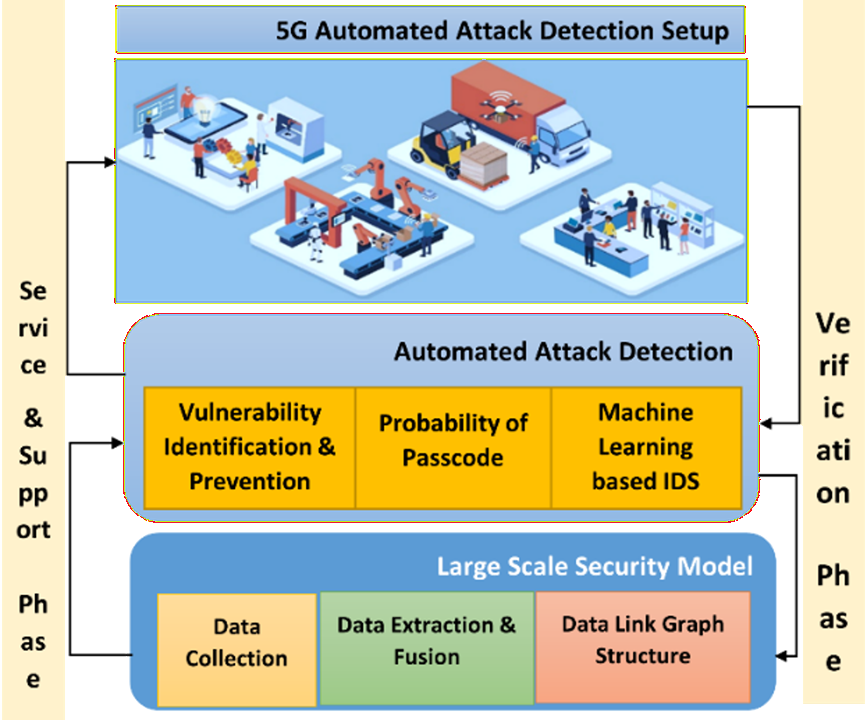
The year 2025 will be a markedly more enriched and complex one in the communication network and service environment than the present scenario. The existing telecommunication technologies are expected to undergo upsurged enhancements, such as changed radio interaction and spectrum, with the emergence of 5th Generation (5G) mobile communication. The persistent and increasing need for multiple applications like massive access to the device, low latency, ultra-high bandwidth, reliability, etc., is met using enormous ground-breaking technologies embraced by the 5G network. Simultaneously, the core network and the logical layer on which the traditional security throws its light are no longer compatible with the 5G Mobile wireless network. Various factors like architectural errors, poor execution of communication protocol, exchange of metadata information, and so on, could be a menace to security and privacy if 5G Mobile wireless networks are programmed to execute all their activities in a secure platform. Furthermore, new privacy issues might arise due to its complexity and inadaptability due to the rapid change and the present communication infrastructure’s tendency. 5G security also requires physical layer security as a part of it. However, the unavailability of proper research on vulnerabilities across all layers in 5G contributes primarily to security research findings at each layer. Correspondingly, potential security threats have failed to generate automated solutions. In the perception of an automated attack detection model, this article conducts a detailed research study of 5G security, incorporating the physical and logical layers to provide an automated solution for 5G security.
Downloads
References
[1] O. I. Khalaf, G. M. Abdulsahib, .H. D. Kasmaei, & K. A. Ogudo, “A new algorithm on application of blockchain technology in live stream video transmissions and telecommunications”. International Journal of e-Collaboration (IJeC), 16(1), 16-32, (2020).
[2] A. D. Salman1, O. I. Khalaf and G. M. Abdulsahib, “An adaptive intelligent alarm system for wireless sensor network”. Indonesian Journal of Electrical Engineering and Computer Science, Vol. 15, No. 1, July 2019, pp. 142~147.
[3] N. Sulaiman, G. Abdulsahib, O. Khalaf, M. N. Mohammed, "Effect of Using Different Propagations of OLSR and DSDV Routing Protocols", Proceedings of the IEEE International Conference on Intelligent Systems Structureing and Simulation, pp. 540-545, 2.
[4] R. Sardar et al., “Challenges in detecting security threats in WoT: a systematic literature review,” Artif Intell Rev, vol. 58, no. 7, 2025, doi: 10.1007/s10462-025-11176-z.
[5] A. Asasfeh, N. A. Al-Dmour, H. Al Hamadi, W. Mansoor, and T. M. Ghazal, “Exploring Cyber Investigators: An In-Depth Examination of the Field of Digital Forensics,” in 2023 IEEE International Conference on Dependable, Autonomic and Secure Computing, International Conference on Pervasive Intelligence and Computing, International Conference on Cloud and Big Data Computing, International Conference on Cyber Science and Tec, 2023, pp. 84–88. doi: 10.1109/DASC/PiCom/CBDCom/Cy59711.2023.10361449.
[6] A. Arabiat and M. Altayeb, “Enhancing internet of things security: evaluating machine learning classifiers for attack prediction,” International Journal of Electrical and Computer Engineering, vol. 14, no. 5, pp. 6036–6046, 2024, doi: 10.11591/ijece.v14i5.pp6036-6046.
[7] K. S. Pokkuluri, A. Kumar, K. K. S. Gautam, P. Deshmukh, G. Pavithra, and L. Abualigah, “Collaborative Intelligence for IoT: Decentralized Net security and confidentiality,” Journal of Intelligent Systems and Internet of Things, vol. 13, no. 2, pp. 202–211, 2024, doi: 10.54216/JISIoT.130216.
[8] A. Qaddos, M. U. Yaseen, A. S. Al-Shamayleh, M. Imran, A. Akhunzada, and S. Z. Alharthi, “A novel intrusion detection framework for optimizing IoT security,” Sci Rep, vol. 14, no. 1, 2024, doi: 10.1038/s41598-024-72049-z.
[9] M. Maaz, G. Ahmed, A. S. Al-Shamayleh, A. Akhunzada, S. Siddiqui, and A. H. Al-Ghushami, “Empowering IoT Resilience: Hybrid Deep Learning Techniques for Enhanced Security,” IEEE Access, vol. 12, pp. 180597–180618, 2024, doi: 10.1109/ACCESS.2024.3482005.
[10] M. W. A. Ashraf, A. R. Singh, A. Pandian, M. Bajaj, I. Zaitsev, and R. S. Rathore, “Enhancing network security with hybrid feedback systems in chaotic optical communication,” Sci Rep, vol. 14, no. 1, 2024, doi: 10.1038/s41598-024-76391-0.
[11] B. M. Elomda, T. A. A. Abdelbary, H. A. Hassan, K. S. Hamza, and Q. Kharma, “An Enhanced Multi-Layer Blockchain Security Model for Improved Latency and Scalability,” Information (Switzerland), vol. 16, no. 3, 2025, doi: 10.3390/info16030241.
[12] T. M. Ghazal, M. K. Hasan, H. M. Alzoubi, M. Alshurideh, M. Ahmad, and S. S. Akbar, Internet of Things Connected Wireless Sensor Networks for Smart Cities, vol. 1056. 2023. doi: 10.1007/978-3-031-12382-5_107.
[13] L. Almahadeen et al., “Enhancing Threat Detection in Financial Cyber Security Through Auto Encoder-MLP Hybrid Models,” International Journal of Advanced Computer Science and Applications, vol. 15, no. 4, pp. 924–933, 2024, doi: 10.14569/IJACSA.2024.0150495.
[14] J. V. N. Ramesh et al., “Satellite IOT Terminal Authentication Mechanism for Enhancing Consumer Security Over Cyber-Physical Systems,” IEEE Transactions on Consumer Electronics, 2025, doi: 10.1109/TCE.2025.3535078.
[15] Y. Sanjalawe, S. Al-E’mari, S. Fraihat, M. Abualhaj, and E. Alzubi, “A deep learning-driven multi-layered steganographic approach for enhanced data security,” Sci Rep, vol. 15, no. 1, 2025, doi: 10.1038/s41598-025-89189-5.
[16] U. S. Kumar et al., “Fusion of MobileNet and GRU: Enhancing Remote Sensing Applications for Sustainable Agriculture and Food Security,” Remote Sens Earth Syst Sci, vol. 8, no. 1, pp. 118–131, 2024, doi: 10.1007/s41976-024-00183-3.
[17] Y. Aldaaja et al., “Quantifying the Managerial and Practical Benefits of Cloud Computing on Information Security in Higher Education Institutions,” Applied Mathematics and Information Sciences, vol. 19, no. 1, pp. 15–24, 2025, doi: 10.18576/amis/190102.
[18] Y. Hassan et al., “Exploring the Mediating Role of Information Security Culture in Enhancing Sustainable Practices Through Integrated Systems Infrastructure,” Sustainability (Switzerland), vol. 17, no. 2, 2025, doi: 10.3390/su17020687.
[19] A. Mughaid, I. Obeidat, L. Abualigah, S. Alzubi, M. S. Daoud, and H. Migdady, “Intelligent cybersecurity approach for data protection in cloud computing based Internet of Things,” Int J Inf Secur, vol. 23, no. 3, pp. 2123–2137, 2024, doi: 10.1007/s10207-024-00832-0.
[20] R. Al-Sayyed, E. Alhenawi, H. Alazzam, A. Wrikat, and D. Suleiman, “Mobile money fraud detection using data analysis and visualization techniques,” Multimed Tools Appl, vol. 83, no. 6, pp. 17093–17108, 2024, doi: 10.1007/s11042-023-16068-4.
[21] S. Tumula et al., “An enhanced bio-inspired energy-efficient localization routing for mobile wireless sensor network,” International Journal of Communication Systems, vol. 37, no. 12, 2024, doi: 10.1002/dac.5803.
[22] T. M. Ghazal et al., Machine Learning-Based Intrusion Detection Approaches for Secured Internet of Things, vol. 1056. 2023. doi: 10.1007/978-3-031-12382-5_110.
[23] A. Al Sharah, Y. A. Alrub, H. A. Owida, E. A. Elsoud, N. Alshdaifat, and H. Khtatnaha, “An Adaptive Framework for Classification and Detection of Android Malware,” International Journal of Interactive Mobile Technologies , vol. 18, no. 21, pp. 59–73, 2024, doi: 10.3991/ijim.v18i21.49669.
[24] A. A. Althuwayb et al., “Multi antenna structure assisted by metasurface concept providing circular polarization for 5G millimeter wave applications,” Sci Rep, vol. 15, no. 1, 2025, doi: 10.1038/s41598-025-02208-3.
[25] R. I. Al-Suhimat et al., "Review of Security Challenges Encountered in Internet of Things Technology," in Proc. 2nd Int. Conf. Cyber Resilience (ICCR 2024), Dubai, UAE, 26–28 Feb. 2024, doi: 10.1109/ICCR61006.2024.10533052.
[26] M. K. Hasan et al.,"Towards Privacy Provisioning for Internet of Things (IoT)," in Proc. 2022 Int. Conf. Cyber Resilience (ICCR 2022), doi: 10.1109/ICCR56254.2022.9995916.
[27] A. Sharma, K. J. Singh, D. S. Kapoor, K. Thakur, and S. Mahajan, Advancements in 5G-IoT Technology-Based Healthcare: A Focus on Healthcare Monitoring for Smart Cities, vol. Part F4006. 2025. doi: 10.1007/978-3-031-72732-0_5.
[28] M. H. Ali et al.,"xdata for transmission in wireless communication networks," Periodicals of Engineering and Natural Sciences, vol. 9, no. 4, pp. 1038–1055, 2021, doi: 10.21533/pen.v9i4.2570.
[29] M. H. G. Muhammad et al., "Resource Provisioning in Cloud Computing using Fuzzy Logic Control System: An Adaptive Approach," in Proc. 2nd Int. Conf. Business Analytics for Technology and Security (ICBATS 2023), Dubai, UAE, 7–8 Mar. 2023, doi: 10.1109/ICBATS57792.2023.10111481.
[30] M. A. Aljubouri and M. Z. Iskandarani, “Comparative analysis of coding schemes for effective wireless communication,” Indonesian Journal of Electrical Engineering and Computer Science, vol. 34, no. 2, pp. 926–940, 2024, doi: 10.11591/IJEECS.V34.I2.PP936-950.
[31] M. Z. Iskandarani, “Communication Analysis of Wireless Sensor Networks with Mobility Function,” in International Conference on Electrical, Computer, Communications and Mechatronics Engineering, ICECCME 2024, 2024. doi: 10.1109/ICECCME62383.2024.10796204.
[32] M. Otair et al., “Enhanced Arithmetic Optimization Algorithm for Intrusion Detection in Wireless Sensor Networks,” International Journal of Communication Systems, vol. 38, no. 10, 2025, doi: 10.1002/dac.70122.
[33] E. Anaam, M. K. Hasan, T. M. Ghazal, S. C. Haw, H. M. Alzoubi, and M. T. Alshurideh, “How Private Blockchain Technology Secure IoT Data Record,” in 2023 IEEE 2nd International Conference on AI in Cybersecurity, ICAIC 2023, 2023. doi: 10.1109/ICAIC57335.2023.10044178.
[34] G. Kiran Kumar et al., “An optimized meta-heuristic clustering-based routing scheme for secured wireless sensor networks,” International Journal of Communication Systems, vol. 37, no. 11, 2024, doi: 10.1002/dac.5791.
[35] L. Abualigah et al., “Optimizing Intrusion Detection in Wireless Sensor Networks via the Improved Chameleon Swarm Algorithm for Feature Selection,” IET Communications, vol. 19, no. 1, 2025, doi: 10.1049/cmu2.70029.
[36] N. C. Masango et al., “Secure and efficient cloudlet networks: blockchain integration with agent-based proof of trust mechanism,” EURASIP J Wirel Commun Netw, vol. 2025, no. 1, 2025, doi: 10.1186/s13638-025-02439-y.
[37] A. S. Mohammed et al., "Unveiling the Landscape of Machine Learning and Deep Learning Methodologies in Network Security: A Comprehensive Literature Review," in Proc. 2nd Int. Conf. Cyber Resilience (ICCR 2024), Dubai, UAE, 26–28 Feb. 2024, doi: 10.1109/ICCR61006.2024.10533066.
[38] R. Sekhar et al.,"Security and Privacy Protection for Online Electronic Documents Based on Novel Encryption Techniques," J. Intell. Syst. Internet Things, vol. 11, no. 1, pp. 21–28, 2024, doi: 10.54216/JISIoT.110103.
[39] A. Ibrahim, "Guarding the Future of Gaming: The Imperative of Cybersecurity," in Proc. 2nd Int. Conf. Cyber Resilience (ICCR 2024), Dubai, UAE, 26–28 Feb. 2024, ISBN 979-835039496-2, doi: 10.1109/ICCR61006.2024.10532843.
Downloads
Published
Issue
Section
Categories
License
Copyright (c) 2025 Computational Discovery and Intelligent Systems

This work is licensed under a Creative Commons Attribution 4.0 International License.
Computational Discovery and Intelligent Systems (CDIS) content is published under a Creative Commons Attribution 4.0 International (CC BY 4.0) License. This means that content is freely available to all readers upon publication, and content is published as soon as production is complete.
Computational Discovery and Intelligent Systems (CDIS) seeks to publish the most influential papers that will significantly advance scientific understanding. Selected articles must present new and widely significant data, syntheses, or concepts. They should merit recognition by the wider scientific community and the general public through publication in a reputable scientific journal.
As well as the content, this is published under a Creative Commons Attribution 4.0 International (CC BY 4.0) License. This means that content is freely available to all readers upon publication, and content is published as soon as production is complete.
SIRG Publisher