About us
Welcome to SIRG Publisher
About SIRG Publisher
Scientific Innovation Research Group (SIRG)
Scientific Innovation Research Group (SIRG) LLC is an academic publisher and research organization based in Michigan, United States, dedicated to supporting the responsible dissemination of scientific and scholarly knowledge.
SIRG publishes international peer-reviewed journals and academic publications across a broad range of scientific, technological, engineering, computational, environmental, mathematical, and interdisciplinary fields.
SIRG is committed to developing a trustworthy and sustainable scholarly publishing environment based on academic integrity, rigorous peer review, editorial independence, transparency, accessibility, responsible research, and preservation of the scholarly record.
Our Mission
The mission of SIRG is to support the responsible dissemination of high-quality scientific and scholarly research through accessible, ethical, transparent, and professionally managed publishing platforms.
SIRG seeks to:
-
Promote original and scientifically meaningful research.
-
Facilitate responsible and transparent scholarly communication.
-
Support rigorous and fair peer-review practices.
-
Encourage international and interdisciplinary research collaboration.
-
Improve the accessibility and discoverability of scholarly publications.
-
Promote research and publication integrity.
-
Support authors, reviewers, editors, researchers, and the wider academic community.
-
Provide reliable digital publishing infrastructure for scholarly communication.
-
Maintain the integrity and reliability of the published scholarly record.
Our Vision
SIRG's vision is to contribute to a globally connected scholarly publishing environment in which scientific quality, research integrity, transparency, accessibility, and editorial independence are central to the dissemination of knowledge.
SIRG aims to build sustainable academic publishing platforms that connect scientific innovation and research with technological, educational, professional, industrial, and societal impact.
Our Publishing Philosophy
SIRG believes that scholarly publishing is a shared responsibility involving authors, editors, reviewers, editorial boards, publishers, institutions, and the wider research community.
Our publishing activities are guided by the following core principles:
Academic Quality
SIRG supports the publication of original, relevant, and scientifically meaningful research that contributes to the advancement of knowledge within the relevant field.
Editorial Independence
Editorial decisions are made by the responsible journal editors based on the academic and scholarly merits of submitted work.
SIRG respects the independence of journal editors and does not seek to improperly influence editorial decisions on the basis of commercial, financial, personal, institutional, political, or other non-academic considerations.
Rigorous Peer Review
SIRG journals operate formal peer-review processes designed to evaluate the quality, originality, relevance, methodological soundness, significance, and ethical integrity of submitted manuscripts.
The SIRG journals currently operate under a Double-Blind Peer Review model, in which the identities of authors and reviewers are concealed from each other during the review process, subject to the applicable journal procedures.
Research Integrity
SIRG is committed to maintaining high standards of research and publication integrity.
SIRG does not tolerate plagiarism, fabrication, falsification, duplicate publication, authorship misrepresentation, citation manipulation, manipulation of peer review, or other forms of research or publication misconduct.
Transparency
SIRG seeks to make its publishing policies, editorial procedures, peer-review practices, licensing arrangements, ethical standards, complaints and appeals procedures, and other relevant information publicly accessible.
Accessibility
SIRG supports broad access to scholarly knowledge through its Open Access publishing program and seeks to make published research accessible to researchers and readers worldwide.
Open Access Publishing
SIRG supports Open Access scholarly publishing and is committed to making published research broadly accessible to readers.
SIRG journals may publish their content under Open Access models in accordance with the applicable journal's policies.
Where a journal publishes under a Creative Commons license, the applicable license is clearly identified on the journal website and on the published article.
Copyright, licensing, Open Access conditions, and any applicable publication charges are specified by each individual journal.
Authors and readers should consult the relevant journal's policies for the specific terms applicable to its publications.
Peer Review and Editorial Governance
SIRG recognizes that rigorous and independent peer review is fundamental to trustworthy scholarly publishing.
Each SIRG journal operates under the academic responsibility of its Editor-in-Chief and Editorial Board, who oversee the scientific and editorial evaluation of manuscripts within the journal's scope.
A typical manuscript workflow may include:
-
Manuscript Submission
-
Technical and Editorial Screening
-
Initial Editorial Assessment
-
Assignment of Independent Reviewers
-
Double-Blind Peer Review
-
Editorial Evaluation
-
Revision, where applicable
-
Final Editorial Decision
-
Production and Publication
-
Post-Publication Maintenance of the Scholarly Record
Research articles are normally evaluated by at least two independent reviewers with appropriate subject expertise, although editors may seek additional reviews when necessary.
The publisher provides the infrastructure and operational support required for the publishing process, while academic decisions remain the responsibility of the appropriate journal editors.
Editorial Independence
Editorial independence is a fundamental principle of SIRG's publishing activities.
Editors are expected to make decisions according to the academic, scientific, methodological, ethical, and scholarly merits of submitted work.
Editorial decisions must not be improperly influenced by:
-
Commercial interests
-
Financial considerations
-
Advertising
-
Personal relationships
-
Institutional pressure
-
Political considerations
-
Author nationality or geographical origin
-
Gender, religion, ethnicity, or other irrelevant personal characteristics
-
Other non-academic factors
SIRG respects the authority of journal editors to make publication decisions in accordance with the policies and scope of their respective journals.
Research and Publication Ethics
SIRG is committed to internationally recognized principles of responsible scholarly publishing and is guided by the principles and resources of the Committee on Publication Ethics (COPE) and other applicable research and publication-ethics standards.
SIRG's publishing policies address matters including:
-
Plagiarism and inappropriate text reuse
-
Duplicate and redundant publication
-
Authorship and contributorship
-
Conflicts of interest
-
Funding disclosure
-
Research ethics
-
Human and animal research
-
Informed consent
-
Data integrity
-
Research transparency
-
Peer-review integrity
-
Citation ethics
-
Generative AI and AI-assisted technologies
-
Corrections and errata
-
Expressions of concern
-
Retractions
-
Post-publication integrity
Detailed requirements are provided through the SIRG Publishing Ethics and Research Integrity policies and the individual journal policies.
Authors and Authorship
SIRG expects all published work to accurately represent the contributions of its authors and contributors.
Authors are responsible for:
-
Ensuring that submitted work is original.
-
Accurately reporting research methods, data, results, and conclusions.
-
Properly acknowledging and citing the work of others.
-
Ensuring that all listed authors satisfy applicable authorship requirements.
-
Obtaining approval from all authors for the submitted manuscript.
-
Disclosing relevant conflicts of interest.
-
Declaring applicable funding sources.
-
Obtaining required ethical approvals and permissions.
-
Cooperating with editors and the publisher when legitimate concerns arise regarding the integrity of published work.
SIRG does not support honorary, guest, gift, ghost, or otherwise inappropriate authorship.
Requests to add, remove, or reorder authors after submission must be appropriately justified and handled in accordance with the relevant journal policy.
Responsibilities of Reviewers
Peer reviewers are essential to maintaining the quality and integrity of SIRG publications.
Reviewers are expected to:
-
Evaluate manuscripts objectively and constructively.
-
Maintain confidentiality.
-
Provide evidence-based comments and recommendations.
-
Declare potential conflicts of interest.
-
Decline reviews when they lack appropriate expertise or independence.
-
Identify significant methodological or ethical concerns.
-
Identify relevant work that may have been omitted where appropriate.
-
Report suspected plagiarism, fabrication, falsification, duplicate publication, or other misconduct.
-
Complete reviews within the agreed timeframe whenever possible.
Reviewers must not use unpublished information obtained through peer review for personal, academic, commercial, or other unauthorized purposes.
Responsibilities of Editors
SIRG editors are responsible for maintaining the academic and ethical standards of their journals.
Editors are expected to:
-
Evaluate manuscripts fairly and objectively.
-
Maintain confidentiality of submitted manuscripts.
-
Select appropriate and independent reviewers.
-
Ensure a fair and rigorous peer-review process.
-
Manage conflicts of interest appropriately.
-
Protect the integrity of the peer-review process.
-
Investigate credible allegations of research or publication misconduct.
-
Maintain an accurate and reliable scholarly record.
-
Issue corrections, expressions of concern, or retractions when appropriate.
-
Ensure that editorial decisions are not based on irrelevant characteristics of authors.
Editors should not participate in decisions involving manuscripts in which they have a personal, professional, financial, or other significant conflict of interest.
Generative AI and AI-Assisted Technologies
SIRG recognizes that generative artificial intelligence and other AI-assisted technologies may be used in scholarly research and manuscript preparation.
The use of AI must be responsible, transparent, and consistent with research and publication integrity.
Authors remain fully responsible for:
-
The accuracy of their manuscripts.
-
The originality and integrity of their work.
-
The validity of research findings.
-
The accuracy of references and citations.
-
The integrity of data and analysis.
-
Compliance with applicable ethical requirements.
AI tools must not be listed as authors or credited with authorship.
Where required by the relevant journal policy, authors must disclose substantive use of generative AI or AI-assisted technologies in manuscript preparation and clearly describe their use.
Authors are responsible for independently verifying AI-assisted content, including references, claims, calculations, data, figures, images, code, and other outputs.
Editors and reviewers must protect the confidentiality of manuscripts and unpublished research information and must not use AI tools in ways that compromise confidentiality or applicable policies.
Conflicts of Interest
SIRG requires authors, editors, reviewers, and relevant publishing personnel to disclose relationships or circumstances that could reasonably be perceived as influencing their judgment.
Potential conflicts may include:
-
Financial relationships
-
Employment
-
Consultancies
-
Funding
-
Personal relationships
-
Institutional interests
-
Intellectual competition
-
Other relevant professional or personal circumstances
A disclosed conflict does not automatically prevent publication or participation in peer review.
Appropriate measures may include reassignment of an editor or reviewer, additional review, disclosure to readers, or other safeguards.
Research Ethics
Research involving human participants, human data, identifiable information, clinical material, or animals must comply with applicable ethical standards and institutional, national, and international requirements.
Where required, authors must provide information regarding appropriate ethical approval or institutional review board approval.
Where applicable, informed consent must be obtained.
Authors must protect participant privacy and confidentiality and must not publish identifiable information without appropriate consent or lawful justification.
Research involving animals should comply with relevant standards for humane treatment and ethical research practice.
Data Availability and Research Reproducibility
SIRG supports responsible research transparency and reproducibility.
Authors are encouraged to make underlying research data, code, software, protocols, and other supporting materials available where ethically, legally, and practically possible.
Where required by the relevant journal or the nature of the research, authors should provide a clear Data Availability Statement.
Where research data cannot be publicly shared because of privacy, confidentiality, ethical, legal, security, intellectual-property, or other legitimate restrictions, authors should explain the applicable limitations.
Intellectual Property, Copyright, and Licensing
SIRG respects intellectual property rights.
Authors are responsible for ensuring that submitted manuscripts do not infringe the copyright or other intellectual-property rights of third parties.
Appropriate permissions must be obtained where copyrighted material is reproduced or reused.
Copyright and licensing arrangements are determined according to the policies of each SIRG journal.
Where a Creative Commons license applies, the applicable license is clearly identified on the journal and article pages.
Corrections, Expressions of Concern, and Retractions
SIRG is committed to maintaining the integrity and reliability of the published scholarly record.
When significant errors or concerns are identified after publication, the responsible journal may take appropriate action, including:
-
Correction notices
-
Errata
-
Corrigenda
-
Publisher's Notes
-
Expressions of Concern
-
Retractions
-
Other appropriate post-publication notices
Corrections will normally be linked to the original publication and will clearly identify the nature of the correction.
An Expression of Concern may be issued when substantial concerns exist but an investigation has not yet reached a definitive conclusion.
Retraction may be considered when published findings are unreliable, when serious research or publication misconduct has occurred, or when the integrity of the scholarly record requires retraction.
Retracted publications normally remain part of the scholarly record with clear retraction labeling and an explanatory notice.
Article Removal
Published articles are considered part of the scholarly record and should not ordinarily be removed.
Exceptional removal may be considered when continued availability creates a serious legal, privacy, ethical, or public-safety risk.
Where removal is necessary, bibliographic information and an appropriate explanatory record will be retained whenever possible.
Complaints and Appeals
SIRG is committed to handling complaints and appeals fairly, consistently, confidentially, and without retaliation.
Complaints may concern:
-
Editorial decisions
-
Editorial procedures
-
Peer-review processes
-
Reviewer conduct
-
Publication ethics
-
Authorship
-
Conflicts of interest
-
Publication practices
-
Other matters related to scholarly publishing
Complaints should normally be directed first to the Editor-in-Chief or the relevant journal editorial office.
Matters involving the Editor-in-Chief, publisher, or potential conflicts of interest may be escalated to the SIRG Publisher or another appropriate independent person or body.
Appeals should provide clear and substantive grounds, such as significant factual errors, misunderstanding of the manuscript, procedural irregularities, or evidence that relevant information was not properly considered.
Disagreement with an editorial decision alone does not necessarily constitute grounds for an appeal.
Digital Publishing and Scholarly Record
SIRG maintains digital publishing infrastructure designed to support the accessibility, integrity, and continuity of scholarly publications.
The publisher supports secure digital hosting, metadata management, persistent identification, backups, and appropriate technical measures intended to protect published content and publishing records.
Specific digital preservation and archiving arrangements may vary between journals and will be identified on the relevant journal website where applicable.
SIRG recognizes that published scholarly content forms part of a permanent academic record and therefore seeks to manage post-publication changes through transparent and documented procedures.
Discoverability and Scholarly Visibility
SIRG works to improve the discoverability and dissemination of published research through appropriate scholarly metadata, persistent identifiers, search-engine visibility, repository interoperability, indexing applications, metadata sharing, and other legitimate scholarly communication channels.
SIRG does not regard indexing status as a substitute for academic quality, rigorous peer review, or research integrity.
Information concerning the indexing, abstracting, discoverability, and preservation status of each journal is provided on the relevant journal website according to its current verified status.
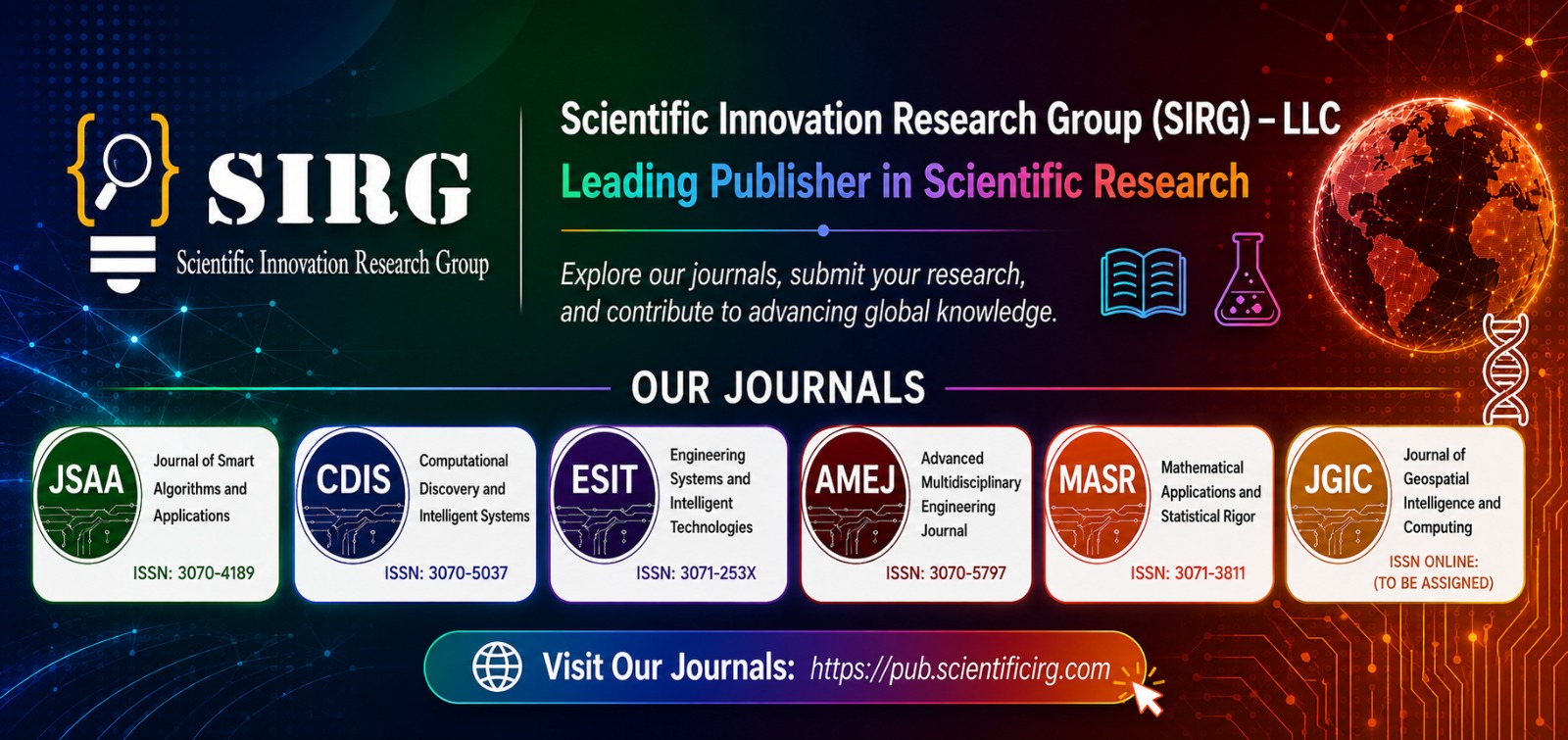
SIRG Journals
SIRG publishes and supports international peer-reviewed journals covering a diverse range of scientific and scholarly disciplines.
Areas represented within the SIRG publishing program include, but are not limited to:
-
Computer Science and Artificial Intelligence
-
Computational Discovery and Intelligent Systems
-
Smart Algorithms and Intelligent Applications
-
Data Science and Computational Intelligence
-
Engineering and Applied Sciences
-
Engineering Systems and Intelligent Technologies
-
Mathematics and Statistics
-
Geospatial Intelligence and Computing
-
Environmental and Sustainable Technologies
-
Tourism and Destination Innovation
-
Interdisciplinary and Emerging Research Fields
Each journal maintains its own:
-
Aims and Scope
-
Editorial Board
-
Author Guidelines
-
Peer-Review Policy
-
Publication Ethics
-
Open Access Policy
-
Copyright and Licensing Policy
-
Research and Data Policies
-
Journal-specific editorial procedures
These journal-specific policies operate within the broader publishing and ethical framework established by SIRG.
Supporting the Research Community
SIRG seeks to support researchers and the wider academic community through professional scholarly publishing services and infrastructure.
Our publishing activities may include:
-
Online journal publishing
-
Editorial and peer-review management
-
Digital article production
-
DOI and scholarly metadata support
-
Author and reviewer support
-
Research dissemination
-
Academic publishing services
-
Scholarly books and edited volumes
-
Special issues and related scholarly publishing initiatives
-
Conferences, workshops, seminars, and academic events
All publishing activities are subject to appropriate editorial, academic, ethical, and quality-control procedures.
Our Commitment to Responsible Publishing
SIRG recognizes that trust in scholarly publishing is built through consistent and transparent practice.
We therefore remain committed to:
Integrity
Promoting honesty, accuracy, and responsible conduct throughout the research and publication process.
Transparency
Providing clear and publicly accessible information about publishing policies and procedures.
Editorial Independence
Respecting the academic independence and decision-making responsibilities of journal editors.
Quality
Supporting rigorous editorial assessment and independent peer review.
Accessibility
Supporting broad access to scholarly knowledge through appropriate Open Access publishing models.
Accountability
Taking legitimate concerns regarding research and publication integrity seriously.
Fairness
Treating authors, reviewers, editors, and readers fairly and professionally.
Scholarly Responsibility
Maintaining the accuracy, reliability, and integrity of the published scholarly record.
International Collaboration
Welcoming researchers, reviewers, editors, and academic institutions from around the world.
Organizational Information
Scientific Innovation Research Group (SIRG) LLC
Jurisdiction: Michigan, United States
Registered Office:
2222 W. Grand River Ave, Suite A
Okemos, Michigan 48864
United States
SIRG conducts its academic publishing activities through its dedicated publishing platform and editorial infrastructure.
Contact SIRG Publisher
For general publishing and editorial inquiries:
Editorial Office
editorialoffice@pub.scientificirg.com
General Editorial Inquiries
editorial@pub.scientificirg.com
Technical Support
technical.support@scientificirg.com
Production
production@pub.scientificirg.com
For journal-specific matters, authors, reviewers, and readers should use the contact information provided on the relevant journal website.
Our Commitment
Scientific Innovation Research Group (SIRG) LLC is committed to developing a responsible, transparent, accessible, and sustainable academic publishing environment in which research quality, ethical conduct, editorial independence, rigorous peer review, transparency, and integrity of the scholarly record remain central to everything we publish.
Scientific Innovation Research Group (SIRG) LLC
Supporting Responsible Research. Advancing Scholarly Communication.