
Likelihood and Bayesian Inference for Exponentiated Lomax Stress-Strength Reliability Under Progressive Type-II Censoring with Binomial Removals
DOI:
https://doi.org/10.66279/w4a1dr28Keywords:
Likelihood, Bayesian Inference, Exponentiated Lomax, Binomial Removals, Metropolis-Hastings AlgorithmAbstract
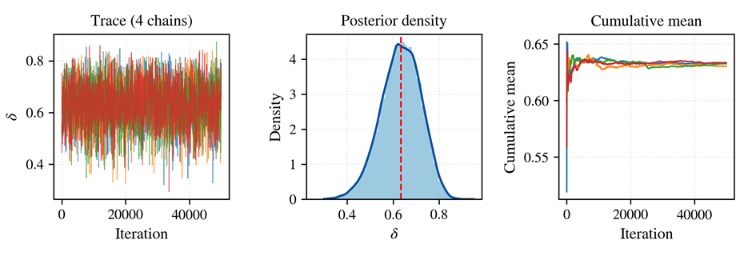
This paper develops frequentist and Bayesian inference for the stress–strength (SS) reliability δ = P(W < V), where the strength V and the stress W are independent Exponentiated Lomax (EL) random variables with common shape and scale parameters (β, θ) but distinct exponentiation parameters α₁ and α₂. The lifetime data are progressively Type-II censored (PT-IIC) with binomial removals. It is shown that δ = α₁/(α₁ + α₂). Maximum likelihood estimators (MLEs) of the model parameters and of δ are derived from the analytic score equations, closed-form estimators of the removal probabilities are obtained, and asymptotic confidence intervals are constructed by the delta method. Bayes estimators of δ are developed under the squared error and linear-exponential (LINEX) loss functions, using informative and non-informative gamma priors and a Metropolis–Hastings sampler. In a Monte Carlo study of 128 scenarios with 300 replications each, the root mean squared errors (RMSEs) of all estimators decrease as the sample size n and the number of observed failures m increase. Bayes estimators with informative priors elicited from pilot samples attain the smallest RMSE in all 128 scenarios (average 0.040 versus 0.052 for the MLE), whereas Bayes estimators with non-informative priors perform similarly to the MLE (average RMSE 0.051). Because the informative priors are built from samples generated under the true parameter values, the resulting advantage is an optimistic upper bound on the benefit of reliable prior information. The methods are illustrated with two classical data sets of insulating-fluid breakdown times at 34 kV and 36 kV. From PT-IIC samples with m = 10 per data set, the MLE of δ is 0.644 (95% asymptotic interval 0.462 to 0.792) and the Bayes estimate under squared error loss is 0.632.Downloads
References
[1] S. Kotz, Y. Lumelskii, and M. Pensky, The Stress-Strength Model and Its Generalizations: Theory and Applications. River Edge, NJ: World Scientific, 2003.
[2] A. M. Awad and M. K. Gharraf, “Estimation of P(Y < X) in the Burr case: A comparative study,” Communications in Statistics- Simulation and Computation, vol. 15, no. 2, pp. 389–403, 1986.
[3] D. Kundu and R. D. Gupta, “Estimation of P[Y < X] for generalized exponential distribution,” Metrika, vol. 61, no. 3, pp. 291–308, 2005.
[4] S. Rezaei, R. Tahmasbi, and M. Mahmoodi, “Estimation of P[Y < X] for generalized Pareto distribution,” Journal of Statistical Planning and Inference, vol. 140, no. 2, pp. 480–494, 2010.
[5] A. Asgharzadeh, R. Valiollahi, and M. Z. Raqab, “Stress-strength reliability of weibull distribution based on progressively censored samples,” SORT: Statistics and Operations Research Transactions, vol. 35, no. 2, pp. 103–124, 2011.
[6] B. Saraçoğlu, İ. Kınacı, and D. Kundu, “On estimation of R = P(Y < X) for exponential distribution under progressive Type-II censoring,” Journal of Statistical Computation and Simulation, vol. 82, pp. 729–744, 5 2012.
[7] A. S. Yadav, S. K. Singh, and U. Singh, “Estimation of stress–strength reliability for inverse weibull distribution under progressive type-ii censoring scheme,” Journal of Industrial and Production Engineering, vol. 35, no. 1, pp. 48–55, 2018.
[8] S. Shoaee and E. Khorram, “Stress-strength reliability of a two-parameter bathtub-shaped lifetime distribution based on progressively censored samples,” Communications in Statistics - Theory and Methods, vol. 44, no. 24, pp. 5306–5328, 2015.
[9] M. M. Yousef, A. S. Hassan, H. M. Alshanbari, A.-A. H. El-Bagoury, and E. M. Almetwally, “Bayesian and non-bayesian analysis of exponentiated exponential stress–strength model based on generalized progressive hybrid censoring process,” Axioms, vol. 11, no. 9, 2022.
[10] R. de la Cruz, H. S. Salinas, and C. Meza, “Reliability estimation for stress-strength model based on unit-half-normal distribution,” Symmetry, vol. 14, no. 4, 2022.
[11] N. Alsadat, A. S. Hassan, M. Elgarhy, C. Chesneau, and R. E. Mohamed, “An efficient stress–strength reliability estimate of the unit gompertz distribution using ranked set sampling,” Symmetry, vol. 15, no. 5, 2023.
[12] A. S. Hassan, I. M. Almanjahie, A. I. Al-Omari, L. Alzoubi, and H. F. Nagy, “Stress–strength modeling using median-ranked set sampling: Estimation, simulation, and application,” Mathematics, vol. 11, no. 2, 2023.
[13] N. Salah Youssef Temraz, “Inference on the stress strength reliability with exponentiated generalized marshall olkin-g distribution,” PLOS ONE, vol. 18, p. e0280183, 8 2023.
[14] I. Kumar, K. Kumar, and I. Ghosh, “Reliability estimation in inverse pareto distribution using progressively first failure censored data,” American Journal of Mathematical and Management Sciences, vol. 42, no. 2, pp. 126–147, 2023.
[15] N. A. Mokhlis, S. K. Khames, and S. W. Sadk, “Estimation of stress-strength reliability for marshall-olkin extended weibull family based on type-ii progressive censoring,” Journal of Statistics Applications & Probability, vol. 10, no. 2, pp. 385–396, 2021.
[16] I. Kamel, T. Anwar, and A. Najim, “Different estimation methods of reliability in stress-strength model under chen distribution,” in AIP Conference Proceedings, vol. 2591, p. 050023, AIP Publishing, Mar. 2023.
[17] A. S. Hassan, E. Elsherpieny, and W. Aghel, “Statistical inference of the burr type iii distribution under joint progressively type-ii censoring,” Scientific African, vol. 21, p. e01770, 2023.
[18] N. Balakrishnan and R. Aggarwala, Progressive Censoring: Theory, Methods, and Applications. Boston, MA: Birkhäuser, 2000.
[19] N. Balakrishnan, “Progressive censoring methodology: an appraisal,” Test, vol. 16, no. 2, pp. 211–259, 2007.
[20] H.-K. Yuen and S.-K. Tse, “Parameters estimation for weibull distributed lifetimes under progressive censoring with random removals,” Journal of Statistical Computation and Simulation, vol. 55, no. 1-2, pp. 57–71, 1996.
[21] Z. H. Amin, “Bayesian inference for the pareto lifetime model under progressive censoring with binomial removals,” Journal of Applied Statistics, vol. 35, no. 11, pp. 1203–1217, 2008.
[22] I. B. Abdul-Moniem and H. F. Abdel-Hameed, “On exponentiated lomax distribution,” International Journal of Mathematical Archive, vol. 3, no. 5, pp. 2144–2150, 2012.
[23] A. S. Hassan and A. S. Al-Ghamdi, “Optimum step stress accelerated life testing for lomax distribution,” Journal of Applied Sciences Research, vol. 5, no. 12, pp. 2153–2164, 2009.
[24] A. J. Lemonte and G. M. Cordeiro, “An extended lomax distribution,” Statistics, vol. 47, no. 4, pp. 800–816, 2013.
[25] A. H. El-Bassiouny, N. F. Abdo, and H. S. Shahen, “Exponential lomax distribution,” International Journal of Computer Applications, vol. 121, no. 13, pp. 24–29, 2015.
[26] G. M. Cordeiro, E. M. Ortega, and B. V. Popović, “The gamma-lomax distribution,” Journal of Statistical Computation and Simulation, vol. 85, no. 2, pp. 305–319, 2015.
[27] I. Elbatal, A. S. Hassan, L. S. Diab, A. Ben Ghorbal, M. Elgarhy, and A. R. El-Saeed, “Stress–strength reliability analysis for different distributions using progressive type-ii censoring with binomial removal,” Axioms, vol. 12, no. 11, 2023.
[28] S. Dey and T. Dey, “Statistical inference for the rayleigh distribution under progressively type-ii censoring with binomial removal,” Applied Mathematical Modelling, vol. 38, no. 3, pp. 974–982, 2014.
[29] S. K. Tse, C. Yang, and H.-K. Yuen, “Statistical analysis of weibull distributed lifetime data under type ii progressive censoring with binomial removals,” Journal of Applied Statistics, vol. 27, no. 8, pp. 1033–1043, 2000.
[30] S.-J. Wu, Y.-J. Chen, and C.-T. Chang, “Statistical inference based on progressively censored samples with random removals from the burr type xii distribution,” Journal of Statistical Computation and Simulation, vol. 77, no. 1, pp. 19–27, 2007.
[31] W. Yan, Y. Shi, B. Song, and Z. Mao, “Statistical analysis of generalized exponential distribution under progressive censoring with binomial removals,” Journal of Systems Engineering and Electronics, vol. 22, no. 4, pp. 707–714, 2011.
[32] A. Zellner, “Bayesian estimation and prediction using asymmetric loss functions,” Journal of the American Statistical Association, vol. 81, no. 394, pp. 446–451, 1986.
[33] W. K. Hastings, “Monte carlo sampling methods using Markov chains and their applications,” Biometrika, vol. 57, no. 1, pp. 97–109, 1970.
[34] M.-H. Chen and Q.-M. Shao, “Monte carlo estimation of bayesian credible and hpd intervals,” Journal of Computational and Graphical Statistics, vol. 8, no. 1, pp. 69–92, 1999.
[35] N. Balakrishnan and R. A. Sandhu, “A simple simulational algorithm for generating progressive type-ii censored samples,” The American Statistician, vol. 49, no. 2, pp. 229–230, 1995.
[36] W. B. Nelson, Applied Life Data Analysis. New York, NY, USA: John Wiley & Sons, 1982.
[37] H. Akaike, “A new look at the statistical model identification,” IEEE Transactions on Automatic Control, vol. 19, no. 6, pp. 716–723, 1974.
[38] G. Schwarz, “Estimating the dimension of a model,” The Annals of Statistics, vol. 6, no. 2, pp. 461–464, 1978.
[39] A. Gelman and D. B. Rubin, “Inference from iterative simulation using multiple sequences,” Statistical Science, vol. 7, no. 4, pp. 457 472, 1992.
Downloads
Published
Issue
Section
Categories
License
Copyright (c) 2026 The Authors

This work is licensed under a Creative Commons Attribution 4.0 International License.
Mathematical Applications and Statistical Rigor (MASR) seeks to publish the most influential papers that will significantly advance scientific understanding. Selected articles must present new and widely significant data, syntheses, or concepts. They should merit recognition by the wider scientific community and the general public through publication in a reputable scientific journal.
Mathematical Applications and Statistical Rigor (MASR) content is published under a Creative Commons Attribution License (CC BY). This means that content is freely available to all readers upon publication, and content is published as soon as production is complete.
SIRG Publisher