
Dynamical Characteristics and Approximate Technique to Solve the Model of Nonlinear Biological Reactions
DOI:
https://doi.org/10.66279/ewystw03Keywords:
Michaelis–Menten Kinetics, Elzaki transform, Existence and Uniqueness, positivity, Runge–Kutta methodAbstract
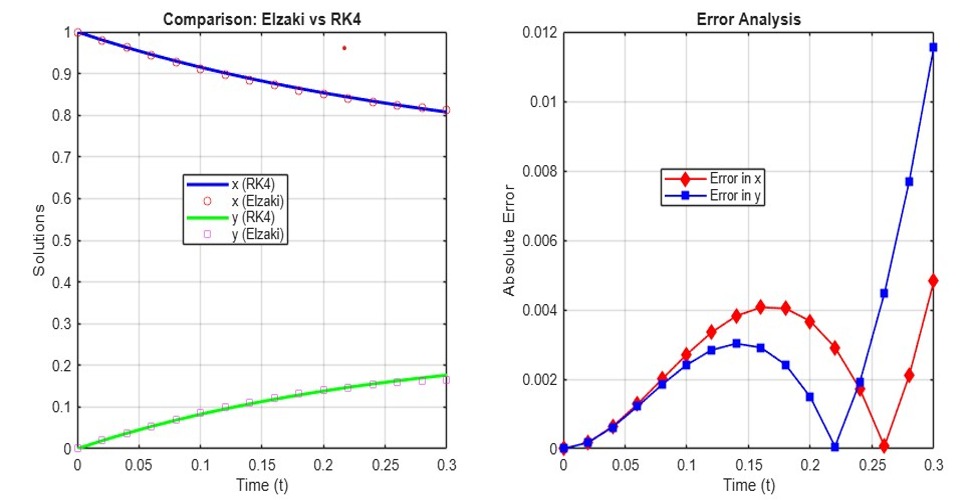
In this paper, we present a rigorous mathematical analysis of the nonlinear Michaelis-Menten biochemical reaction model, formulated as a system of non-dimensional coupled nonlinear ordinary differential equations (ODEs). Using the classical theory of ordinary differential equations, comparison principles, and Lyapunov's direct method, fundamental qualitative properties of the model, such as existence, uniqueness, non-negativity, boundedness, and local and global asymptotic stability of solutions, are established. The Elzaki Transform Homotopy Perturbation Method (ETHPM) is used to obtain an accurate approximate analytical solution, and its accuracy is studied by direct comparison with the fourth-order Runge-Kutta (RK4) method and error analysis. Numerical simulations confirm the temporal dynamics of biochemical systems and validate the efficiency and accuracy of the proposed semi-analytical approach. The results indicate that the Elzaki transform decomposition framework provides a computationally efficient, linearization-free, and highly accurate tool for analyzing nonlinear biochemical reaction models with wider applicability to a broad class of nonlinear problems arising in mathematical biology and applied science.
Downloads
References
[1] P. A. Lindahl, J. R. Walton, P. A. Lindahl, and J. R. Walton, “A kinetic mathematical model of comprehensive iron metabolism in a respiring yeast cell: a basic-pathways approach to solving a large system dynamically,” BioMetals 2025 39:1, vol. 39, no. 1, pp. 231–257, Dec. 2025, doi: 10.1007/S10534-025-00758-7. DOI: https://doi.org/10.1007/s10534-025-00758-7
[2] S. Schnell and C. Mendoza, “Closed Form Solution for Time-dependent Enzyme Kinetics,” J. Theor. Biol., vol. 187, no. 2, pp. 207–212, Jul. 1997, doi: 10.1006/JTBI.1997.0425. DOI: https://doi.org/10.1006/jtbi.1997.0425
[3] K. Srivastava, J. Eilertsen, V. Booth, and S. Schnell, “Accuracy Versus Predominance: Reassessing the Validity of the Quasi-Steady-State Approximation,” Bulletin of Mathematical Biology 2025 87:6, vol. 87, no. 6, pp. 73-, May 2025, doi: 10.1007/S11538-025-01451-Z. DOI: https://doi.org/10.1007/s11538-025-01451-z
[4] K. Srivastava, “Analytical and Computational Approaches to Nonlinear Dynamics in Enzyme Kinetics and Sleep-Wake Regulation,” 2025, doi: 10.7302/26937.
[5] G. T. Horowitz and J. E. Santos, “Smooth extremal horizons are the exception, not the rule,” Journal of High Energy Physics 2025 2025:2, vol. 2025, no. 2, pp. 169-, Feb. 2025, doi: 10.1007/JHEP02(2025)169. DOI: https://doi.org/10.1007/JHEP02(2025)169
[6] A. K. Sen, “An application of the Adomian decomposition method to the transient behavior of a model biochemical reaction,” J. Math. Anal. Appl., vol. 131, no. 1, pp. 232–245, Apr. 1988, doi: 10.1016/0022-247X(88)90202-8. DOI: https://doi.org/10.1016/0022-247X(88)90202-8
[7] “On the numerical solutions to nonlinear biochemical reaction model using picard-padé technique | Request PDF.” Accessed: Jun. 28, 2026. [Online]. Available: https://www.researchgate.net/publication/285983846_On_the_numerical_solutions_to_nonlinear_biochemical_reaction_model_using_picard-pade_technique
[8] X. Feng, M. P. Laiu, and T. Strohmer, “Convergence Analysis of the Alternating Anderson–Picard Method for Nonlinear Fixed-Point Problems,” https://doi.org/10.1137/24M1676922, pp. S436–S461, Oct. 2025, doi: 10.1137/24M1676922. DOI: https://doi.org/10.1137/24M1676922
[9] G. Kerr, N. Lopez, and G. González-Parra, “Analytical Solutions of Systems of Linear Delay Differential Equations by the Laplace Transform: Featuring Limit Cycles,” Mathematical and Computational Applications 2024, Vol. 29, Page 11, vol. 29, no. 1, p. 11, Feb. 2024, doi: 10.3390/MCA29010011. DOI: https://doi.org/10.3390/mca29010011
[10] N. Sharif, M. S. Alam, and H. U. Molla, “Dynamics of nonlinear pendulum equations: Modified homotopy perturbation method,” Journal of Low Frequency Noise Vibration and Active Control, vol. 44, no. 3, pp. 1460–1473, Sep. 2025, doi: 10.1177/14613484251320219;CTYPE:STRING:JOURNAL. DOI: https://doi.org/10.1177/14613484251320219
[11] T. A. Khalid, “Application of Elzaki Transform Decomposition Method in Solving Time-Fractional Sawada Kotera Ito Equation.,” Malaysian Journal of Mathematical Sciences, vol. 19, no. 2, p. 691, Jun. 2025, doi: 10.47836/MJMS.19.2.17. DOI: https://doi.org/10.47836/mjms.19.2.17
[12] N. S. Punekar, “Henri–Michaelis–Menten Equation,” ENZYMES: Catalysis, Kinetics and Mechanisms, pp. 151–173, 2025, doi: 10.1007/978-981-97-8179-9_14. DOI: https://doi.org/10.1007/978-981-97-8179-9_14
[13] M. Du, Y. Chen, Z. Wang, L. Nie, and D. Zhang, “Large language models for automatic equation discovery of nonlinear dynamics,” Physics of Fluids, vol. 36, no. 9, Sep. 2024, doi: 10.1063/5.0224297/3312108. DOI: https://doi.org/10.1063/5.0224297
[14] R. Rajaraman, “Beyond conventional models: integer and fractional order analysis of nonlinear Michaelis-Menten kinetics in immobilised enzyme reactors,” Eng. Comput. (Swansea)., vol. 41, no. 8–9, pp. 1987–2025, Oct. 2024, doi: 10.1108/EC-03-2024-0238. DOI: https://doi.org/10.1108/EC-03-2024-0238
[15] M. Bigdeli, V. Marrocco, F. G. Modica, and I. Fassi, “Advancements and challenges in modelling and simulations of micro-electrical discharge machining (micro EDM): a review,” The International Journal of Advanced Manufacturing Technology 2026, pp. 1–36, Jun. 2026, doi: 10.1007/S00170-026-18398-7. DOI: https://doi.org/10.1007/s00170-026-18398-7
[16] M. Bhargava, A. Shankar, and X. Wang, “Squarefree values of polynomial discriminants II,” Forum of Mathematics, Pi, vol. 13, p. e17, May 2025, doi: 10.1017/FMP.2025.9. DOI: https://doi.org/10.1017/fmp.2025.9
[17] Y. Nawaz, A. H. Majeed, M. Bin-Asfour, and H. A. E. W. Khalifa, “Stability and convergence analysis for coupling of exponential integrator and Runge–Kutta method for eyring-powell fluid under unsteady Electro-Osmosis flow effects,” Ricerche di Matematica 2025 75:1, vol. 75, no. 1, pp. 337–359, Aug. 2025, doi: 10.1007/S11587-025-00991-9. DOI: https://doi.org/10.1007/s11587-025-00991-9
[18] C. Xu et al., “Mathematical analysis and dynamical transmission of SEIrIsR model with different infection stages by using fractional operator,” https://doi.org/10.1142/S1793524524501511, Mar. 2025, doi: 10.1142/S1793524524501511. DOI: https://doi.org/10.1142/S1793524524501511
[19] K. O. Idowu, A. Adedeji, A. C. Loyinmi, and G. Lin, “A Semi-Analytic Hybrid Approach for Solving the Buckmaster Equation: Application of the Elzaki Projected Differential Transform Method (EPDTM),” Engineering Reports, vol. 7, no. 3, p. e70044, Mar. 2025, doi: 10.1002/ENG2.70044;WGROUP:STRING:PUBLICATION. DOI: https://doi.org/10.1002/eng2.70044
Downloads
Published
Issue
Section
Categories
License
Copyright (c) 2026 Mathematical Applications and Statistical Rigor (MASR)

This work is licensed under a Creative Commons Attribution 4.0 International License.
Mathematical Applications and Statistical Rigor (MASR) seeks to publish the most influential papers that will significantly advance scientific understanding. Selected articles must present new and widely significant data, syntheses, or concepts. They should merit recognition by the wider scientific community and the general public through publication in a reputable scientific journal.
Mathematical Applications and Statistical Rigor (MASR) content is published under a Creative Commons Attribution License (CC BY). This means that content is freely available to all readers upon publication, and content is published as soon as production is complete.
SIRG Publisher