For Reviewers
If you are interested in serving as a peer-reviewer/referee for Mathematical Applications and Statistical Rigor (MASR) , please contact our Editor-in-Chief at manager@pub.scientificirg.com , with your full contact information, your area of expertise and a list of your recent publications.
If you are selected to be a reviewer/referee, your name will be included in our list of potential referees. When a manuscript submitted to (MASR) matches your interests, one of our editors will contact you with the paper. Please respond promptly to the Editor's message asking whether you are willing to referee the paper. If you have other commitments and cannot referee the paper in six (6) weeks, let him or her know immediately so that another referee can be chosen. If you can referee the paper, please confirm.
We would like to express our sincere thanks to our peer reviewers who helped to ensure the high standards of the Mathematical Applications and Statistical Rigor (MASR). The informed opinions of referees, relayed in a timely manner, are critical to our editorial process.
Review Steps
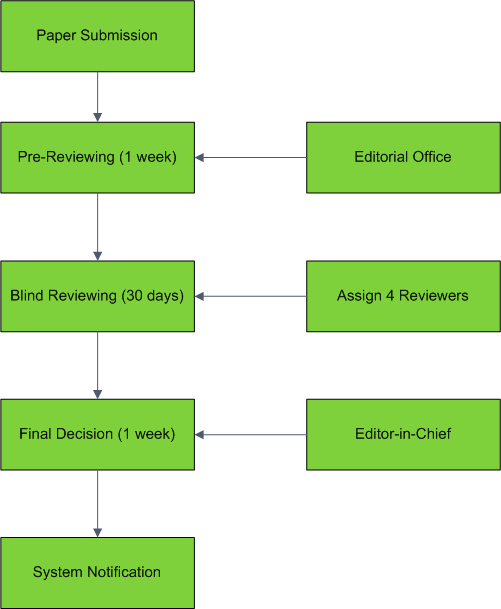
All manuscripts will be assigned to more than one reviewer through 5 steps. As soon as we receive an article, the Editorial Office will pre-review your manuscript within one week. The officer will check whether the manuscript is valid, whether the language is fluent, and whether all necessary factors are included. The officer will also cross-check the article in crossref database in order to avoid plagiarism. The following is a formal review process accomplished by other official reviewers for one month. It is decided by the Editor-in-Chief within one week whether your manuscript is accepted or not. All submitted papers will be reviewed in about six weeks.
Type of Peer Review
This journal follows a blind reviewing process, where both the referee and author remain anonymous throughout the process.
Formal Conditions of Acceptance
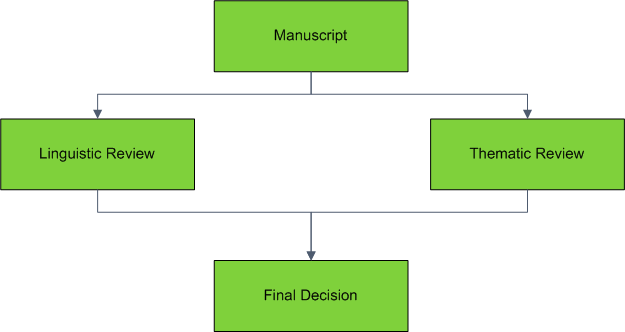
Each article submitted to us will be reviewed by at least 2 reviewers. Moreover, the papers will be checked for linguistic consistency. The thematic review will decide whether to accept or reject according to the originality, significance for theory and practice, quality of content, and presentation of the submitted paper.
Plagiarism Policy
The editorial board is participating in a growing community of Similarity Check Systems users in order to ensure that the content published is original and trustworthy. Similarity Check is a medium that allows for comprehensive manuscript screening, aimed at eliminating plagiarism and providing a high-standard and quality peer-review process.
Reviewer Policy on the Use of Artificial Intelligence (AI)
To maintain the integrity, confidentiality, and scientific rigor of the peer-review process, reviewers of journals published by Scientific International Research Group (SIRG) are not permitted to use generative Artificial Intelligence (AI) tools, including but not limited to large language models (LLMs), for generating, writing, or substantially assisting in the preparation of peer-review reports.
Reviewers are expected to conduct all evaluations independently based on their own scientific expertise, critical analysis, and professional judgment. The use of AI systems may pose risks related to manuscript confidentiality, intellectual property protection, data security, and the reliability of review recommendations.
Accordingly:
- Manuscripts, supplementary files, and any confidential review materials must not be uploaded, shared, or entered into any AI-powered platform or service.
- Peer-review reports must be written solely by the assigned reviewer.
- Editorial decisions must be based on the reviewer's independent scholarly assessment.
- Any potential conflict regarding the use of AI tools during the review process should be disclosed to the journal editor immediately.
SIRG journals are committed to ensuring that peer review remains a confidential, ethical, transparent, and expert-driven process that upholds the highest standards of scholarly publishing.