
Classical and Bayesian Inference for Stress-Strength Reliabilityof Shifted Geometric Lifetimes under Unified Hybrid Censoring
DOI:
https://doi.org/10.66279/6248yr43Keywords:
Bayesian Inference, Shifted Geometric Lifetimes, Hybrid Censoring, Maximum Likelihood Estimation, Jeffreys PriorAbstract
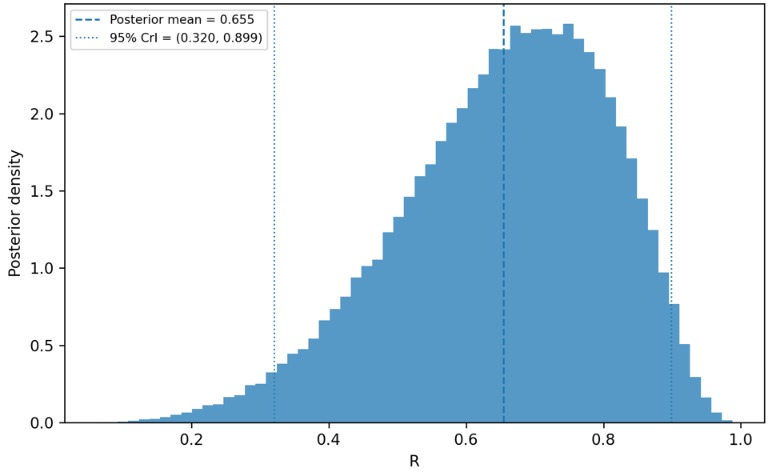
Stress-strength reliability inference is developed for independent shifted geometric strength and stress lifetimes observed under unified hybrid censoring schemes (UHCSs). The reliability R=P(X > Y) is appropriate for experiments in which lifetime is recorded as a number of operating cycles, inspections, or trials. Under the UHCS the likelihood reduces to a kernel in the number of observed failures and the total discrete exposure, which yields closed-form maximum likelihood estimators of the geometric parameters and, by invariance, of ????. Wald and delta-method intervals are derived from the observed Fisher information, a conservative conditional beta interval is obtained from beta tails with a Bonferroni adjustment, and an exact procedure based on inversion of the UHCS sampling distribution is outlined. Bayesian inference under the Jeffreys prior of the shifted geometric model and under the uniform prior leads to beta posteriors for the parameters and to Monte Carlo evaluation of the posterior of R. A parametric bootstrap percentile interval is also considered. A pilot Monte Carlo study with PX=0.05, PY =0.10, , and sample sizes between 250 and 600 compares bias, mean squared error, coverage probability, and average interval length. The maximum likelihood and Jeffreys estimators are nearly indistinguishable, and the uniform prior adds a small bias. The conditional beta interval attains coverage of at least 0.995 with intervals about 1.6 times longer, whereas the delta-method, Jeffreys credible, and bootstrap intervals have coverage within Monte Carlo error of 0.95. Accelerated capacitor lifetimes converted to inspection cycles illustrate the methods. The estimate of R remains between 0.656 and 0.677 as the cycle width varies from 1 to 200 hours, while the per-cycle parameters change by a factor of about 180.
Downloads
References
[1] S. Kotz, Y. Lumelskii, and M. Pensky, The Stress-Strength Model and Its Generalizations: Theory and Applications. Singapore: World Scientific, 2003. DOI: https://doi.org/10.1142/9789812564511
[2] M. O. Mohamed, “Inference for reliability and stress-strength for geometric distribution,” Sylwan, vol. 159, no. 2, pp. 281–289, 2015.
[3] M. K. Shakhatreh, “Bayesian inference on stress–strength reliability with geometric distributions,” Symmetry, vol. 17, no. 10, 2025. DOI: https://doi.org/10.3390/sym17101723
[4] M. Nadar and F. Kızılaslan, “Classical and Bayesian estimation of p(x < y) using upper record values from Kumaraswamy’s distribution,” Statistical Papers, vol. 55, no. 3, pp. 751–783, 2014. DOI: https://doi.org/10.1007/s00362-013-0526-x
[5] R. Kumari, K. K. Mahajan, and S. Arora, “Bayesian estimation of stress-strength reliability using upper record values from generalised inverted exponential distribution,” International Journal of Mathematical, Engineering and Management Sciences, vol. 4, no. 4, pp. 882–894, 2019. DOI: https://doi.org/10.33889/IJMEMS.2019.4.4-070
[6] Q. J. Azhad, M. Arshad, and N. Khandelwal, “Statistical inference of reliability in multicomponent stress strength model for Pareto distribution based on upper record values,” International Journal of Modelling and Simulation, vol. 42, no. 2, pp. 319–334, 2022. DOI: https://doi.org/10.1080/02286203.2021.1891496
[7] R. M. Juvairiyya and P. Anilkumar, “Estimation of stress-strength reliability for the Pareto distribution based on upper record values,” Statistica, vol. 78, no. 4, pp. 397–409, 2018.
[8] A. Pak, M. Raqab, M. R. Mahmoudi, S. S. Band, and A. Mosavi, “Estimation of stress-strength reliability r=p(x>y) based on weibull record data in the presence of inter-record times,” Alexandria Engineering Journal, vol. 61, no. 3, pp. 2130–2144, 2022. DOI: https://doi.org/10.1016/j.aej.2021.07.025
[9] M. O. Mohamed, “Reliability with stress-strength for Poisson-exponential distribution,” Journal of Computational and Theoretical Nanoscience, vol. 12, no. 11, pp. 4915–4919, 2015. DOI: https://doi.org/10.1166/jctn.2015.4459
[10] B. Elkalzah, M. O. Mohamed, K. Elsharkawy, E. S. Osman, A. Aldukeel, and G. A. Marei, “Classical and bayesian estimation of stress strength reliability under the discrete alpha-power weibull distribution with incomplete and record data: Application to high-voltage capacitors,” AIMS Mathematics, vol. 11, no. 3, pp. 6374–6399, 2026. DOI: https://doi.org/10.3934/math.2026263
[11] M. A. Elgawad, M. Alawady, H. Barakat, G. Mansour, I. Husseiny, S. A. Alyami, A. F. Hashem, and M. Mohamed, “Bivariate power lomax sarmanov distribution: Statistical properties, reliability measures, and parameter estimation,” Alexandria Engineering Journal, vol. 113, pp. 593–610, 2025. DOI: https://doi.org/10.1016/j.aej.2024.10.074
[12] J. F. Lawless, Statistical Models and Methods for Lifetime Data. John Wiley & Sons, 2 ed., 2003. DOI: https://doi.org/10.1002/9781118033005
[13] W. Q. Meeker and L. Escobar, Statistical Methods for Reliability Data. Wiley Series in Probability & Mathematical Statistics, Wiley, 1998.
[14] G. Casella and R. Berger, Statistical Inference. Duxbury advanced series in statistics and decision sciences, Thomson Learning, 2002.
[15] N. Balakrishnan, A. Rasouli, and N. Sanjari Farsipour, “Exact likelihood inference based on an unified hybrid censored sample from the exponential distribution,” Journal of Statistical Computation and Simulation, vol. 78, no. 5, pp. 475–488, 2008. DOI: https://doi.org/10.1080/00949650601158336
[16] W. Feller, An Introduction to Probability Theory and Its Applications. No. v. 1 in An Introduction to Probability Theory and Its Applications, Wiley, 1957. DOI: https://doi.org/10.1515/jbnst-1958-1700125
[17] N. Johnson, A. Kemp, and S. Kotz, Univariate Discrete Distributions. Wiley Series in Probability and Statistics, Wiley, 2005. DOI: https://doi.org/10.1002/0471715816
[18] M. O. Mohamed, “Estimation of R for geometric distribution under lower record values,” Journal of Applied Research and Technology, vol. 18, no. 6, pp. 368–375, 2020. DOI: https://doi.org/10.22201/icat.24486736e.2020.18.6.1354
[19] D. Kumar, “Explicit expressions and statistical inference of generalized Rayleigh distribution based on lower record values,” Mathematical Methods of Statistics, vol. 24, no. 3, pp. 225–241, 2015. DOI: https://doi.org/10.3103/S1066530715030035
[20] A. Pak and S. Dey, “Statistical inference for the power lindley model based on record values and inter-record times,” Journal of Computational and Applied Mathematics, vol. 347, pp. 156–172, 2019. DOI: https://doi.org/10.1016/j.cam.2018.08.012
[21] F. Louzada-Neto, V. G. Cancho, and G. D. C. Barriga, “The Poisson–exponential distribution: a Bayesian approach,” Journal of Applied Statistics, vol. 38, no. 6, pp. 1239–1248, 2011. DOI: https://doi.org/10.1080/02664763.2010.491862
[22] M. O. Mohamed, N. A. Hassan, and N. Abdelrahman, “Discrete alpha-power weibull distribution: Properties and application,” International Journal of Nonlinear Analysis and Applications, vol. 13, no. 2, pp. 1305–1317, 2022.
[23] T. M. Therneau, T. Lumley, E. Atkinson, and C. Crowson, “survival: Survival analysis,” 2008. R package version 2.34.
Downloads
Published
Issue
Section
Categories
License
Copyright (c) 2026 The Authors

This work is licensed under a Creative Commons Attribution 4.0 International License.
Mathematical Applications and Statistical Rigor (MASR) seeks to publish the most influential papers that will significantly advance scientific understanding. Selected articles must present new and widely significant data, syntheses, or concepts. They should merit recognition by the wider scientific community and the general public through publication in a reputable scientific journal.
Mathematical Applications and Statistical Rigor (MASR) content is published under a Creative Commons Attribution License (CC BY). This means that content is freely available to all readers upon publication, and content is published as soon as production is complete.
SIRG Publisher