
Chebyshev-Gauss Collocation with Exact Fractional Integration for Multiterm Variable-Order Fractional Differential Equations
DOI:
https://doi.org/10.66279/k9rg7z26Keywords:
Chebyshev-Gauss, Fractional Differential Equations, Chebyshev Polynomials, Spectral Methods, Error AnalysisAbstract
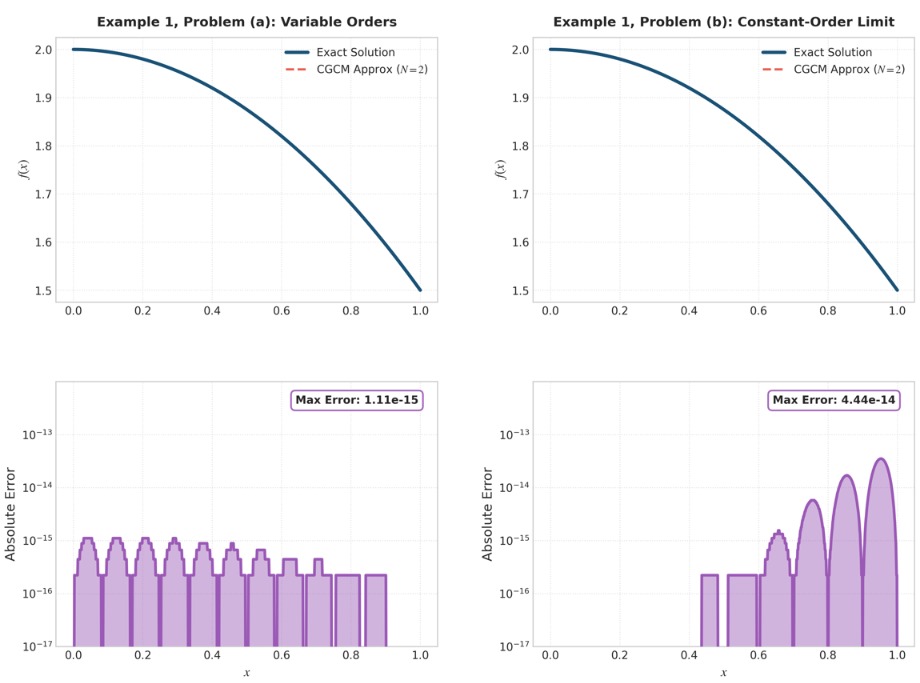
A collocation method is developed for multiterm variable-order fractional differential equations with Caputo derivatives. The highest integer-order derivative of the solution is expanded in shifted Chebyshev polynomials of the first kind, and the solution and all of its variable-order derivatives are recovered by exact integration of the monomial form of the basis. No operational matrix is formed, and the initial conditions hold by construction. Enforcing the equation at the Chebyshev-Gauss points yields a square algebraic system, which is linear for linear equations and is otherwise solved by Newton’s method. The variable-order integral operator is bounded on L²(0,1) with an explicit constant, and solutions that are polynomials of degree at most N + l are reproduced exactly, where N is the truncation degree, and l is the number of initial conditions. An error estimate of order N^(1/2-s) is derived in terms of the weighted Sobolev regularity s of the lth derivative; it is conditional on a discrete stability hypothesis that is stated but not proved. Six linear benchmark problems with polynomial solutions, including the Bagley-Torvik equation and a problem with the non-polynomial order α(x)=(x+2e^x)/7, are solved with at most four basis functions, with maximum errors from 5.55 × 10⁻¹⁷ to 4.44 × 10⁻¹⁴. These values are at the rounding level, verify the implementation, and are of the same order as published results for operational matrix and hybrid block-pulse schemes, so no accuracy advantage is claimed. Two further linear tests with non-polynomial solutions show exponential convergence for a smooth solution and an observed algebraic rate of about N^(-3.5) for a solution of limited regularity. The monomial representation restricts double-precision arithmetic to roughly N ≤ 24 and N ≤ 18 in these two tests, respectively. The nonlinear branch of the algorithm is not tested numerically.
Downloads
References
[1] Y. H. Youssri, W. M. Abd-Elhameed, A. S. Mohamed, and S. M. Sayed, “Generalized lucas polynomial sequence treatment of fractional pantograph differential equation,” International Journal of Applied and Computational Mathematics, vol. 7, no. 2, p. 27, 2021. DOI: https://doi.org/10.1007/s40819-021-00958-y
[2] Y. H. Youssri and W. M. Abd-Elhameed, “Legendre-spectral algorithms for solving some fractional differential equations,” in Fractional Order Analysis: Theory, Methods and Applications (H. Dutta, A. O. Akdemir, and A. Atangana, eds.), ch. 8, pp. 195–224, Hoboken, NJ: John Wiley & Sons, Ltd, 2020. DOI: https://doi.org/10.1002/9781119654223.ch8
[3] S. M. Sayed, A. S. Mohamed, E. M. Abo El-Dahab, and Y. H. Youssri, “Alleviated shifted gegenbauer spectral method for ordinary and fractional differential equations,” Contemporary Mathematics, vol. 5, no. 2, pp. 1344–1370, 2024. DOI: https://doi.org/10.37256/cm.5220244559
[4] S. M. Sayed, A. S. Mohamed, E. M. Abo-Eldahab, and Y. H. Youssri, “Legendre-galerkin spectral algorithm for fractional-order bvps: application to the bagley-torvik equation,” Mathematical Systems Science, vol. 2, no. 1, pp. 27–33, 2024. DOI: https://doi.org/10.54517/mss.v2i1.2733
[5] W. M. Abd-Elhameed, Y. H. Youssri, A. K. Amin, and A. G. Atta, “Eighth-kind chebyshev polynomials collocation algorithm for the nonlinear time-fractional generalized kawahara equation,” Fractal and Fractional, vol. 7, no. 9, 2023. DOI: https://doi.org/10.3390/fractalfract7090652
[6] S. G. Samko and B. Ross, “Integration and differentiation to a variable fractional order,” Integral Transforms and Special Functions, vol. 1, no. 4, pp. 277–300, 1993. DOI: https://doi.org/10.1080/10652469308819027
[7] C. F. M. Coimbra, “Mechanics with variable-order differential operators,” Annalen der Physik, vol. 12, no. 11–12, pp. 692–703, 2003. DOI: https://doi.org/10.1002/andp.200351511-1203
[8] G. Diaz and C. F. M. Coimbra, “Nonlinear dynamics and control of a variable order oscillator with application to the van der Pol equation,” Nonlinear Dynamics, vol. 56, no. 1–2, pp. 145–157, 2009. DOI: https://doi.org/10.1007/s11071-008-9385-8
[9] F. Wu, R. Gao, J. Liu, and C. Li, “New fractional variable-order creep model with short memory,” Applied Mathematics and Computation, vol. 380, p. 125278, 2020. DOI: https://doi.org/10.1016/j.amc.2020.125278
[10] P. Oziablo, D. Mozyrska, and M. Wyrwas, “Fractional-variable-order digital controller design tuned with the chaotic yellow saddle goatfish algorithm for the avr system,” ISA Transactions, vol. 125, pp. 260–267, 2022. DOI: https://doi.org/10.1016/j.isatra.2021.07.006
[11] Y.-M. Chen, Y.-Q. Wei, D.-Y. Liu, and H. Yu, “Numerical solution for a class of nonlinear variable order fractional differential equations with legendre wavelets,” Applied Mathematics Letters, vol. 46, pp. 83–88, 2015. DOI: https://doi.org/10.1016/j.aml.2015.02.010
[12] J. Liu, X. Li, and L. Wu, “An operational matrix of fractional differentiation of the second kind of Chebyshev polynomial for solving multiterm variable order fractional differential equation,” Mathematical Problems in Engineering, vol. 2016, no. 1, p. 7126080, 2016. DOI: https://doi.org/10.1155/2016/7126080
[13] A. M. Nagy, N. H. Sweilam, and A. A. El-Sayed, “New operational matrix for solving multiterm variable order fractional differential equations,” Journal of Computational and Nonlinear Dynamics, vol. 13, no. 1, p. 011001, 2018. DOI: https://doi.org/10.1115/1.4037922
[14] A. A. El-Sayed and P. Agarwal, “Numerical solution of multiterm variable-order fractional differential equations via shifted legendre polynomials,” Mathematical Methods in the Applied Sciences, vol. 42, no. 11, pp. 3978–3991, 2019. DOI: https://doi.org/10.1002/mma.5627
[15] K. Maleknejad, K. Nouri, and L. Torkzadeh, “Operational matrix of fractional integration based on the shifted second kind Chebyshev polynomials for solving fractional differential equations,” Mediterranean Journal of Mathematics, vol. 13, no. 3, pp. 1377–1390, 2016. DOI: https://doi.org/10.1007/s00009-015-0563-x
[16] O. Postavaru and A. Toma, “A numerical approach based on fractional-order hybrid functions of block-pulse and bernoulli polynomials for numerical solutions of fractional optimal control problems,” Mathematics and Computers in Simulation, vol. 194, pp. 269–284, 2022. DOI: https://doi.org/10.1016/j.matcom.2021.12.001
[17] O. Postavaru and A. Toma, “A fractional hybrid function composed of block-pulses and fractional fibonacci polynomials for solving multiterm fractional variable-order differential equations,” Computational and Applied Mathematics, vol. 44, no. 3, p. 151, 2025. DOI: https://doi.org/10.1007/s40314-025-03110-4
[18] S. Nemati, P. M. Lima, and D. F. M. Torres, “Numerical solution of variable-order fractional differential equations using bernoulli polynomials,” Fractal and Fractional, vol. 5, no. 4, p. 219, 2021. DOI: https://doi.org/10.3390/fractalfract5040219
[19] R. Almeida, D. Tavares, and D. F. M. Torres, The Variable-Order Fractional Calculus of Variations. Springer Briefs in Applied Sciences and Technology, Cham: Springer, 2019. DOI: https://doi.org/10.1007/978-3-319-94006-9
[20] C. Canuto, M. Y. Hussaini, A. Quarteroni, and T. A. Zang, Spectral Methods: Fundamentals in Single Domains. Scientific Computation, Berlin, Heidelberg: Springer, 2006. DOI: https://doi.org/10.1007/978-3-540-30726-6
[21] A. El-Mesiry, A. El-Sayed, and H. El-Saka, “Numerical methods for multi-term fractional (arbitrary) orders differential equations,” Applied Mathematics and Computation, vol. 160, no. 3, pp. 683–699, 2005. DOI: https://doi.org/10.1016/j.amc.2003.11.026
[22] S. Irandoust-Pakchin, H. Kheiri, and S. Abdi-Mazraeh, “Efficient computational algorithms for solving one class of fractional boundary value problems,” Computational Mathematics and Mathematical Physics, vol. 53, no. 7, pp. 920–932, 2013. DOI: https://doi.org/10.1134/S0965542513070117
Downloads
Published
Issue
Section
Categories
License
Copyright (c) 2026 The Authors

This work is licensed under a Creative Commons Attribution 4.0 International License.
Mathematical Applications and Statistical Rigor (MASR) seeks to publish the most influential papers that will significantly advance scientific understanding. Selected articles must present new and widely significant data, syntheses, or concepts. They should merit recognition by the wider scientific community and the general public through publication in a reputable scientific journal.
Mathematical Applications and Statistical Rigor (MASR) content is published under a Creative Commons Attribution License (CC BY). This means that content is freely available to all readers upon publication, and content is published as soon as production is complete.
SIRG Publisher