
An Intelligent Multi-Task Framework for Used Vehicle Valuation Marketability Classification and Budget-Aware Recommendation
DOI:
https://doi.org/10.66279/svgz0r91Keywords:
Multi-Task, Vehicle Valuation, Marketability Classification, Budget-Aware Recommendation, SMOTEAbstract
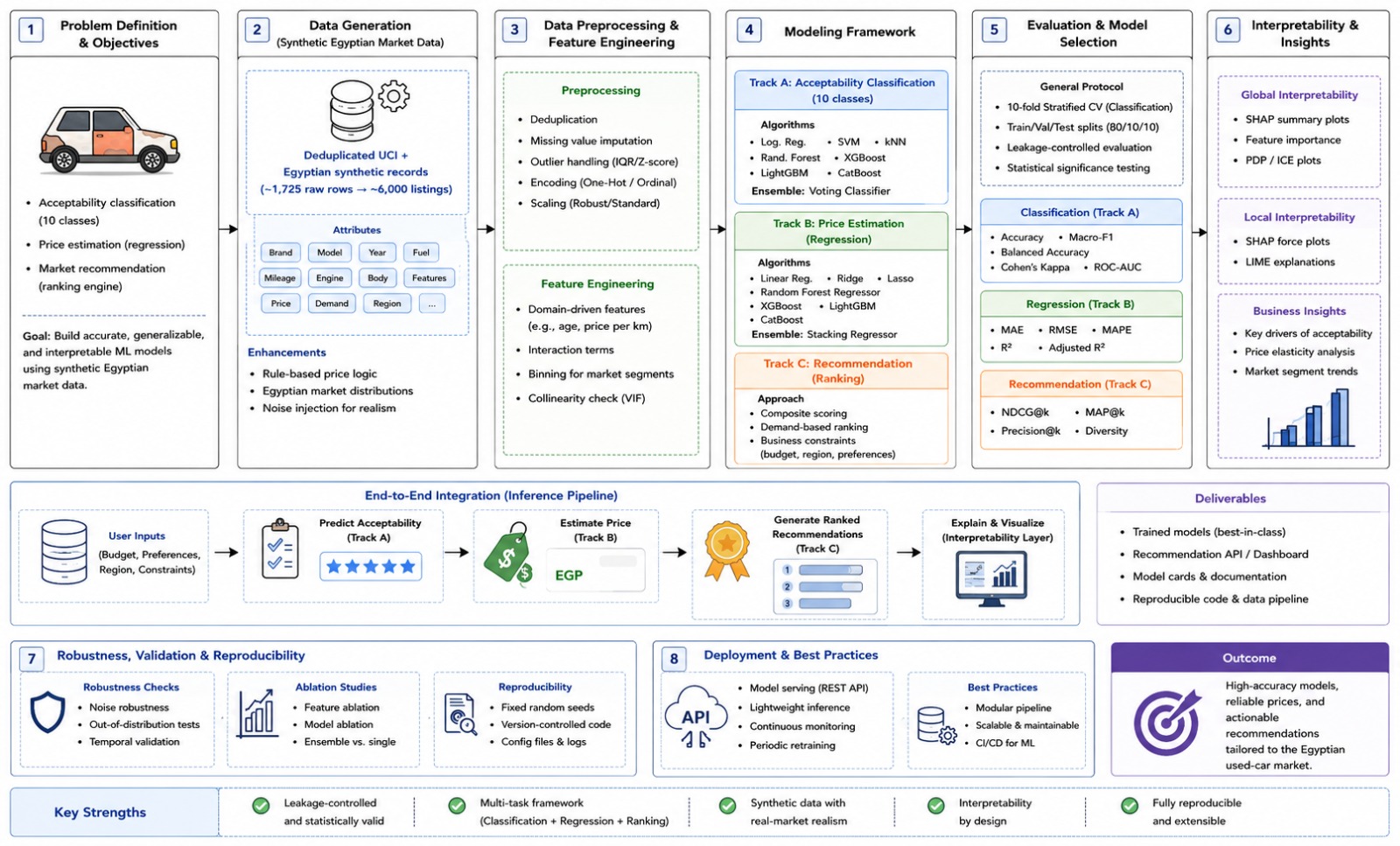
An intelligent decision support framework for used car evaluation, pricing, and recommendation is presented, integrating acceptability assessment, price estimation, marketability classification, and budget aware recommendation. The Car Evaluation benchmark is used for vehicle evaluation. After removing nineteen invalid marker rows from the 1,729 row source file, 1,710 valid, label consistent instances remain, with no duplicates, and preprocessing including SMOTE balancing is performed within training folds only. Ten classifiers are evaluated using stratified ten fold cross validation with grid search optimization and a soft voting ensemble, reaching a cross validated accuracy of 0.9985, with the leading tree based and boosting models statistically indistinguishable on the test set. A synthetic Egyptian used car dataset of 6,000 listings, generated from documented depreciation and pricing rules, supports the market oriented tasks. CatBoost gives the strongest price estimation performance, with an MAE of 44,768 EGP, a MAPE of 6.0 percent, and an ????2 of 0.986, significantly outperforming Random Forest. The marketability classifier reaches 0.605 accuracy across three demand classes, matching a logistic regression baseline given the deliberately noisy demand label. The recommendation engine, evaluated on 200 simulated buyer queries against a transparent ground truth, achieves a Precision at 5 of 0.88 and an NDCG at 10 of 0.82, measuring recovery of the generator’s hidden signals rather than validated real world quality, since the ground truth shares the engine’s utility formula. The results demonstrate feasibility for integrating predictive analytics, market assessment, and recommendation into a single framework, with real listing validation left for future work.
Downloads
References
[1] M. Bohanec and V. Rajkovic, “Knowledge acquisition and explanation for multi-attribute decision making,” in 8th intl workshop on expert systems and their applications, pp. 59–78, Avignon France, 1988.
[2] M. Bohanec and V. Rajkovic, “Expert system for decision making,” Sistemica, vol. 1, no. 1, pp. 145–157, 1990.
[3] M. Bohanec, “Car evaluation,” UCI Machine Learning Repository, vol. 10, p. C5JP48, 1997.
[4] T. Chen and C. Guestrin, “Xgboost: A scalable tree boosting system,” in Proceedings of the 22nd acm sigkdd international conference on knowledge discovery and data mining, pp. 785–794, 2016. DOI: https://doi.org/10.1145/2939672.2939785
[5] G. Ke, Q. Meng, T. Finley, T. Wang, W. Chen, W. Ma, Q. Ye, and T.-Y. Liu, “Lightgbm: A highly efficient gradient boosting decision tree,” Advances in neural information processing systems, vol. 30, 2017.
[6] L. Prokhorenkova, G. Gusev, A. Vorobev, A. V. Dorogush, and A. Gulin, “Catboost: unbiased boosting with categorical features,” Advances in neural information processing systems, vol. 31, 2018.
[7] L. Breiman, “Random forests,” Machine learning, vol. 45, no. 1, pp. 5–32, 2001. DOI: https://doi.org/10.1023/A:1010933404324
[8] C. Cortes and V. Vapnik, “Support-vector networks,” Machine learning, vol. 20, no. 3, pp. 273–297, 1995. DOI: https://doi.org/10.1023/A:1022627411411
[9] T. Cover and P. Hart, “Nearest neighbor pattern classification,” IEEE transactions on information theory, vol. 13, DOI: https://doi.org/10.1109/TIT.1967.1053964
no. 1, pp. 21–27, 1967. DOI: https://doi.org/10.2307/1086616
[10] J. H. Friedman, “Greedy function approximation: a gradient boosting machine,” The Annals of Statistics, vol. 29, no. 5, pp. 1189–1232, 2001. DOI: https://doi.org/10.1214/aos/1013203451
[11] J. Hao and T. K. Ho, “Machine learning made easy: a review of scikit-learn package in python programming language,” Journal of educational and behavioral statistics, vol. 44, no. 3, pp. 348–361, 2019. DOI: https://doi.org/10.3102/1076998619832248
[12] L. Grinsztajn, E. Oyallon, and G. Varoquaux, “Why do tree-based models still outperform deep learning on typical tabular data?,” Advances in neural information processing systems, vol. 35, pp. 507–520, 2022. DOI: https://doi.org/10.52202/068431-0037
[13] R. Shwartz-Ziv and A. Armon, “Tabular data: Deep learning is not all you need,” Information fusion, vol. 81, pp. 84–90, 2022. DOI: https://doi.org/10.1016/j.inffus.2021.11.011
[14] V. Borisov, T. Leemann, K. Seßler, J. Haug, M. Pawelczyk, and G. Kasneci, “Deep neural networks and tabular data: A survey,” IEEE transactions on neural networks and learning systems, vol. 35, no. 6, pp. 7499–7519, 2022. DOI: https://doi.org/10.1109/TNNLS.2022.3229161
[15] N. V. Chawla, K. W. Bowyer, L. O. Hall, and W. P. Kegelmeyer, “Smote: synthetic minority over-sampling technique,” Journal of artificial intelligence research, vol. 16, pp. 321–357, 2002. DOI: https://doi.org/10.1613/jair.953
[16] O. Farid, M. Melhi, and A. Somaie, “Optimizing yolov12-l for imbalanced satellite vehicle detection via physics-informed data synthesis and adaptive class aware loss weighting,” Journal of Smart Algorithms and Applications (JSAA), vol. 4, no. 1, pp. 1–21, 2026. DOI: https://doi.org/10.66279/mn2yev65
[17] S. M. Lundberg and S.-I. Lee, “A unified approach to interpreting model predictions,” Advances in neural information processing systems, vol. 30, 2017.
[18] S. M. Lundberg, G. Erion, H. Chen, A. DeGrave, J. M. Prutkin, B. Nair, R. Katz, J. Himmelfarb, N. Bansal, and S.-I. Lee, “From local explanations to global understanding with explainable ai for trees,” Nature machine intelligence, vol. 2, no. 1, pp. 56–67, 2020. DOI: https://doi.org/10.1038/s42256-019-0138-9
[19] A. B. Arrieta, N. Díaz-Rodríguez, J. Del Ser, A. Bennetot, S. Tabik, A. Barbado, S. García, S. Gil-López, D. Molina, R. Benjamins, et al., “Explainable artificial intelligence (xai): Concepts, taxonomies, opportunities and challenges toward responsible ai,” Information fusion, vol. 58, pp. 82–115, 2020. DOI: https://doi.org/10.1016/j.inffus.2019.12.012
[20] W. Saeed and C. Omlin, “Explainable ai (xai): A systematic meta-survey of current challenges and future opportunities,” Knowledge-based systems, vol. 263, p. 110273, 2023. DOI: https://doi.org/10.1016/j.knosys.2023.110273
[21] L. Longo, M. Brcic, F. Cabitza, J. Choi, R. Confalonieri, J. D. Ser, R. Guidotti, Y. Hayashi, F. Herrera, A. Holzinger, R. Jiang, H. Khosravi, F. Lecue, G. Malgieri, A. Páez, W. Samek, J. Schneider, T. Speith, and S. Stumpf, “Explainable artificial intelligence (xai) 2.0: A manifesto of open challenges and interdisciplinary research directions,” Information Fusion, vol. 106, p. 102301, 2024. DOI: https://doi.org/10.1016/j.inffus.2024.102301
[22] N. Pal, P. Arora, P. Kohli, D. Sundararaman, and S. S. Palakurthy, “How much is my car worth? a methodology for predicting used cars’ prices using random forest,” in Future of Information and Communication Conference, pp. 413–422, Springer, 2018. DOI: https://doi.org/10.1007/978-3-030-03402-3_28
[23] C. Selvarathi, G. Bhava Dharani, and R. Pavithra, “Survey on pre-owned car price prediction using random forest algorithm,” in International Conference on Information and Communication Technology for Intelligent Systems, pp. 177–189, Springer, 2023. DOI: https://doi.org/10.1007/978-981-99-3982-4_15
[24] D. A. Budiono, K. S. Utomo, K. J. Wibowo, and M. J. Wiradinata, “Used car price prediction model: a machine learning approach,” International Journal of Computer and Information System (IJCIS), vol. 5, no. 1, pp. 59–66, 2024. DOI: https://doi.org/10.29040/ijcis.v5i1.147
[25] P. Bhatnagar, G. H. Lokesh, J. Shreyas, F. Flammini, and S. Gautam, “An analysis of car price prediction using machine learning,” in Proceedings of the 2024 9th International Conference on Machine Learning Technologies, pp. 11–15, 2024. DOI: https://doi.org/10.1145/3674029.3674032
[26] M. Gollapalli, T. A. Alqahtani, D. H. Alhamed, M. R. Alnassar, A. M. Alajmi, Y. H. Alali, M. M. Abdulqader, and A. Saadeldeen, “Intelligent modelling techniques for predicting used cars prices in saudi arabia.,” Mathematical Modelling of Engineering Problems, vol. 10, no. 1, p. 139, 2023. DOI: https://doi.org/10.18280/mmep.100115
[27] T. Li, “Used car price prediction and feature importance analysis using xgboost and shap,” Highlights in Business, Economics and Management, vol. 65, pp. 460–465, 2025. DOI: https://doi.org/10.54097/kv2fnv60
[28] M. D. Ekstrand, A. Das, R. Burke, and F. Diaz, “Fairness in recommender systems,” in Recommender Systems Handbook (F. Ricci, L. Rokach, and B. Shapira, eds.), pp. 679–707, New York, NY, USA: Springer, 2022. DOI: https://doi.org/10.1007/978-1-0716-2197-4_18
[29] S. Zhang, L. Yao, A. Sun, and Y. Tay, “Deep learning based recommender system: A survey and new perspectives,” ACM computing surveys (CSUR), vol. 52, no. 1, pp. 1–38, 2019. DOI: https://doi.org/10.1145/3285029
[30] K. U. K. Reddy, K. L. Sai, and R. N. Rao, “Machine learning-powered car recommendation system: A content-based and collaborative approach,” in International Conference on Smart Computing and Communication, pp. 339–349, Springer, 2024. DOI: https://doi.org/10.1007/978-981-97-1326-4_28
[31] S. Raza, M. Rahman, S. Kamawal, A. Toroghi, A. Raval, F. Navah, and A. Kazemeini, “A comprehensive review of recommender systems: Transitioning from theory to practice,” Computer science review, vol. 59, p. 100849, 2026. DOI: https://doi.org/10.1016/j.cosrev.2025.100849
[32] D. Kreuzberger, N. Kühl, and S. Hirschl, “Machine learning operations (mlops): Overview, definition, and architecture,” IEEE access, vol. 11, pp. 31866–31879, 2023. DOI: https://doi.org/10.1109/ACCESS.2023.3262138
[33] A. Bodor, M. Hnida, and D. Najima, “From development to deployment: An approach to mlops monitoring for machine learning model operationalization,” in 2023 14th International Conference on Intelligent Systems: Theories and Applications (SITA), pp. 1–7, IEEE, 2023. DOI: https://doi.org/10.1109/SITA60746.2023.10373733
[34] L. E. Lwakatare, A. Raj, I. Crnkovic, J. Bosch, and H. H. Olsson, “Large-scale machine learning systems in real-world industrial settings: A review of challenges and solutions,” Information and software technology, vol. 127, p. 106368, 2020. DOI: https://doi.org/10.1016/j.infsof.2020.106368
[35] M. Kunath and H. Winkler, “Integrating the digital twin of the manufacturing system into a decision support system for improving the order management process,” Procedia Cirp, vol. 72, pp. 225–231, 2018. DOI: https://doi.org/10.1016/j.procir.2018.03.192
[36] B. Korth, C. Schwede, and M. Zajac, “Simulation-ready digital twin for realtime management of logistics systems,” in 2018, IEEE international conference on big data (big data), pp. 4194–4201, IEEE, 2018. DOI: https://doi.org/10.1109/BigData.2018.8622160
[37] S. Gautam, R. Noureddine, and W. D. Solvang, “Machine learning and iiot application for predictive maintenance,” in International Workshop of Advanced Manufacturing and Automation, pp. 257–265, Springer, 2022. DOI: https://doi.org/10.1007/978-981-19-9338-1_32
Downloads
Published
License
Copyright (c) 2026 Engineering Systems and Intelligent Technologies (ESIT)

This work is licensed under a Creative Commons Attribution 4.0 International License.
Engineering Systems and Intelligent Technologies (ESIT) seeks to publish the most influential papers that will significantly advance scientific understanding. Selected articles must present new and widely significant data, syntheses, or concepts. They should merit recognition by the wider scientific community and the general public through publication in a reputable scientific journal.
Engineering Systems and Intelligent Technologies (ESIT) content is published under a Creative Commons Attribution License (CC BY). This means that content is freely available to all readers upon publication, and content is published as soon as production is complete.
SIRG Publisher