
Robust LSTM-Based Channel State Estimation for Next-Generation Wireless Communication Systems
DOI:
https://doi.org/10.66279/jdgvdt83Keywords:
LSTM, Channel State Estimation, 5G Communication Systems, Gaussian Error Linear Unit, OFDMAbstract
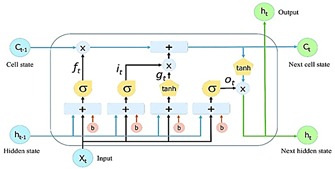
Long Short-Term Memory (LSTM) networks conventionally employ the hyperbolic tangent (tanh) and sigmoid functions for state and gate activations, respectively. Although numerous alternative activation functions have been introduced for deep neural networks, their potential to improve LSTM performance in wireless communication tasks remains insufficiently explored. This paper investigates the replacement of the tanh state activation function in LSTM architectures with three alternatives: the Bi-tanh1, the Elliott, and the Gaussian Error Linear Unit (GELU). The resulting modified LSTM networks are evaluated as channel state estimators (CSEs) for 5G Orthogonal Frequency-Division Multiplexing (OFDM) systems operating over Rayleigh fading channels. Simulation results demonstrate that all proposed activation-function-based LSTM CSEs substantially outperform conventional Least Squares (LS) and Minimum Mean Square Error (MMSE) estimators, particularly under low pilot-density conditions. Among the evaluated configurations, the GELU-based LSTM CSE achieves the lowest symbol error rate (SER) across all tested signal-to-noise ratios (SNRs), establishing GELU as a strong candidate for robust channel estimation in next-generation wireless receivers
Downloads
References
[1] S. Hochreiter and J. Schmidhuber, “Long short-term memory,” Neural computation, vol. 9, no. 8, pp. 1735–1780, 1997. DOI: https://doi.org/10.1162/neco.1997.9.8.1735
[2] H. A. Hassan, M. A. Mohamed, M. H. Essai, H. Esmaiel, A. S. Mubarak, and O. A. Omer, “Effective deep learning-based channel state estimation and signal detection for ofdm wireless systems,” Journal of Electrical Engineering, vol. 74, no. 3, pp. 167–176, 2023. DOI: https://doi.org/10.2478/jee-2023-0022
[3] S. R. Dubey, S. K. Singh, and B. B. Chaudhuri, “Activation functions in deep learning: A comprehensive survey and benchmark,” Neurocomputing, vol. 503, pp. 92–108, 2022. DOI: https://doi.org/10.1016/j.neucom.2022.06.111
[4] M. Basirat and P. M. Roth, “Learning task-specific activation functions using genetic programming.,” in VISIGRAPP (5: VISAPP), pp. 533–540, 2019. DOI: https://doi.org/10.5220/0007408200002108
[5] K. Vijayaprabakaran and K. Sathiyamurthy, “Towards activation function search for long short-term model network: A differential evolution based approach,” Journal of King Saud University-Computer and Information Sciences, vol. 34, no. 6, pp. 2637–2650, 2022. DOI: https://doi.org/10.1016/j.jksuci.2020.04.015
[6] D. Hendrycks and K. Gimpel, “Gaussian error linear units (gelus),” arXiv preprint arXiv:1606.08415, 2016.
[7] M. H. E. Ali and I. B. Taha, “Channel state information estimation for 5g wireless communication systems: recurrent neural networks approach,” PeerJ Computer Science, vol. 7, p. e682, 2021. DOI: https://doi.org/10.7717/peerj-cs.682
[8] A. Ly and Y.-D. Yao, “A review of deep learning in 5g research: Channel coding, massive mimo, multiple access, resource allocation, and network security,” IEEE Open Journal of the Communications Society, vol. 2, pp. 396–408, 2021. DOI: https://doi.org/10.1109/OJCOMS.2021.3058353
[9] H. A. Hassan, M. A. Mohamed, M. N. Shaaban, M. H. E. Ali, and O. A. Omer, “An efficient deep neural network channel state estimator for ofdm wireless systems,” Wireless Networks, vol. 30, no. 3, pp. 1441–1451, 2024. DOI: https://doi.org/10.1007/s11276-023-03585-1
[10] M. H. Essai Ali, A. R. Abdellah, H. A. Atallah, G. S. Ahmed, A. Muthanna, and A. Koucheryavy, “Deep learning peephole lstm neural network-based channel state estimators for ofdm 5g and beyond networks,” Mathematics, vol. 11, no. 15, p. 3386, 2023. DOI: https://doi.org/10.3390/math11153386
[11] S. J. Olickal and R. Jose, “Lstm projected layer neural network-based signal estimation and channel state estimator for ofdm wireless communication systems.,” AIMS Electronics & Electrical Engineering, vol. 7, no. 2, 2023. DOI: https://doi.org/10.3934/electreng.2023011
[12] M. H. E. Ali, A. B. Abdel-Raman, and E. A. Badry, “Developing novel activation functions based deep learning lstm for classification,” IEEE Access, vol. 10, pp. 97259–97275, 2022. DOI: https://doi.org/10.1109/ACCESS.2022.3205774
[13] J. Li, Z. Zhang, Y. Wang, B. He, W. Zheng, and M. Li, “Deep learning-assisted ofdm channel estimation and signal detection technology,” IEEE Communications Letters, vol. 27, no. 5, pp. 1347–1351, 2023. DOI: https://doi.org/10.1109/LCOMM.2023.3245807
[14] R. Shankar, “Bi-directional lstm based channel estimation in 5g massive mimo ofdm systems over tdl-c model with rayleigh fading distribution,” International Journal of Communication Systems, vol. 36, no. 16, p. e5585, 2023. DOI: https://doi.org/10.1002/dac.5585
[15] P. Ramachandran, B. Zoph, and Q. V. Le, “Searching for activation functions,” arXiv preprint arXiv:1710.05941, 2017.
[16] C. Luo, J. Ji, Q. Wang, X. Chen, and P. Li, “Channel state information prediction for 5g wireless communications: A deep learning approach,” IEEE transactions on network science and engineering, vol. 7, no. 1, pp. 227–236, 2018. DOI: https://doi.org/10.1109/TNSE.2018.2848960
[17] M. A. Mohamed, H. A. Hassan, M. H. Essai, H. Esmaiel, A. S. Mubarak, and O. A. Omer, “Modified gate activation functions of bi-lstm-based sc-fdma channel equalization,” Journal of Electrical Engineering, vol. 74, no. 4, pp. 256–266, 2023. DOI: https://doi.org/10.2478/jee-2023-0032
[18] S. S. Sodhi and P. Chandra, “Bi-modal derivative activation function for sigmoidal feedforward networks,” Neurocomputing, vol. 143, pp. 182–196, 2014. DOI: https://doi.org/10.1016/j.neucom.2014.06.007
[19] D. P. Kingma and J. Ba, “Adam: A method for stochastic optimization,” arXiv preprint arXiv:1412.6980, 2014.
Downloads
Published
Issue
Section
Categories
License
Copyright (c) 2026 Engineering Systems and Intelligent Technologies (ESIT)

This work is licensed under a Creative Commons Attribution 4.0 International License.
Engineering Systems and Intelligent Technologies (ESIT) seeks to publish the most influential papers that will significantly advance scientific understanding. Selected articles must present new and widely significant data, syntheses, or concepts. They should merit recognition by the wider scientific community and the general public through publication in a reputable scientific journal.
Engineering Systems and Intelligent Technologies (ESIT) content is published under a Creative Commons Attribution License (CC BY). This means that content is freely available to all readers upon publication, and content is published as soon as production is complete.
SIRG Publisher