
IoT-Enabled Smart Cities Architectures Connectivity Edge Computing Digital Twins and Security
DOI:
https://doi.org/10.66279/6z1mcx98Keywords:
Internet Of Things, Smart Cities, IoT Architectures, Edge Computing, Digital TwinsAbstract
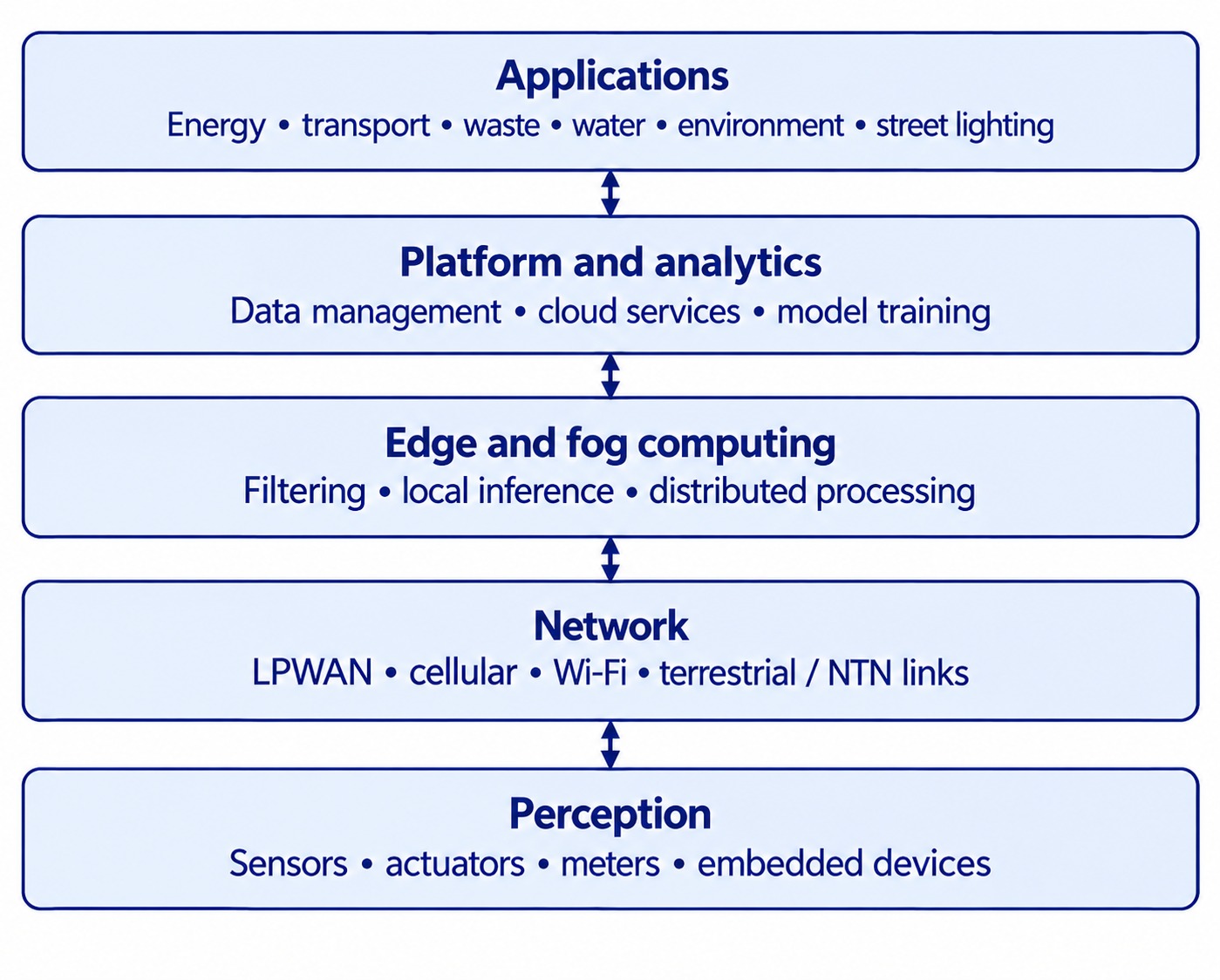
The Internet of Things (IoT) supports urban monitoring and service management by connecting sensors, actuators, communication networks, and computing platforms. This survey examines IoT-enabled smart cities across five themes: layered reference architectures; connectivity, including low-power wide-area networks (LPWAN), fifth-generation (5G) cellular networks, satellite links, and prospective sixth-generation (6G) technologies; edge and fog computing; digital twins; and security and privacy, with emphasis on blockchain based and federated approaches. Application domains in energy, transportation, waste, water, environmental monitoring, and street lighting are reviewed. The central contribution is a conceptual cross-layer decision framework that links service requirements to connectivity selection, computation placement, and digital twin configuration under security and governance constraints. A first-order model of offloading delay and device energy illustrates the computation placement trade-off. The reviewed studies show that no single connectivity technology satisfies all urban requirements; that a field pilot of 5G exhibited significant variation in network performance; that, in simulation, a low Earth orbit (LEO) narrowband IoT constellation of 60 satellites guaranteed a minimum link availability of about 30% of the simulated period; that city-scale digital twins have been applied most often to urban planning; that a blockchain ledger does not guarantee the truthfulness of recorded sensor data; and that learning-based defenses can be evaded. An evidence classification shows that the quantitative studies examined mostly report results from simulations, benchmark datasets, or single pilots, and not from operational city deployments. Persistent challenges include interoperability, energy efficiency, scalability, connectivity reliability, and data governance. Promising directions include hybrid terrestrial and satellite connectivity, adaptive edge and cloud processing, sensor-driven digital twins on standardized data models, privacy-preserving collaborative learning, and selectively applied distributed ledgers. The survey is non-exhaustive and follows no formal systematic protocol.
Downloads
References
[1] I. Rafiq, A. Mahmood, S. Razzaq, S. H. M. Jafri, and I. Aziz, “IoT applications and challenges in smart cities and services,” The Journal of Engineering, vol. 2023, no. 4, p. e12262, 2023.
[2] L. Atzori, A. Iera, and G. Morabito, “The internet of things: A survey,” Computer Networks, vol. 54, no. 15, pp. 2787–2805, 2010.
[3] A. Zanella, N. Bui, A. Castellani, L. Vangelista, and M. Zorzi, “Internet of things for smart cities,” IEEE Internet of Things Journal, vol. 1, no. 1, pp. 22–32, 2014.
[4] A. Al-Fuqaha, M. Guizani, M. Mohammadi, M. Aledhari, and M. Ayyash, “Internet of things: A survey on enabling technologies, protocols, and applications,” IEEE Communications Surveys & Tutorials, vol. 17, no. 4, pp. 2347–2376, 2015.
[5] L. U. Khan, I. Yaqoob, N. H. Tran, S. M. A. Kazmi, T. N. Dang, and C. S. Hong, “Edge-computing-enabled smart cities: A comprehensive survey,” IEEE Internet of Things Journal, vol. 7, no. 10, pp. 10200–10232, 2020.
[6] A. S. Syed, D. Sierra-Sosa, A. Kumar, and A. Elmaghraby, “Iot in smart cities: A survey of technologies, practices and challenges,” Smart Cities, vol. 4, no. 2, pp. 429–475, 2021.
[7] B. Ahlgren, M. Hidell, and E. C.-H. Ngai, “Internet of things for smart cities: Interoperability and open data,” IEEE Internet Computing, vol. 20, no. 6, pp. 52–56, 2016.
[8] E. U. Ogbodo, A. M. Abu-Mahfouz, and A. M. Kurien, “A survey on 5g and lpwan-iot for improved smart cities and remote area applications: From the aspect of architecture and security,” Sensors, vol. 22, no. 16, 2022.
[9] F. Bonomi, R. Milito, J. Zhu, and S. Addepalli, “Fog computing and its role in the internet of things,” in Proceedings of the First Edition of the MCC Workshop on Mobile Cloud Computing, MCC ’12, (New York, NY, USA), pp. 13–16, Association for Computing Machinery, 2012.
[10] W. Yu, F. Liang, X. He, W. G. Hatcher, C. Lu, J. Lin, and X. Yang, “A survey on the edge computing for the internet of things,” IEEE Access, vol. 6, pp. 6900–6919, 2018.
[11] G. Mylonas, A. Kalogeras, G. Kalogeras, C. Anagnostopoulos, C. Alexakos, and L. Muñoz, “Digital twins from smart manufacturing to smart cities: A survey,” IEEE Access, vol. 9, pp. 143222–143249, 2021.
[12] M. Herath, M. Alvi, R. Minerva, H. Dutta, N. Crespi, and S. M. Raza, “Smart city digital twins: A modular and adaptive architecture for real-time data-driven urban management,” in 2024 20th International Conference on Network and Service Management (CNSM), pp. 1–7, 2024.
[13] Ö. Aslan, S. S. Aktuğ, M. Ozkan-Okay, A. A. Yilmaz, and E. Akin, “A comprehensive review of cyber security vulnerabilities, threats, attacks, and solutions,” Electronics, vol. 12, no. 6, p. 1333, 2023.
[14] R. Kaur, J. Singh, S. Kaur, and V. Malhotra, “Iot in smart cities: Review of iot architecture for smart cities, applications, and key challenges,” in Beyond Artificial Intelligence (B. Soni, P. Saini, G. K. Verma, and B. B. Gupta, eds.), (Singapore), pp. 497–510, Springer Nature Singapore, 2025.
[15] A. A. Zakaria, T. Amr, and A. A. Ragheb, “Iot in smart urban planning: A comprehensive review of applications, developments, and engineering perspectives,” IEEE Access, vol. 13, pp. 135316–135335, 2025.
[16] S. Sharma, R. Popli, S. Singh, G. Chhabra, G. S. Saini, M. Singh, A. Sandhu, A. Sharma, and R. Kumar, “The role of 6g technologies in advancing smart city applications: Opportunities and challenges,” Sustainability, vol. 16, no. 16, 2024.
[17] E. J. Sacoto-Cabrera, A. Perez-Torres, L. Tello-Oquendo, and M. Cerrada, “Iot, ai, and digital twins in smart cities: A systematic review for a thematic mapping and research agenda,” Smart Cities, vol. 8, no. 5, 2025.
[18] G. Torrao, J.-P. Virtanen, and E. Volanen, “Exploring digital twins for urban mobility: Applications and the case study of helsinki,” in 2025 International Workshop on Intelligent Systems (IWIS), pp. 1–7, 2025.
[19] A. Kapoor and D. Kumar, “Federated learning for urban sensing systems: A comprehensive survey on attacks, defences, incentive mechanisms, and applications,” IEEE Communications Surveys & Tutorials, vol. 27, no. 2, pp. 1293 1325, 2025.
[20] I. A. Hashem, A. Siddiqa, F. A. Alaba, M. Bilal, and S. M. Alhashmi, “Distributed intelligence for IoT-based smart cities: a survey,” Neural Computing and Applications, vol. 36, no. 27, pp. 16621–16656, 2024.
[21] A. Banerjee, B. Costa, A. R. M. Forkan, Y.-B. Kang, F. Marti, C. McCarthy, H. Ghaderi, D. Georgakopoulos, and P. P. Jayaraman, “5g enabled smart cities: A real-world evaluation and analysis of 5g using a pilot smart city application,” Internet of Things, vol. 28, p. 101326, 2024.
[22] T. D. Le, M. Stusek, R. Dvorak, P. Palurik, P. Masek, D. Moltchanov, and J. Hosek, “Downlink coverage and bit rate performance of leo-based non-terrestrial networks for nb-iot,” in 2025 17th International Congress on Ultra Modern Telecommunications and Control Systems and Workshops (ICUMT), pp. 80–86, 2025.
[23] W. Shi and S. Dustdar, “The promise of edge computing,” Computer, vol. 49, no. 5, pp. 78–81, 2016.
[24] M. Satyanarayanan, “The emergence of edge computing,” Computer, vol. 50, no. 1, pp. 30–39, 2017.
[25] P. Mach and Z. Becvar, “Mobile edge computing: A survey on architecture and computation offloading,” IEEE Communications Surveys & Tutorials, vol. 19, no. 3, pp. 1628–1656, 2017.
[26] R. R. Asaad, A. A. Hani, A. B. Sallow, S. M. Abdulrahman, H. B. Ahmad, and R. M. Subhi, “A development of edge computing method in integration with iot system for optimizing and to produce energy efficiency system,” in 2024 4th International Conference on Advance Computing and Innovative Technologies in Engineering (ICACITE), pp. 835–840, 2024.
[27] S. Rinaldi, S. D. Iacono, P. Bellagente, and M. Pasetti, “Analysis of time synchronization challenges in digital twins for edge-enabled data centers in smart cities scenario,” in 2025 33rd Euromicro International Conference on Parallel, Distributed, and Network-Based Processing (PDP), pp. 506–511, 2025.
[28] M. Houichi, F. Jaidi, and A. Bouhoula, “A systematic approach for iot cyber-attacks detection in smart cities using machine learning techniques,” in Advanced Information Networking and Applications (L. Barolli, I. Woungang, and T. Enokido, eds.), (Cham), pp. 215–228, Springer International Publishing, 2021.
[29] A. J. Obaid and M. A. Alkhafaji, “Security and privacy for iot-based blockchain technology: Review, solutions, and challenges,” in Intelligent Systems (S. Kumar Udgata, S. Sethi, G. Ghinea, and S. K. Kuanar, eds.), (Singapore), pp. 299–313, Springer Nature Singapore, 2025.
[30] H. Abu-tarboush, J. H. Lee, M. Al-shrouf, N. O. Maaitah, and N. A. Al-Dmour, “Blockchain and its integration with iot security,” in 2024 2nd International Conference on Cyber Resilience (ICCR), pp. 1–4, 2024.
[31] S. Aggarwal and N. Kumar, “Chapter twenty - attacks on blockchain working model.,” in The Blockchain Technology for Secure and Smart Applications across Industry Verticals (S. Aggarwal, N. Kumar, and P. Raj, eds.), vol. 121 of Advances in Computers, pp. 399–410, Elsevier, 2021.
[32] A. I. A. Alzahrani, S. H. Chauhdary, and A. A. Alshdadi, “Internet of things (iot)-based wastewater management in smart cities,” Electronics, vol. 12, no. 12, 2023.
[33] G. Archana, R. Goyal, and K. M. V. Madan Kumar, “A literature survey on block chain based security concerns in edge computing,” in 2024 IEEE International Students’ Conference on Electrical, Electronics and Computer Science (SCEECS), pp. 1–8, 2024.
[34] J. C. F. De Guimarães, E. A. Severo, L. A. Felix Júnior, W. P. L. B. Da Costa, and F. T. Salmoria, “Governance and quality of life in smart cities: Towards sustainable development goals,” Journal of Cleaner Production, vol. 253, p. 119926, 2020.
Downloads
Published
Data Availability Statement
No datasets were generated or analyzed in this study. This work is a review of publicly available literature.
Issue
Section
Categories
License
Copyright (c) 2026 The Authors

This work is licensed under a Creative Commons Attribution 4.0 International License.
Computational Discovery and Intelligent Systems (CDIS) seeks to publish the most influential papers that will significantly advance scientific understanding. Selected articles must present new and widely significant data, syntheses, or concepts. They should merit recognition by the wider scientific community and the general public through publication in a reputable scientific journal.
In addition to the content, this is published under a Creative Commons Attribution 4.0 International (CC BY 4.0) License. This means the content is freely available to all readers upon publication, and it is published as soon as production is complete.
SIRG Publisher