
Smart Solar Drip Irrigation System for Reducing Operational Carbon Emissions and Enhancing Water-Use Efficiency under Egyptian Agricultural Conditions
DOI:
https://doi.org/10.66279/6mer9c10Keywords:
Smart Solar Irrigation, IoT-Based Irrigation, Photovoltaic Water Pumping, Water-Use Efficiency, 4E AssessmentAbstract
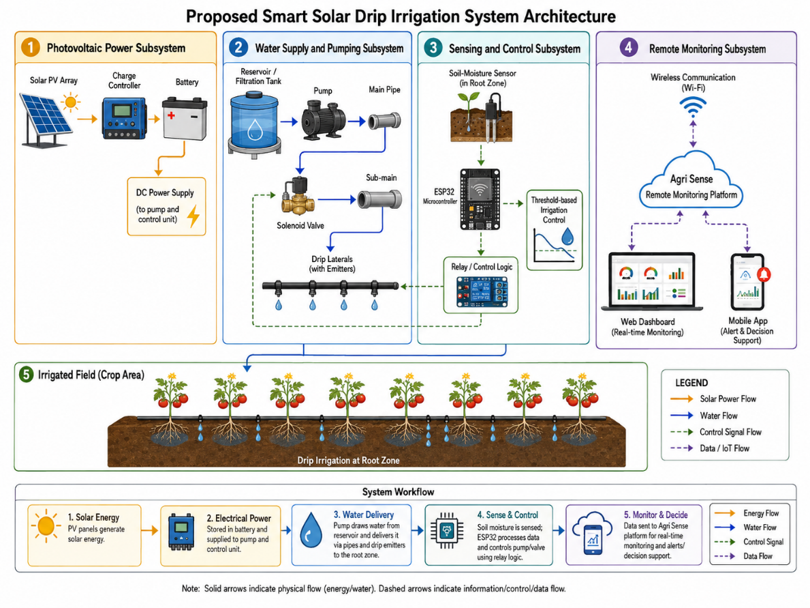
Water scarcity, irrigation energy demand, and greenhouse gas emissions are the major constraints to sustainable agricultural production in arid regions. This paper proposes an integrated Smart Solar Drip Irrigation System (SSDIS), which is comprised of photovoltaic (PV) power generation, low-pressure drip irrigation, Internet of Things (IoT)-based soil-moisture sensing, automated irrigation control, and remote monitoring. For a typical one-acre tomato field, we performed hydraulic and photovoltaic design calculations and built a laboratory-scale prototype to test the sensing and control functions. The design procedure was to estimate crop water demand, irrigation flow rate, pipe sizing, total dynamic head, pump selection, and PV array sizing, followed by Energy, Exergy, Economic, and Environmental (4E) assessment. The estimated irrigation-water requirement was 30 m³/day, which was equivalent to a design flow rate of 5 m³/h for six hours of daily pumping. Hydraulic analysis gave a total dynamic head of 60 m, and a 1.5 kW submersible pump was selected. The final installed PV array capacity was 2.2 kWp, comprising four 550 W modules. The exergy efficiency was found to be about 8.5%. The estimated annual economic saving and simple payback period were 18600 EGP/year and 4.5 years, respectively. Prototype observations suggested that soil-moisture-based control reduced unnecessary irrigation events and allowed for demand-based water application. Prototype monitoring also indicated lower water delivery under the controlled drip-irrigation configuration than under the adopted flood-irrigation baseline. Because photovoltaic pumping does not require diesel combustion during normal operation, the proposed configuration also avoids direct fuel-combustion emissions at the point of use.
Downloads
References
[1] S. Alharbi, A. Felemban, A. Abdelrahim, and M. Al-Dakhil, “Agricultural and Technology-Based Strategies to Improve Water-Use Efficiency in Arid and Semiarid Areas,” Water 2024, Vol. 16, Page 1842, vol. 16, no. 13, p. 1842, Jun. 2024, doi: 10.3390/W16131842.
[2] M. I. Elsakhry, M. H. Fayed, and T. M. Elzanaty, “Enhancing rice yield and water productivity through localized irrigation systems: A comparative evaluation of flood, sprinkler, and drip irrigation for the Oraby rice cultivar,” Al-Azhar Journal of Agricultural Engineering, vol. 11, no. 1, pp. 1–12, Jun. 2026, doi: 10.21608/AZENG.2026.461163.1048.
[3] U. Daraz, Š. Bojnec, and Y. Khan, “Energy-Efficient Smart Irrigation Technologies: A Pathway to Water and Energy Sustainability in Agriculture,” Agriculture 2025, Vol. 15, Page 554, vol. 15, no. 5, p. 554, Mar. 2025, doi: 10.3390/AGRICULTURE15050554.
[4] A. Kaab, H. Ghasemi-Mobtaker, M. Sharifi, and U. Jørgensen, “Evaluating the viability of installing photovoltaic panels on irrigation canals for energy generation and water storage,” Energy Nexus, vol. 18, p. 100455, Jun. 2025, doi: 10.1016/J.NEXUS.2025.100455.
[5] M. Aliyu, G. Hassan, S. A. Said, M. U. Siddiqui, A. T. Alawami, and I. M. Elamin, “A review of solar-powered water pumping systems,” Renewable and Sustainable Energy Reviews, vol. 87, pp. 61–76, May 2018, doi: 10.1016/J.RSER.2018.02.010.
[6] P. Yang et al., “Review on Drip Irrigation: Impact on Crop Yield, Quality, and Water Productivity in China,” Water 2023, Vol. 15, Page 1733, vol. 15, no. 9, p. 1733, Apr. 2023, doi: 10.3390/W15091733.
[7] A. R. Bawa, A. K. Sunnu, and E. A. Sarsah, “Recent Advances in Solar-powered Photovoltaic Pumping Systems for Drip Irrigation,” iRASD Journal of Energy & Environment, vol. 4, no. 2, pp. 112–132, Dec. 2023, doi: 10.52131/JEE.2023.0402.0040.
[8] M. N. Mowla, N. Mowla, A. F. M. S. Shah, K. M. Rabie, and T. Shongwe, “Internet of Things and Wireless Sensor Networks for Smart Agriculture Applications: A Survey,” IEEE Access, vol. 11, pp. 145813–145852, 2023, doi: 10.1109/ACCESS.2023.3346299.
[9] S. Datta and S. Taghvaeian, “Soil water sensors for irrigation scheduling in the United States: A systematic review of literature,” Agric. Water Manag., vol. 278, p. 108148, Mar. 2023, doi: 10.1016/J.AGWAT.2023.108148.
[10] A. A. Elngar, A. M. Ahmed, and A. Saad, “Artificial intelligence models for adsorption-based wastewater treatment: a critical review toward environmental sustainability,” International Journal of Environmental Science and Technology, vol. 23, no. 6, Jun. 2026, doi: 10.1007/S13762-026-07282-2.
[11] A. M. A. 1, A. M. A. 1, N. A. E.-M. * 2, and H. I. 3, “Smart Irrigation Management System for Precision Agriculture and Climate Resilience,” Journal of Smart Algorithms and Applications (JSAA), vol. 1, no. 1, pp. 28–36, Dec. 2025, Accessed: Aug. 30, 2026. [Online]. Available: https://pub.scientificirg.com/index.php/JSAA/article/view/12
[12] S. Hilarydoss, “Suitability, sizing, economics, environmental impacts and limitations of solar photovoltaic water pumping system for groundwater irrigation—a brief review,” Environmental Science and Pollution Research 2021 30:28, vol. 30, no. 28, pp. 71491–71510, Feb. 2021, doi: 10.1007/S11356-021-12402-1.
[13] J. Burney, L. Woltering, M. Burke, R. Naylor, and D. Pasternak, “Solar-powered drip irrigation enhances food security in the Sudano–Sahel,” Proc. Natl. Acad. Sci. U. S. A., vol. 107, no. 5, p. 1848, Feb. 2010, doi: 10.1073/PNAS.0909678107.
[14] A. Goap, D. Sharma, A. K. Shukla, and C. Rama Krishna, “An IoT based smart irrigation management system using Machine learning and open source technologies,” Comput. Electron. Agric., vol. 155, pp. 41–49, Dec. 2018, doi: 10.1016/J.COMPAG.2018.09.040.
[15] R. Liao, S. Zhang, X. Zhang, M. Wang, H. Wu, and L. Zhangzhong, “Development of smart irrigation systems based on real-time soil moisture data in a greenhouse: Proof of concept,” Agric. Water Manag., vol. 245, p. 106632, Feb. 2021, doi: 10.1016/J.AGWAT.2020.106632.
[16] S. Vinod Kumar, C. D. Singh, K. V. R. Rao, M. Kumar, and Y. A. Rajwade, “Development of a smart IoT-based drip irrigation system for precision farming,” Irrigation and Drainage, vol. 72, no. 1, pp. 21–37, Feb. 2023, doi: 10.1002/IRD.2757;REQUESTEDJOURNAL:JOURNAL:15310361;ISSUE:ISSUE:DOI.
[17] K. Obaideen et al., “An overview of smart irrigation systems using IoT,” Energy Nexus, vol. 7, p. 100124, Sep. 2022, doi: 10.1016/J.NEXUS.2022.100124.
[18] F. Grant et al., “Creating a Solar-Powered Drip Irrigation Optimal Performance model (SDrOP) to lower the cost of drip irrigation systems for smallholder farmers,” Appl. Energy, vol. 323, p. 119563, Oct. 2022, doi: 10.1016/J.APENERGY.2022.119563.
[19] M. Chahartaghi and A. Nikzad, “Exergy, environmental, and performance evaluations of a solar water pump system,” Sustainable Energy Technologies and Assessments, vol. 43, p. 100933, Feb. 2021, doi: 10.1016/J.SETA.2020.100933.
[20] I. A. Lakhiar et al., “A Review of Precision Irrigation Water-Saving Technology under Changing Climate for Enhancing Water Use Efficiency, Crop Yield, and Environmental Footprints,” Agriculture 2024, Vol. 14, Page 1141, vol. 14, no. 7, p. 1141, Jul. 2024, doi: 10.3390/AGRICULTURE14071141.
[21] S. Banluesapy, M. Ketcham, and M. Rattanasiriwongwut, “AI-Augmented Smart Irrigation System Using IoT and Solar Power for Sustainable Water and Energy Management,” Energy Engineering, vol. 122, no. 10, pp. 4261–4296, Sep. 2025, doi: 10.32604/EE.2025.068422.
[22] A. Karnib, N. Elbendary, W. Abouelhassan, and M. Dawoud, “Sustainability assessment of solar-powered drip irrigation for sugarcane in Egypt: A water–energy–food–ecosystem nexus perspective,” World Water Policy, vol. 11, no. 2, pp. 393–409, May 2025, doi: 10.1002/WWP2.12247;JOURNAL:JOURNAL:23806540;WGROUP:STRING:PUBLICATION.
[23] M. A. I. Said, H. H. El-Ghetany, and A. G. M. Shabak, “Comprehensive Design Tool for Sizing Solar Water Pumping System in Egypt,” Applied Solar Energy 2020 56:1, vol. 56, no. 1, pp. 18–29, May 2020, doi: 10.3103/S0003701X20010053.
[24] A. A. Abdulsamad and K. A. Abdulrazzaq, “Applying the WaterGEMS Software to Conduct a Comparison of the Darcy-Weisbach and Hazen-Williams Equations for Calculating the Frictional Head Loss in a Selected Pipe Network,” Journal of Engineering, vol. 29, no. 02, pp. 153–163, Feb. 2023, doi: 10.31026/J.ENG.2023.02.10.
[25] V. Tanaratchat et al., “Environment and Water Engineering Hydraulic performance enhancement of a screw impeller-assisted axial flow pump: Experimental evaluation for Southeast Asian agricultural irrigation,” Environ. Water Eng, vol. 2026, no. 1, pp. 150–163, doi: 10.22034/ewe.2026.244467.
[26] A. K. Salman, I. K. Alhadeethi, and A. M. Mohammed, “Assessing irrigation system efficiency within the Water-Energy-Food Nexus: Introducing energy performance metrics,” Agric. Water Manag., vol. 317, p. 109665, Aug. 2025, doi: 10.1016/J.AGWAT.2025.109665.
[27] R. M. Ismail, A. N. Makarov, K. B. Korneev, A. Y. Rusin, D. V. Chernyshov, and D. K. Ivanov, “Assessment of Solar Energy Potential in Egypt,” International Youth Conference on Radio Electronics, Electrical and Power Engineering, REEPE, no. 2026, 2026, doi: 10.1109/REEPE69046.2026.11481265.
[28] A. F. Almarshoud, M. A. Abdel-halim, R. A. Almasri, and A. M. Alshwairekh, “Experimental Study of Bifacial Photovoltaic Module Performance on a Sunny Day with Varying Backgrounds Using Exergy and Energy Analysis,” Energies 2024, Vol. 17, Page 5456, vol. 17, no. 21, p. 5456, Oct. 2024, doi: 10.3390/EN17215456.
[29] R. B. Sowby and A. Capener, “Reducing carbon emissions through water conservation: An analysis of 10 major U.S. cities,” Energy Nexus, vol. 7, p. 100094, Sep. 2022, doi: 10.1016/J.NEXUS.2022.100094.
Downloads
Published
Issue
Section
Categories
License
Copyright (c) 2026 Advanced Multidisciplinary Engineering Journal (AMEJ)

This work is licensed under a Creative Commons Attribution 4.0 International License.
Advanced Multidisciplinary Engineering Journal (AMEJ) seeks to publish the most influential papers that will significantly advance scientific understanding. Selected articles must present new and widely significant data, syntheses, or concepts. They should merit recognition by the wider scientific community and the general public through publication in a reputable scientific journal.
Advanced Multidisciplinary Engineering Journal (AMEJ) content is published under a Creative Commons Attribution License (CC BY). This means that content is freely available to all readers upon publication, and content is published as soon as production is complete.
SIRG Publisher