
Impact Resistance and Buckling Mitigation in Hybrid Textile–Polymer Composite Helmets
DOI:
https://doi.org/10.66279/x0magp70Keywords:
Hybrid Textile Composites, Protective Helmets, Mitigating Buckling, Impact Damage Assessment, Indentation Severity IndexAbstract
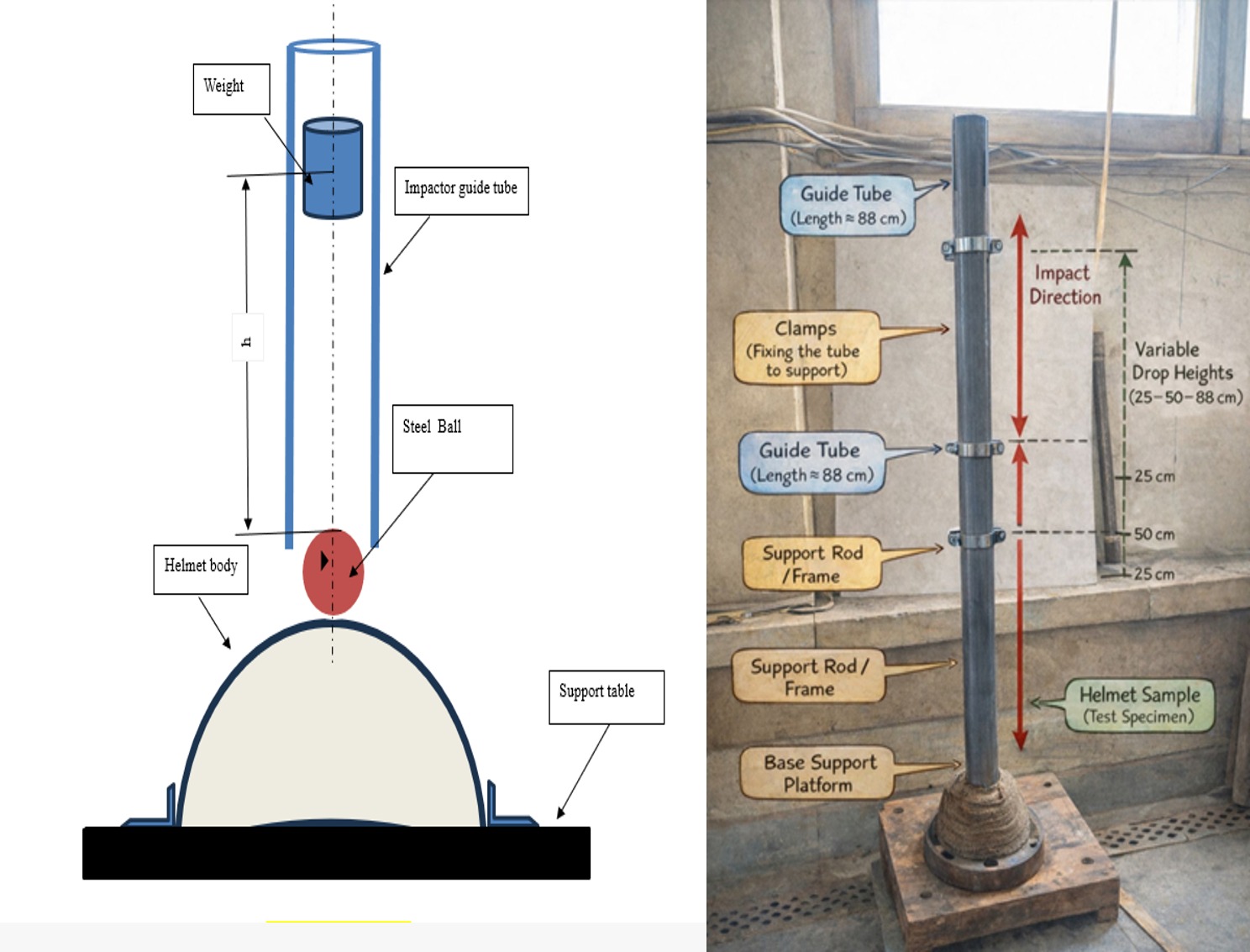
This study presents an innovative approach to protective helmet design by integrating textile-reinforced polymer composites with structural geometries inspired by ancient Egyptian wrapping techniques. Finite element analysis was employed to examine the influence of fabric strip layouts on stress distribution and to support the development of the proposed helmet architecture. A polyester–jute hybrid configuration (H2) helmet was subsequently fabricated and experimentally evaluated under repeated vertical drop-weight impacts. Its performance was compared with pure jute (H1), pure cotton (H3), and conventional thermoplastic (H4) helmet shells. The H2 configuration demonstrated outstanding structural resilience, withstanding 20 consecutive impacts ranging from 14.71 J to 51.80 J and absorbing a cumulative impact of 738.69 J with very low measurable permanent deformation of 0.2 cm. In contrast, the pure jute shell failed during the first impact due to severe delamination and strip separation, while the cotton and thermoplastic reference shells exhibited permanent residual deformations of 1.5 cm and 1.3 cm, respectively. The superior performance of the H2 configuration is attributed to the combined effect of vertical load-carrying fabric strips and circumferential confinement provided by a horizontal reinforcement strip at the helmet rim, which improves load redistribution, delays local buckling, and enhances impact energy absorption. The findings demonstrate the potential of sustainable hybrid textile–polymer composites as lightweight and efficient structural solutions for advanced protective headgear applications.
Downloads
References
[1] P. M. Cunniff, “An analysis of the system effects in woven fabrics under ballistic impact,” Textile Research Journal, vol. 62, no. 9, pp. 495–509, 1992. DOI: https://doi.org/10.1177/004051759206200902
[2] Q. Sun, J. Lin, and Y. Li, “Ballistic performance of the UHMWPE fibre-reinforced composite helmet: Experiments and numerical simulations,” Thin-Walled Structures, vol. 210, 2025. DOI: https://doi.org/10.1016/j.tws.2025.113037
[3] V. Fiore, T. Scalici, and A. Valenza, “A review of basalt fiber and its composites,” Composites Part B: Engineering, vol. 74, pp. 74–94, 2015. DOI: https://doi.org/10.1016/j.compositesb.2014.12.034
[4] O. Singh and B. K. Behera, “A developmental perspective on protective helmets,” Journal of Materials Science, vol. 58, no. 15, pp. 6444–6473, 2023. DOI: https://doi.org/10.1007/s10853-023-08441-3
[5] P. I. Dolez, J. C. Arrieta, and S. R. Chae, “Fibres and textiles for personal protective equipment,” Textiles, vol. 2, no. 2, pp. 349–381, 2022. DOI: https://doi.org/10.3390/textiles2020020
[6] A. A. Kamble, A. R. Deshmukh, and N. S. Biradar, “Research and development of safety helmet using composite materials,” International Advanced Research Journal in Science, Engineering and Technology, vol. 10, no. 6, 2023.
[7] K. L. Pickering, M. G. A. Efendy, and T. M. Le, “A review of recent developments in natural fibre composites and their mechanical performance,” Composites Part A: Applied Science and Manufacturing, vol. 83, pp. 98–112, 2016. DOI: https://doi.org/10.1016/j.compositesa.2015.08.038
[8] O. Faruk, A. K. Bledzki, and H. P. Fink, “Biocomposites reinforced with natural fibers: 2000–2010,” Industrial Crops and Products, vol. 37, no. 1, pp. 515–528, 2012. DOI: https://doi.org/10.1016/j.progpolymsci.2012.04.003
[9] R. Rafiee and R. Shahzadi, “Mechanical properties of nanoclay and nanoclay reinforced polymers: A review,” Polymer Composites, vol. 40, pp. 431–445, 2018. DOI: https://doi.org/10.1002/pc.24725
[10] H. Kim, J. Choi, and K. Park, “Graphene-reinforced dynamic helmet composite shells under dynamic load profiles,” Carbon, vol. 162, pp. 1–10, 2020.
[11] E. Palta, F. Hongbing, and D. Weggel, “Finite element analysis of the advanced combat helmet under various ballistic impacts,” International Journal of Impact Engineering, vol. 112, pp. 125–143, 2018. DOI: https://doi.org/10.1016/j.ijimpeng.2017.10.010
[12] R. Scazzosi, M. Giglio, and A. Manes, “Numerical simulation of high-velocity impact on fibre-reinforced composites using MAT-162,” Materials Design and Processing Communications, vol. 3, 2020. DOI: https://doi.org/10.1002/mdp2.163
[13] J. Hu, Y. Wang, and Z. Zhang, “3D woven fabric architectures for protective body gear and helmets,” Textile Research Journal, vol. 91, no. 3–4, pp. 312–325, 2021.
[14] K. L. Alderson, V. R. Simkins, and K. E. Evans, “The production and characterization of auxetic textile structures for protective helmet padding,” Smart Materials and Structures, vol. 27, no. 2, Art. no. 025008, 2018.
[15] J. L. Thomason, “The influence of fibre length and concentration on the properties of glass fibre reinforced polymers,” Composites Science and Technology, vol. 123, pp. 17–27, 2016.
[16] ASTM F1446-20, Standard Test Methods for Protective Headgear, ASTM International, West Conshohocken, PA, USA, 2020.
[17] S. Suresh, S. R. Raman, and K. Kumar, “VARTM processing and dynamic characterization of hybrid composite protective layers,” Journal of Reinforced Plastics and Composites, vol. 36, no. 10, pp. 749–758, 2017.
[18] J. Lee, P. J. Kim, and K. J. Woo, “Automated fiber placement optimization for thin-walled composite helmet shells,” Composites Part A: Applied Science and Manufacturing, vol. 124, Art. no. 105481, 2019.
[19] X. Chen, Y. Wang, and L. Liu, “Design and impact monitoring of smart safety helmets reinforced with carbon fiber composites,” Sensors and Actuators A: Physical, vol. 320, Art. no. 112543, 2021.
[20] M. Pervaiz, M. M. Sain, and M. Asif, “Sustainable and eco-friendly biocomposites for structural engineering and protective gear,” Journal of Cleaner Production, vol. 258, Art. no. 120678, 2020.
[21] G. Koronis, A. Silva, and M. Fontes, “Green composites: A review of natural fibre reinforcements and resins for sustainable alternative applications,” Composites Part B: Engineering, vol. 44, no. 1, pp. 120–127, 2013. DOI: https://doi.org/10.1016/j.compositesb.2012.07.004
[22] L. Yan, N. Chouw, and K. Jayaraman, “Flax and its hybrid fibre reinforced polymer composites for structural applications,” Composites Part B: Engineering, vol. 56, pp. 296–317, 2014. DOI: https://doi.org/10.1016/j.compositesb.2013.08.014
[23] A. K. Bledzki, O. Faruk, and V. Sperber, “Cotton fibre reinforced polypropylene composites: Progress of mechanical properties and applications,” Polymers and Polymer Composites, vol. 23, no. 8, pp. 621–629, 2015.
[24] D. Kai, M. J. Tan, and X. J. Loh, “Towards lignin-based functional materials in bio-composites for sustainable engineering,” Green Chemistry, vol. 18, no. 5, pp. 1175–1189, 2016. DOI: https://doi.org/10.1039/C5GC02616D
[25] L. Gil, A. Silva, and L. M. Castro, “Cork-based core composite layers for dynamic energy absorption in structural components,” Materials & Design, vol. 68, pp. 121–126, 2015. DOI: https://doi.org/10.1016/j.matdes.2014.12.016
[26] Snell Memorial Foundation, Standard for Protective Headgear for Use with Motorcycles and Other Motorized Vehicles (Snell M2020), North Highlands, CA, USA, 2020.
[27] M. Jawaid and H. P. S. A. Khalil, “Cellulosic/synthetic hybrid polymer composites: A review on mechanical evaluation for structural application,” Carbohydrate Polymers, vol. 117, pp. 70–80, 2015.
[28] V. Fiore, T. Scalici, and A. Valenza, “Hybrid composites for impact resistance: Natural fibres combined with synthetic reinforcements,” Composites Part B: Engineering, vol. 67, pp. 163–168, 2015.
[29] J. Holbery and D. Houston, “Natural-fiber-reinforced polymer composites in automotive applications,” JOM, vol. 58, no. 11, pp. 80–86, 2006. DOI: https://doi.org/10.1007/s11837-006-0234-2
[30] O. Faruk, A. K. Bledzki, and H. P. Fink, “Progress in biocomposites and sustainable industrial applications,” Macromolecular Materials and Engineering, vol. 299, no. 1, pp. 9–26, 2014. DOI: https://doi.org/10.1002/mame.201300008
[31] A. Somasundaram et al., “Explicit dynamic analysis of industrial helmet manufactured using bamboo and vakka fibre composite,” International Journal of Emerging Trends in Engineering Research, vol. 8, no. 5, pp. 1875–1881, 2020. DOI: https://doi.org/10.30534/ijeter/2020/110852020
[32] C. Bisagni and L. Lanzi, “Post-buckling and collapse analysis of composite structures,” Composite Structures, vol. 58, no. 4, pp. 397–404, 2002. DOI: https://doi.org/10.1016/S0263-8223(02)00053-3
[33] J. Sun, L. L. Huang, and Y. Dai, “Dynamic response and damage accumulation of laminated composites under repeated low-velocity impacts,” Materials, vol. 16, no. 2, Art. no. 778, 2023. DOI: https://doi.org/10.3390/ma16020778
[34] J. Z. Wu et al., “Application of polyethylene air-bubble cushions to improve the shock absorption performance of Type I construction helmets for repeated impacts,” Bio-Medical Materials and Engineering, vol. 32, no. 1, pp. 1–12, 2021. DOI: https://doi.org/10.3233/BME-201132
[35] P. Gao et al., “Studies on the life, damage evolution, and crack propagation behaviors of TC18 titanium alloy under repeated impact loading,” International Journal of Fatigue, vol. 176, Art. no. 108074, 2023. DOI: https://doi.org/10.1016/j.ijfatigue.2023.108074
[36] M. La Fauci, “Enhancing helmet safety: Development of a novel tangential impact absorption system using shear thickening fluids,” presented at the 15th IFZ International Conference on Motorcycle Safety, Cologne, Germany, 2024.
[37] M. R. Sanjay et al., “Characterization and mechanical performance of chemically treated natural fiber polymer composites: A review,” Journal of Natural Fibers, vol. 19, no. 4, pp. 1230–1245, 2022.
[38] M. Rajesh et al., “Skin-core effects on the multi-axial impact behavior of natural-synthetic hybrid composite laminates,” Composite Structures, vol. 332, Art. no. 117920, 2024.
[39] EN 960, Headforms for Use in Tests for Protective Helmets, European Committee for Standardization, Brussels, Belgium, 2006.
[40] M. El Messiry, S. Fathy, and E. Eltahan, “A multi-criterion impact damage severity ranking system for textile fiber/polymer composites using Composite Damage Severity Index (CDSI),” Alexandria Engineering Journal, vol. 133, pp. 89–103, 2025. DOI: https://doi.org/10.1016/j.aej.2025.11.008
[41] Industrial safety helmets, EN 397:2012+A1, European Committee for Standardization (CEN), 2012.
[42] Helmets for pedal cyclists and for users of skateboards and roller skates, EN 1078:2012+A1, 2012.
Downloads
Published
Data Availability Statement
On Request from Authors
Issue
Section
Categories
License
Copyright (c) 2026 Advanced Multidisciplinary Engineering Journal AMEJ

This work is licensed under a Creative Commons Attribution 4.0 International License.
Advanced Multidisciplinary Engineering Journal (AMEJ) seeks to publish the most influential papers that will significantly advance scientific understanding. Selected articles must present new and widely significant data, syntheses, or concepts. They should merit recognition by the wider scientific community and the general public through publication in a reputable scientific journal.
Advanced Multidisciplinary Engineering Journal (AMEJ) content is published under a Creative Commons Attribution License (CC BY). This means that content is freely available to all readers upon publication, and content is published as soon as production is complete.
SIRG Publisher