
Enhanced Multi-Generation Geothermal System for Sustainable Energy, HHO, and Freshwater Production
DOI:
https://doi.org/10.66279/s2a24j87Keywords:
Geothermal Energy, HHO, Alkaline electrolyzer, ANSYS Fluent, DesalinationAbstract
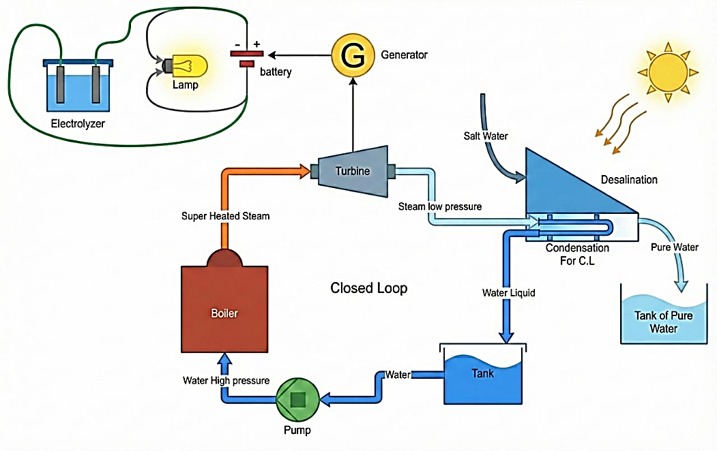
The growing demand for sustainable energy, clean water, and green fuels has increased interest in integrated renewable-energy systems, which can produce multiple valuable outputs from a single energy source. In this paper, a laboratory-scale geothermal-based multi-generation system was designed, developed, and experimentally investigated for the production of electricity, HHO gas, and desalinated freshwater. The proposed system is composed of a geothermal steam generator, a steam turbine coupled with a DC generator, an alkaline water electrolyzer, and a waste-heat-assisted solar still combined by a thermal cascading configuration. The steam turbine for electricity generation was driven by the superheated steam generated from the geothermal heat source. In order to improve the performance of the solar desalination unit, the electricity generated was then used to produce HHO using an alkaline electrolyzer, and the low-pressure turbine exhaust steam was recovered in a submerged heat exchanger. In addition, a three-dimensional Computational Fluid Dynamics (CFD) simulation was performed using ANSYS Fluent to study the fluid flow and heat transfer behavior and to validate the experimental results. The experimental results showed the stable operation of the integrated system with an average electrical power output of about 31 W, which is enough to run the electrolyzer continuously. The maximum efficiency in the four-cell alkaline electrolyzer was about 79%, and the time of HHO production was decreased compared to the two-cell. The recovered turbine exhaust heat improved desalination performance significantly with increased freshwater productivity to 8.6 L day-1. Water quality analysis indicated a significant reduction of total dissolved solids (TDS) to about 76 ppm, indicating the production of high-quality fresh water. The maximum deviation between numerical and experimental results was approximately 6%. The results demonstrate the technical feasibility of integrating geothermal power generation, HHO production, and desalination on a single platform.
Downloads
References
[1] P. Olasolo, M. C. Juárez, M. P. Morales, S. D'Amico, and I. A. Liarte, "Enhanced geothermal systems (EGS): A review," Renew. Sustain. Energy Rev., vol. 56, pp. 133–144, 2016, doi: 10.1016/j.rser.2015.11.031. DOI: https://doi.org/10.1016/j.rser.2015.11.031
[2] H. Al-Hinai, M. S. Al-Nassri, and B. A. Jubran, "Parametric investigation of a double-effect solar still," Desalination, vol. 146, nos. 1–3, pp. 273–279, 2002, doi: 10.1016/S0011-9164(02)00486-5.
[3] H. Nath, M. N. Mahmood, E. Ofosu, and A. Khanal, "Enhanced geothermal systems: A critical review of recent advancements and future potential for clean energy production," Geoenergy Sci. Eng., vol. 243, Art. no. 213370, 2024, doi: 10.1016/j.geoen.2024.213370. DOI: https://doi.org/10.1016/j.geoen.2024.213370
[4] S.-M. Lu, "A global review of enhanced geothermal system (EGS)," Renew. Sustain. Energy Rev., vol. 81, pp. 2902–2921, 2018, doi: 10.1016/j.rser.2017.06.097. DOI: https://doi.org/10.1016/j.rser.2017.06.097
[5] Y. Feng, J. Zhao, and X. Luo, "Sustainable development of enhanced geothermal systems based on geotechnical research—A review," Earth-Sci. Rev., vol. 199, Art. no. 102955, 2019, doi: 10.1016/j.earscirev.2019.102955. DOI: https://doi.org/10.1016/j.earscirev.2019.102955
[6] A. Boretti, "Enhanced geothermal systems: Potential, challenges, and a realistic path to integration in a sustainable energy future," Next Energy, vol. 8, Art. no. 100332, 2025, doi: 10.1016/j.nxener.2025.100332. DOI: https://doi.org/10.1016/j.nxener.2025.100332
[7] K. Zeng and D. Zhang, "Recent progress in alkaline water electrolysis for hydrogen production and applications," Prog. Energy Combust. Sci., vol. 36, no. 3, pp. 307–326, 2010, doi: 10.1016/j.pecs.2009.11.002. DOI: https://doi.org/10.1016/j.pecs.2009.11.002
[8] J. Brauns and T. Turek, "Alkaline water electrolysis powered by renewable energy: A review," Processes, vol. 8, no. 2, Art. no. 248, 2020, doi: 10.3390/pr8020248. DOI: https://doi.org/10.3390/pr8020248
[9] K. Ghaffari, J. J. S. de Oliveira, and L. O. Seman, "Exploring geothermal energy as a sustainable source of energy," Sustain. Horizons, vol. 13, Art. no. 100135, 2025, doi: 10.1016/j.horiz.2025.100135. DOI: https://doi.org/10.1016/j.horiz.2025.100135
[10] N. T. Alwan, S. E. Shcheklein, and O. K. Ahmed, "Performance of solar still units and enhancement techniques: A review investigation," Heliyon, vol. 10, no. 18, Art. no. e37693, 2024, doi: 10.1016/j.heliyon.2024.e37693. DOI: https://doi.org/10.1016/j.heliyon.2024.e37693
[11] S. Ye, G. Feng, J. Xu, X. Zhang, and Y. Zhang, "Artificial intelligence empowering geothermal energy development," Renew. Sustain. Energy Rev., vol. 212, Art. no. 115201, 2025, doi: 10.1016/j.rser.2024.115201. DOI: https://doi.org/10.1016/j.rser.2024.115201
[12] S. Sebbahi, A. Assila, A. A. Belghiti, S. Laasri, et al., "A comprehensive review of recent advances in alkaline water electrolysis for hydrogen production," Int. J. Hydrogen Energy, vol. 82, pp. 583–599, 2024, doi: 10.1016/j.ijhydene.2024.07.428. DOI: https://doi.org/10.1016/j.ijhydene.2024.07.428
[13] E. Barbier, "Geothermal energy technology and current status: An overview," Renew. Sustain. Energy Rev., vol. 6, nos. 1–2, pp. 3–65, 2002, doi: 10.1016/S1364-0321(02)00002-3. DOI: https://doi.org/10.1016/S1364-0321(02)00002-3
[14] A. Franco and M. Vaccaro, "Numerical simulation of geothermal reservoirs for the sustainable design of energy plants: A review," Renew. Sustain. Energy Rev., vol. 30, pp. 987–1002, 2014, doi: 10.1016/j.rser.2013.11.041. DOI: https://doi.org/10.1016/j.rser.2013.11.041
[15] R. DiPippo, Geothermal Power Plants: Principles, Applications, Case Studies and Environmental Impact, 4th ed. Amsterdam, The Netherlands: Elsevier, 2016.
[16] M. Ball and M. Wietschel, "The future of hydrogen—Opportunities and challenges," Int. J. Hydrogen Energy, vol. 34, no. 2, pp. 615–627, 2009, doi: 10.1016/j.ijhydene.2008.11.014. DOI: https://doi.org/10.1016/j.ijhydene.2008.11.014
[17] M. Muthiah, M. Elnashar, W. Afzal, and H. Tan, "Safety assessment of hydrogen production using alkaline water electrolysis," Int. J. Hydrogen Energy, vol. 84, pp. 803–821, 2024, doi: 10.1016/j.ijhydene.2024.08.237. DOI: https://doi.org/10.1016/j.ijhydene.2024.08.237
[18] M. Carmo, D. L. Fritz, J. Mergel, and D. Stolten, "A comprehensive review on PEM water electrolysis," Int. J. Hydrogen Energy, vol. 38, no. 12, pp. 4901–4934, 2013, doi: 10.1016/j.ijhydene.2013.01.151. DOI: https://doi.org/10.1016/j.ijhydene.2013.01.151
[19] A. Ursúa, L. M. Gandía, and P. Sanchis, "Hydrogen production from water electrolysis: Current status and future trends," Proc. IEEE, vol. 100, no. 2, pp. 410–426, 2012, doi: 10.1109/JPROC.2011.2156750. DOI: https://doi.org/10.1109/JPROC.2011.2156750
[20] A. E. Kabeel, M. Abdelgaied, and G. M. Mahmoud, "Performance evaluation of continuous solar still water desalination system," Journal of Thermal Analysis and Calorimetry, vol. 144, no. 6, pp. 907–916, 2021, doi: 10.1007/s10973-020-09547-5. DOI: https://doi.org/10.1007/s10973-020-09547-5
[21] A. E. Kabeel, Z. M. Omara, and F. A. Essa, "Enhancement of pyramid-shaped solar stills performance using a high thermal conductivity absorber plate and cooling the glass cover," Desalination, vol. 281, pp. 400–404, 2011, doi: 10.1016/j.desal.2011.08.018. DOI: https://doi.org/10.1016/j.desal.2011.08.018
[22] A. Fathy, H. Rezk, and A. G. Olabi, "A novel method for optimizing the size of a hybrid solar-wind-battery energy system," Renew. Sustain. Energy Rev., vol. 82, pp. 343–355, 2018, doi: 10.1016/j.rser.2017.09.072. DOI: https://doi.org/10.1016/j.rser.2017.09.072
[23] M. Sharshir, G. Peng, N. Yang, M. O. A. Ali, and A. H. Elsheikh, "A study on heat and mass transfer analysis of solar distillation system," Energy Convers. Manage., vol. 133, pp. 173–183, 2017, doi: 10.1016/j.enconman.2016.11.044. DOI: https://doi.org/10.1016/j.enconman.2016.11.044
[24] M. A. Rosen and I. Dincer, "On hydrogen and hydrogen energy strategies: I. Current status and needs," Int. J. Hydrogen Energy, vol. 28, no. 3, pp. 229–236, 2003, doi: 10.1016/S0360-3199(02)00056-4.
[25] I. Dincer and C. Acar, "Review and evaluation of hydrogen production methods for better sustainability," Int. J. Hydrogen Energy, vol. 40, no. 34, pp. 11094–11111, 2015, doi: 10.1016/j.ijhydene.2014.12.035. DOI: https://doi.org/10.1016/j.ijhydene.2014.12.035
[26] M. A. Ahmadi, M. A. Rosen, and I. Dincer, "Greenhouse gas emissions and exergy of a solar-based multigeneration system," Energy Convers. Manage., vol. 88, pp. 833–846, 2014, doi: 10.1016/j.enconman.2014.09.024. DOI: https://doi.org/10.1016/j.enconman.2014.09.024
[27] M. Kanoglu, I. Dincer, and M. A. Rosen, "Understanding energy and exergy efficiencies for improved energy management in renewable energy systems," Renew. Sustain. Energy Rev., vol. 15, no. 4, pp. 1931–1942, 2011, doi: 10.1016/j.rser.2010.12.013. DOI: https://doi.org/10.1016/j.rser.2010.12.013
[28] M. Mahmoudi, M. Yari, M. A. Rosen, and M. A. Amidpour, "Exergoeconomic analysis of a combined cycle power plant with a solar-assisted steam generator," Energy Convers. Manage., vol. 63, pp. 108–117, 2012, doi: 10.1016/j.enconman.2012.03.018. DOI: https://doi.org/10.1016/j.enconman.2012.03.018
[29] A. J. Wheeler and A. R. Ganji, Introduction to Engineering Experimentation, 3rd ed. London, U.K.: Pearson, 2010.
[30] B. E. Launder and D. B. Spalding, "The numerical computation of turbulent flows," Comput. Methods Appl. Mech. Eng., vol. 3, no. 2, pp. 269–289, 1974, doi: 10.1016/0045-7825(74)90029-2. DOI: https://doi.org/10.1016/0045-7825(74)90029-2
[31] H. K. Versteeg and W. Malalasekera, An Introduction to Computational Fluid Dynamics: The Finite Volume Method, 2nd ed. Oxford, U.K.: Elsevier, 2007.
[32] W. Chen, X. Zheng, and B. Liu, "3D numerical simulation and performance analysis of a micro-scale impulse steam turbine," Appl. Energy, vol. 185, pp. 1317–1325, 2017, doi: 10.1016/j.apenergy.2016.01.077. DOI: https://doi.org/10.1016/j.apenergy.2016.01.077
[33] M. Rahimi, A. Asadi, and S. M. Khoshhal, "Computational fluid dynamics simulation and experimental validation of a micro steam turbine," Appl. Therm. Eng., vol. 111, pp. 1297–1306, 2017, doi: 10.1016/j.applthermaleng.2016.10.021. DOI: https://doi.org/10.1016/j.applthermaleng.2016.10.021
[34] A. E. Kabeel, A. Khalil, Z. M. Omara, and M. M. Younes, "Theoretical and experimental parametric study of modified stepped solar still," Desalination, vol. 289, pp. 12–20, 2012, doi: 10.1016/j.desal.2011.12.023. DOI: https://doi.org/10.1016/j.desal.2011.12.023
[35] V. K. Bhargava, P. K. Srivastava, and S. Kumar, "3D CFD modeling of a passive solar still and its experimental validation," Desalination, vol. 385, pp. 60–68, 2016, doi: 10.1016/j.desal.2016.02.016. DOI: https://doi.org/10.1016/j.desal.2016.02.016
[36] T. Arunkumar, K. Raj, M. Chaturvedi, A. Thenmozhi, D. Denkenberger, and G. Tingting, "A review on distillate water quality parameter analysis in solar still," Int. J. Ambient Energy, vol. 42, no. 11, pp. 1335–1342, 2021, doi: 10.1080/01430750.2019.1587722. DOI: https://doi.org/10.1080/01430750.2019.1587722
Downloads
Published
Data Availability Statement
On demand from Authors
License
Copyright (c) 2026 Advanced Multidisciplinary Engineering Journal AMEJ

This work is licensed under a Creative Commons Attribution 4.0 International License.
Advanced Multidisciplinary Engineering Journal (AMEJ) seeks to publish the most influential papers that will significantly advance scientific understanding. Selected articles must present new and widely significant data, syntheses, or concepts. They should merit recognition by the wider scientific community and the general public through publication in a reputable scientific journal.
Advanced Multidisciplinary Engineering Journal (AMEJ) content is published under a Creative Commons Attribution License (CC BY). This means that content is freely available to all readers upon publication, and content is published as soon as production is complete.
SIRG Publisher