




Highlights

  1. Mathematical Applications and Statistical Rigor (MASR)

    Mathematical Applications and Statistical Rigor (MASR) is an international, peer-reviewed scholarly journal devoted to advancing research at the intersection of deep mathematical theory, rigorous statistical methodology, and impactful real-world applications

    Read More
  2. Aims and Scope

    Mathematical Applications and Statistical Rigor (MASR) provides a premier forum for high-quality research that demonstrates how theoretical insight and methodological rigor directly inform and elevate applied problem-solving. 

    Read More
  3. Peer Review Process

    The Mathematical Applications and Statistical Rigor (MASR)  evaluate each submission that warrant further consideration for publication are sent out for in-depth peer review by reviewers. 

    Read More
  4. Fast Review Process

    Fast Review Process: Initial decisions are provided within 2–4 weeks to support timely publication.

    Read More
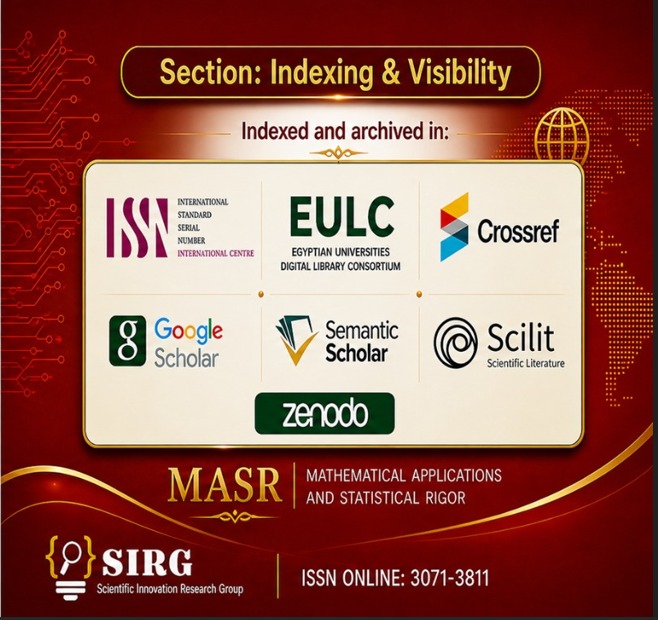
  5. Indexing

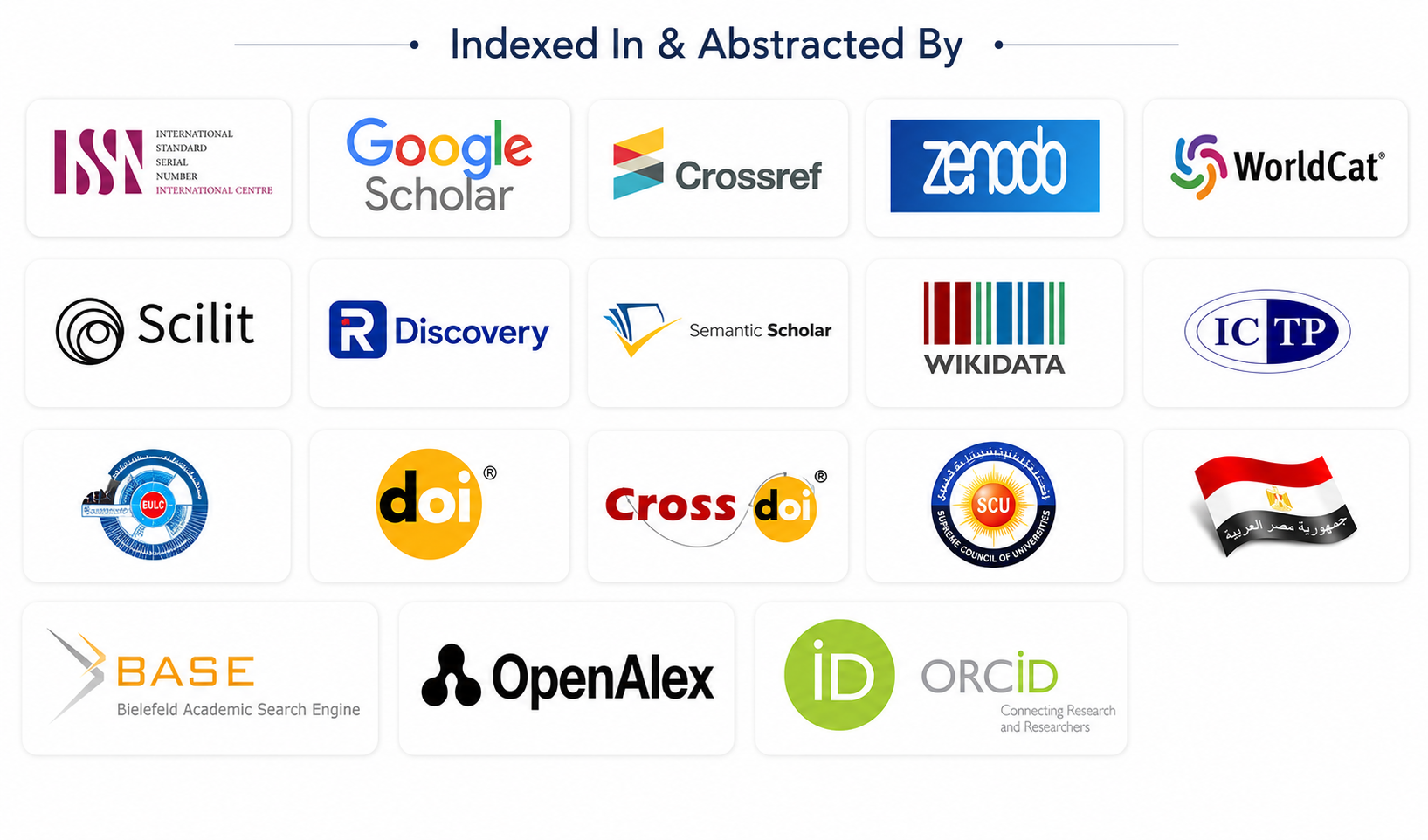
    Mathematical Applications and Statistical Rigor (MASR)  is indexed in the following Databases:
    Read More
  6. Open Access

    MASR is a fully open-access journal. All articles are freely available online immediately upon publication, with no article processing charges (APCs) for authors. 

    Read More
  7. DOI For Every Article

    Each paper receives a permanent and unique digital identifier. Ensuring easy citation, tracking, and long-term accessibility

    Read More
Mathematical Applications and Statistical Rigor (MASR)

About the Journal

Mathematical Applications and Statistical Rigor (MASR) is an international, peer-reviewed scholarly journal devoted to advancing research at the intersection of deep mathematical theory, rigorous statistical methodology, and impactful real-world applications. MASR is founded on the conviction that mathematics and statistics achieve their highest value when they are not only theoretically sound but also decisively relevant to contemporary scientific, technological, and societal challenges.

MASR is more than a publication venue; it is a global research community committed to building a durable bridge between abstraction and application. The journal serves as a meeting point for theorists, applied scientists, and interdisciplinary researchers who seek to translate mathematical and statistical innovation into robust, actionable solutions.

Researchers are welcome to submit papers to MASR after preparing them according to the SIRG  template and following the SIRG Publisher Ethics and Malpractice Statement. (MASR) follows the SIRG Publisher peer-review process in handling all submitted papers. By submitting their paper to MASR, authors confirm their agreement to SIRG Publisher terms, conditions, and publication ethics and Copyrights page.

ISSN (Online): 3071-3811

Frequency: 6 Volumes Annually

Editor-in-Chiefs: 

Prof. Haroon Barakat

Department of Mathematics, Faculty of Science, Zagazig University, Zagazig- Egypt.

hbarakat@zu.edu.eghbarakat2@hotmail.comhbarakat2@yahoo.com

Prof. Haroon Mohamed Abdel Fattah Barakat, a distinguished Professor of Mathematical Statistics at the Faculty of Science, Zagazig University, Egypt. His academic background includes a Ph.D. in Mathematical Statistics from Moscow State University (1986), an M.Sc. from Alexandria University (1980), and a B.Sc. in Statistics (1976).

His research profile is strongly oriented toward probability theory, statistical inference, reliability theory, extreme value theory, and order statistics, with a particular emphasis on asymptotic theory and stochastic modeling. A significant part of his work contributes to the development of order statistics, generalized order statistics, record values, and their applications in statistical reliability and environmental modeling.

Prof. Barakat has made substantial contributions to advanced distribution theory, including multivariate and bivariate models, copula-based distributions, and generalized families of probability distributions. His research also extends to stress–strength reliability models, Bayesian and non-Bayesian inference, censoring schemes, and bootstrap methodologies, which are widely applied in survival analysis and engineering statistics.

He has an extensive publication record with more than two hundred peer-reviewed papers in international journals, covering topics such as:

Limit theorems and asymptotic behavior of order statistics

Extreme value theory and tail modeling

Statistical dependence structures and copula models

Information measures including entropy and extropy

Reliability analysis and stochastic processes

Bayesian estimation under complex sampling and censoring schemes

In addition to theoretical contributions, his research includes applied statistical modeling in environmental studies, air pollution analysis, engineering systems, and biomedical data.

Prof. Barakat has also supervised a large number of Ph.D. and M.Sc. theses, many of which focus on modern topics in statistical inference, stochastic modeling, and applied probability. His academic service includes editorial roles in international journals, refereeing for major statistical journals, and participation in national and international scientific committees.

He has been an active participant in international conferences and workshops across Europe, Asia, and the Middle East, frequently serving as invited speaker, session chair, and scientific committee member. His contributions have been recognized through multiple national and international awards in mathematics and statistical sciences.

Overall, his scientific work reflects a sustained and influential contribution to modern mathematical statistics, particularly in the theory of ordered data, reliability modeling, and stochastic processes, with strong integration between theoretical development and real-world applications.

================================================= 

For more details, please get in touch with MASR:

Journal Contact Email:

Email: ( editorial.masr@scientificirg.com )


Current Issue

Vol. 3 No. 1 (2026): June - 2026
View All Issues