
A Robust Cross-Sensor Image Steganalysis Framework for Robotic Telemetry in Nuclear Facilities
DOI:
https://doi.org/10.66279/neehrc96Keywords:
Image Steganalysis, Robotic Telemetry, Channel Attention, HIT-UAV, J UNIWARDAbstract
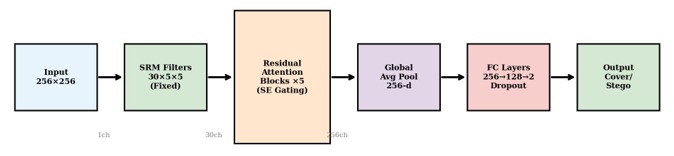
Autonomous robotic platforms increasingly support inspection, surveillance, and environmental monitoring at safety-critical facilities. Image telemetry from these platforms creates a potential covert channel because a payload can be embedded in otherwise legitimate frames before transmission. This study evaluates a convolutional steganalysis network, NuclearStegNet, that combines fixed Spatial Rich Model residual filters with residual attention blocks and Squeeze-and-Excitation channel weighting. The evaluation uses BOSSbase 1.01 as an optical reference source and HIT-UAV thermal imagery as a cross-sensor test source. On the supplied experimental record, NuclearStegNet reaches 89.3% accuracy for J-UNIWARD at 0.4 bits per pixel on the matched optical test condition and 82.8% under optical-to-thermal mismatch. The corresponding SRM with Ensemble Classifier baseline reaches 68.4% and 59.9%, respectively. These findings suggest that residual preprocessing and channel attention may enhance detection under the evaluated distribution shift. However, the thermal dataset is not representative of nuclear inspection imagery and cannot establish operational performance in a nuclear facility. Accordingly, the study is presented as a reproducibility focused research framework with a preliminary deployment concept, rather than as evidence of an observed attack or a validated field system.
Downloads
References
[1] V. Holub, J. Fridrich, and T. Denemark, “Universal distortion function for steganography in an arbitrary domain,” EURASIP Journal on Information Security, vol. 2014, no. 1, p. 1, 2014. DOI: https://doi.org/10.1186/1687-417X-2014-1
[2] V. Holub and J. Fridrich, “Designing steganographic distortion using directional filters,” in 2012 IEEE International workshop on information forensics and security (WIFS), pp. 234–239, IEEE, 2012. DOI: https://doi.org/10.1109/WIFS.2012.6412655
[3] V. Holub and J. Fridrich, “Digital image steganography using universal distortion,” in Proceedings of the first ACM workshop on Information hiding and multimedia security, pp. 59–68, 2013. DOI: https://doi.org/10.1145/2482513.2482514
[4] P. Bas, T. Filler, and T. Pevn `y, “Break our steganographic system”: the ins and outs of organizing boss,” in International workshop on information hiding, pp. 59–70, Springer, 2011. DOI: https://doi.org/10.1007/978-3-642-24178-9_5
[5] J. Fridrich and J. Kodovský, “Rich models for steganalysis of digital images,” IEEE Transactions on Information Forensics and Security, vol. 7, no. 3, pp. 868–882, 2012. DOI: https://doi.org/10.1109/TIFS.2012.2190402
[6] J. Kodovsky, J. Fridrich, and V. Holub, “Ensemble classifiers for steganalysis of digital media,” IEEE Transactions on information forensics and security, vol. 7, no. 2, pp. 432–444, 2011. DOI: https://doi.org/10.1109/TIFS.2011.2175919
7] M. Boroumand, M. Chen, and J. Fridrich, “Deep residual network for steganalysis of digital images,” IEEE transactions on information forensics and security, vol. 14, no. 5, pp. 1181–1193, 2018. DOI: https://doi.org/10.1109/TIFS.2018.2871749
[8] G. Quentin, B. Patrick, C. Rémi, and B. Dirk, “The cover source mismatch problem in deep-learning steganalysis,” in 2022 30th European Signal Processing Conference (EUSIPCO), pp. 1032–1036, IEEE, 2022. DOI: https://doi.org/10.23919/EUSIPCO55093.2022.9909553
[9] A. Mallet, M. Beneš, and R. Cogranne, “Cover-source mismatch in steganalysis: Systematic review,” EURASIP Journal on Information Security, vol. 2024, no. 1, p. 26, 2024. DOI: https://doi.org/10.1186/s13635-024-00171-6
[10] J. Hu, L. Shen, and G. Sun, “Squeeze-and-excitation networks,” in Proceedings of the IEEE conference on computer vision and pattern recognition, pp. 7132–7141, 2018. DOI: https://doi.org/10.1109/CVPR.2018.00745
[11] J. Ye, J. Ni, and Y. Yi, “Deep learning hierarchical representations for image steganalysis,” IEEE Transactions on Information Forensics and Security, vol. 12, no. 11, pp. 2545–2557, 2017. DOI: https://doi.org/10.1109/TIFS.2017.2710946
[12] M. Yedroudj, F. Comby, and M. Chaumont, “Yedroudj-net: An efficient cnn for spatial steganalysis,” in 2018 IEEE international conference on acoustics, speech and signal processing (ICASSP), pp. 2092–2096, IEEE, 2018. DOI: https://doi.org/10.1109/ICASSP.2018.8461438
[13] R. Cogranne, Q. Giboulot, and P. Bas, “The alaska steganalysis challenge: A first step towards steganalysis,” in Proceedings of the ACM Workshop on Information Hiding and Multimedia Security, pp. 125–137, 2019. DOI: https://doi.org/10.1145/3335203.3335726
[14] T. Denemark, V. Sedighi, V. Holub, R. Cogranne, and J. Fridrich, “Selection-channel-aware rich model for steganalysis of digital images,” in 2014 IEEE international workshop on information forensics and security (WIFS), pp. 48–53, IEEE, 2014. DOI: https://doi.org/10.1109/WIFS.2014.7084302
[15] L. Pibre, P. Jérôme, D. Ienco, and M. Chaumont, “Deep learning is a good steganalysis tool when embedding key is reused for different images, even if there is a cover source-mismatch,” arXiv preprint arXiv:1511.04855, 2015. DOI: https://doi.org/10.2352/ISSN.2470-1173.2016.8.MWSF-078
[16] J. Suo, T. Wang, X. Zhang, H. Chen, W. Zhou, and W. Shi, “Hit-uav: A high-altitude infrared thermal dataset for unmanned aerial vehicle-based object detection,” Scientific Data, vol. 10, no. 1, p. 227, 2023. DOI: https://doi.org/10.1038/s41597-023-02066-6
[17] Z. Wang, A. C. Bovik, H. R. Sheikh, and E. P. Simoncelli, “Image quality assessment: from error visibility to structural similarity,” IEEE transactions on image processing, vol. 13, no. 4, pp. 600–612, 2004. DOI: https://doi.org/10.1109/TIP.2003.819861
Downloads
Published
Data Availability Statement
This study uses the publicly available BOSSbase 1.01 and HIT-UAV image datasets. The analysis is based on selected subsets of these datasets and reports aggregate experimental results.
Issue
Section
Categories
License
Copyright (c) 2026 The Authors

This work is licensed under a Creative Commons Attribution 4.0 International License.
Computational Discovery and Intelligent Systems (CDIS) seeks to publish the most influential papers that will significantly advance scientific understanding. Selected articles must present new and widely significant data, syntheses, or concepts. They should merit recognition by the wider scientific community and the general public through publication in a reputable scientific journal.
In addition to the content, this is published under a Creative Commons Attribution 4.0 International (CC BY 4.0) License. This means the content is freely available to all readers upon publication, and it is published as soon as production is complete.
SIRG Publisher