Gas Alert A Satellite Surveillance Framework for Multi-GasIndustrial Emission Detection, and Flux Quantification in Arid Environments
DOI:
https://doi.org/10.66279/p8fwd350Keywords:
Satellite Surveillance, Industrial Emissions Detection, Arid Environments, Tip-and-Cue, NASA EMITAbstract
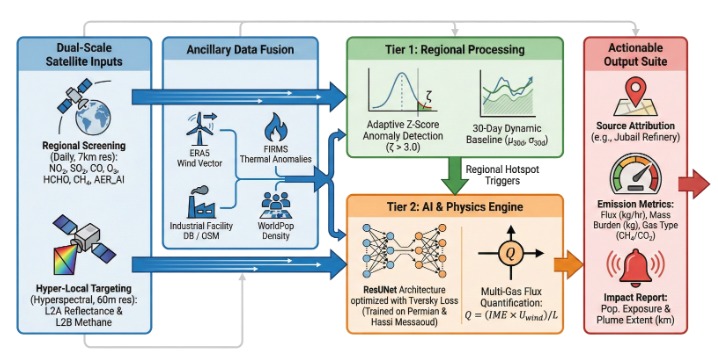
Industrial emissions from petroleum refineries and power generation facilities represent primary anthropogenic sources of atmospheric pollution, posing substantial public health and climate risks across the rapidly expanding industrial corridors of the Kingdom of Saudi Arabia (KSA). Ground-based monitoring networks lack the spatial coverage necessary for arid, high-albedo environments, while existing satellite frameworks either resolve regional trends without facility-scale attribution or operate as episodic manual campaigns. This paper introduces Gas Alert, a hierarchical prototype surveillance framework built on a Tip-and-Cue principle that links two automated functional layers. The first layer performs regional screening by ingesting daily Sentinel-5P TROPOMI Level-2/3 products for seven atmospheric variables ( NO2, SO2, CO, O3, HCHO, CH4, and aerosol index) with an adaptive 30-day rolling Z-score anomaly engine. The second layer, activated on a confirmed regional cue, deploys a physics-guided deep learning module on NASA EMIT hyperspectral imagery. A custom Residual U-Net (ResUNet) with 2.08 million trainable parameters, optimized with Tversky loss (????=0.7, ????=0.3), addresses the extreme spectral class imbalance inherent in arid-region plume segmentation, while the Integrated Mass Enhancement (IME) engine converts predicted masks into instantaneous flux estimates. Pilot-scale validation over 12 EMIT scenes from the Jubail AOI yielded a scene-level detection rate of 91.7% (Wilson 95% CI: 64.6–98.5%). An ablation study on a 100-scene Permian Basin test set demonstrated that ResUNet with Tversky loss achieved pixel-level precision of 87.4% and an F1-score of 0.84, surpassing U-Net baselines with cross-entropy and Dice losses. A confirmed methane detection over the Jubail Refinery complex produced an estimated flux of 836.96 kg/hr (±22.4%; 95% CI: 470–1204 kg/hr), consistent with published baselines for medium-to-large refinery fugitive emissions. These results demonstrate technical feasibility and pilot-scale performance for an integrated, automated industrial emission screening workflow.
Downloads
References
[1] M. Reichstein, G. Camps-Valls, B. Stevens, M. Jung, J. Denzler, N. Carvalhais, and F. Prabhat, “Deep learning and process understanding for data-driven earth system science,” Nature, vol. 566, no. 7743, pp. 195–204, 2019. DOI: https://doi.org/10.1038/s41586-019-0912-1
[2] J. P. Veefkind, I. Aben, K. McMullan, H. Förster, J. De Vries, G. Otter, J. Claas, H. Eskes, J. De Haan, Q. Kleipool, et al., “Tropomi on the esa sentinel-5 precursor: A gmes mission for global observations of the atmospheric composition for climate, air quality and ozone layer applications,” Remote sensing of environment, vol. 120, pp. 70–83, 2012. DOI: https://doi.org/10.1016/j.rse.2011.09.027
[3] R. O. Green, N. Mahowald, C. Ung, D. R. Thompson, L. Bator, M. Bennet, M. Bernas, N. Blackway, C. Bradley, J. Cha, et al., “The earth surface mineral dust source investigation: An earth science imaging spectroscopy mission,” in 2020 IEEE aerospace conference, pp. 1–15, IEEE, 2020.
[4] D. J. Varon, J. McKeever, D. Jervis, J. Maasakkers, S. Pandey, S. Houweling, I. Aben, T. Scarpelli, and D. Jacob, “Satellite discovery of anomalously large methane point sources from oil/gas production,” Geophysical Research Letters, vol. 46, no. 22, pp. 13507–13516, 2019. DOI: https://doi.org/10.1029/2019GL083798
[5] A. K. Thorpe, C. Frankenberg, A. Aubrey, D. Roberts, A. Nottrott, T. Rahn, J. Sauer, M. Dubey, K. Costigan, C. Arata, et al., “Mapping methane concentrations from a controlled release experiment using the next generation airborne visible/infrared imaging spectrometer (aviris-ng),” Remote Sensing of Environment, vol. 179, pp. 104–115, 2016.
[6] D. J. Varon, D. Jervis, J. McKeever, I. Spence, D. Gains, and D. J. Jacob, “High-frequency monitoring of anomalous methane point sources with multispectral sentinel-2 satellite observations,” Atmospheric Measurement Techniques, vol. 14, no. 4, pp. 2771–2785, 2021. DOI: https://doi.org/10.5194/amt-14-2771-2021
[7] K. He, X. Zhang, S. Ren, and J. Sun, “Deep residual learning for image recognition,” in Proceedings of the IEEE conference on computer vision and pattern recognition, pp. 770–778, 2016. DOI: https://doi.org/10.1109/CVPR.2016.90
[8] S. S. M. Salehi, D. Erdogmus, and A. Gholipour, “Tversky loss function for image segmentation using 3d fully convolutional deep networks,” in International workshop on machine learning in medical imaging, pp. 379–387, Springer, 2017. DOI: https://doi.org/10.1007/978-3-319-67389-9_44
[9] C. Frankenberg, A. K. Thorpe, D. R. Thompson, G. Hulley, E. A. Kort, N. Vance, J. Borchardt, T. Krings, K. Gerilowski, C. Sweeney, et al., “Airborne methane remote measurements reveal heavy-tail flux distribution in four corners region,” Proceedings of the national academy of sciences, vol. 113, no. 35, pp. 9734–9739, 2016. DOI: https://doi.org/10.1073/pnas.1605617113
[10] L. Guanter, I. Irakulis-Loitxate, J. Gorroño, E. Sánchez-García, D. H. Cusworth, D. J. Varon, S. Cogliati, and R. Colombo, “Mapping methane point emissions with the prisma spaceborne imaging spectrometer,” Remote Sensing of Environment, vol. 265, p. 112671, 2021. DOI: https://doi.org/10.1016/j.rse.2021.112671
[11] J. Van Geffen, H. Eskes, S. Compernolle, G. Pinardi, T. Verhoelst, J.-C. Lambert, M. Sneep, M. Ter Linden, A. Ludewig, K. F. Boersma, et al., “Sentinel-5p tropomi no 2 retrieval: impact of version v2. 2 improvements and comparisons with omi and ground-based data,” Atmospheric Measurement Techniques, vol. 15, no. 7, pp. 2037–2060, 2022. DOI: https://doi.org/10.5194/amt-15-2037-2022
[12] D. H. Cusworth, R. M. Duren, A. K. Thorpe, W. Olson-Duvall, J. Heckler, J. W. Chapman, M. L. Eastwood, M. C. Helmlinger, R. O. Green, G. P. Asner, et al., “Intermittency of large methane emitters in the permian basin,” Environmental Science & Technology Letters, vol. 8, no. 7, pp. 567–573, 2021. DOI: https://doi.org/10.1021/acs.estlett.1c00173
[13] G. Ehret, P. Bousquet, C. Pierangelo, M. Alpers, B. Millet, J. B. Abshire, H. Bovensmann, J. P. Burrows, F. Chevallier, P. Ciais, et al., “Merlin: A french-german space lidar mission dedicated to atmospheric methane,” Remote Sensing, vol. 9, no. 10, p. 1052, 2017. DOI: https://doi.org/10.3390/rs9101052
[14] D. Thompson, I. Leifer, H. Bovensmann, M. Eastwood, M. Fladeland, C. Frankenberg, K. Gerilowski, R. Green, S. Kratwurst, T. Krings, et al., “Real-time remote detection and measurement for airborne imaging spectroscopy: a case study with methane,” Atmospheric Measurement Techniques, vol. 8, no. 10, pp. 4383–4397, 2015. DOI: https://doi.org/10.5194/amt-8-4383-2015
[15] D. J. Varon, D. J. Jacob, J. McKeever, D. Jervis, B. O. Durak, Y. Xia, and Y. Huang, “Quantifying methane point sources from fine-scale satellite observations of atmospheric methane plumes,” Atmospheric Measurement Techniques, vol. 11, no. 10, pp. 5673–5686, 2018. DOI: https://doi.org/10.5194/amt-11-5673-2018
[16] X. Lu, D. J. Jacob, Y. Zhang, J. D. Maasakkers, M. P. Sulprizio, L. Shen, Z. Qu, T. R. Scarpelli, H. Nesser, R. M. Yantosca, et al., “Global methane budget and trend, 2010–2017: complementarity of inverse analyses using in situ (globalviewplus ch 4 obspack) and satellite (gosat) observations,” Atmospheric Chemistry and Physics, vol. 21, no. 6, pp. 4637–4657, 2021. DOI: https://doi.org/10.5194/acp-21-4637-2021
[17] L. Zhang, Z. Yan, K. Huang, and W. Zhang, “Evaluation and statistical bias correction of era5-land meteorological variables for a humid river basin in southwest china,” Scientific Reports, vol. 15, no. 1, p. 41101, 2025. DOI: https://doi.org/10.1038/s41598-025-24942-4
[18] A. Vaughan, G. Mateo-García, L. Gómez-Chova, V. R ˇužička, L. Guanter, and I. Irakulis-Loitxate, “Ch4net: a deep learning model for monitoring methane super-emitters with sentinel-2 imagery,” EGUsphere, vol. 2023, pp. 1–17, 2023. DOI: https://doi.org/10.5194/egusphere-2023-563
[19] R. Ahsan, M. Shanto, M. S. Arifin, and T. Hashem, “Attmetnet: Attention-enhanced deep neural network for methane plume detection in sentinel-2 satellite imagery,” arXiv preprint arXiv:2512.02751, 2025.
[20] E. D. Sherwin, J. S. Rutherford, Y. Chen, S. Aminfard, E. A. Kort, R. B. Jackson, and A. R. Brandt, “Single-blind validation of space-based point-source methane emissions detection and quantification,” 2022. DOI: https://doi.org/10.31223/X5DH09
[21] E. D. Sherwin, J. S. Rutherford, Y. Chen, S. Aminfard, E. A. Kort, R. B. Jackson, and A. R. Brandt, “Single-blind validation of space-based point-source detection and quantification of onshore methane emissions,” Scientific Reports, vol. 13, no. 1, p. 3836, 2023. DOI: https://doi.org/10.1038/s41598-023-30761-2
[22] A. Radman, M. Mahdianpari, D. J. Varon, and F. Mohammadimanesh, “S2metnet: A novel dataset and deep learning benchmark for methane point source quantification using sentinel-2 satellite imagery,” Remote Sensing of Environment, vol. 295, p. 113708, 2023. DOI: https://doi.org/10.1016/j.rse.2023.113708
[23] A. Farahat, “Air pollution in the arabian peninsula (saudi arabia, the united arab emirates, kuwait, qatar, bahrain, and oman): causes, effects, and aerosol categorization,” Arabian Journal of Geosciences, vol. 9, no. 3, p. 196, 2016.
Downloads
Published
Data Availability Statement
DATA AVAILABILITY
The datasets generated during the current study are available from the corresponding author on reasonable request.
Issue
Section
Categories
License
Copyright (c) 2026 The Authors

This work is licensed under a Creative Commons Attribution 4.0 International License.
Computational Discovery and Intelligent Systems (CDIS) seeks to publish the most influential papers that will significantly advance scientific understanding. Selected articles must present new and widely significant data, syntheses, or concepts. They should merit recognition by the wider scientific community and the general public through publication in a reputable scientific journal.
In addition to the content, this is published under a Creative Commons Attribution 4.0 International (CC BY 4.0) License. This means the content is freely available to all readers upon publication, and it is published as soon as production is complete.
SIRG Publisher